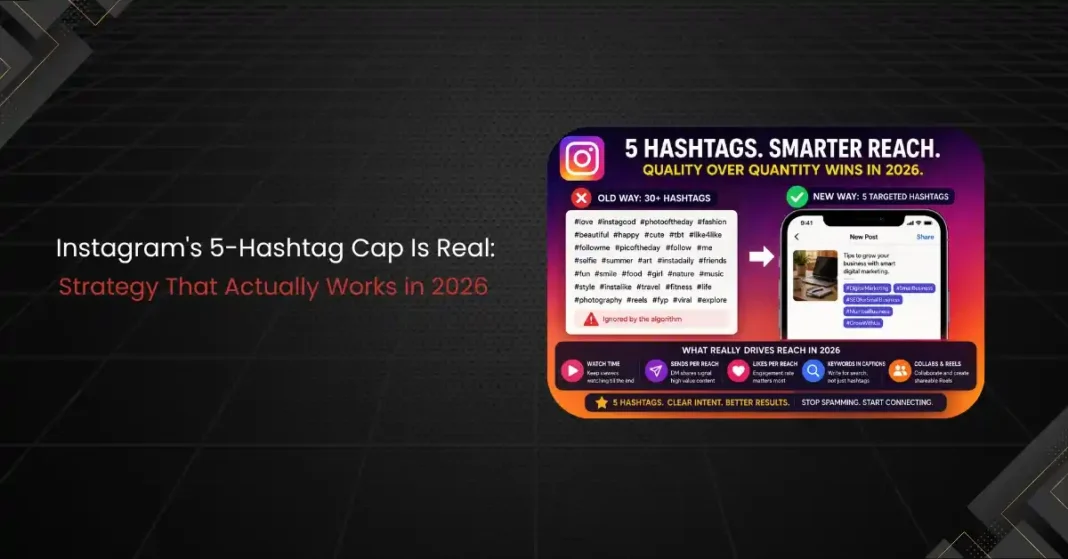
The era of stuffing 30 hashtags into every Instagram caption is officially over. Adam Mosseri confirmed on his Instagram advice channel that Instagram is gradually rolling out a strict five-hashtag maximum on every post and Reel. Posts with more hashtags will still upload, but anything beyond five gets ignored by the ranking system. The change has been quietly tested for over a year and is now being formalised across the platform in 2026.
For Instagram marketers and creators who built workflows around dropping 30 carefully researched tags into every post, this is a real disruption. For the rest of the platform, it is a tidy-up of a feature that had stopped working years ago. This article breaks down exactly what changed, why Instagram made the move, and the hashtag strategy that actually works in 2026 now that the old playbook is dead.
What Actually Changed
Mosseri’s announcement was specific. Instagram is gradually updating the number of hashtags you can include in a caption for a Reel or post to five. The reasoning, in Mosseri’s own words, is that using fewer and more targeted hashtags, rather than many generic ones, can improve both your content’s performance and other people’s experience on Instagram.
The rollout has been gradual, which means different accounts have hit the cap at different times. Some accounts could still post with 10 to 30 hashtags in early 2026. By mid-2026, the five-hashtag cap is being applied to all standard accounts. Meta’s business tools and the Meta Planner scheduling app may still technically allow more than five hashtags to be added, but the ranking algorithm ignores anything beyond five regardless of how the post was scheduled.
The decision is consistent with what Mosseri has been saying publicly for years. In February 2025, he said hashtags do not work to increase reach. In May 2025, he repeated that hashtags do not improve visibility on Instagram, though they remain a useful way to let people know what a post is about and connect related posts. The five-hashtag cap is the formal acknowledgement of what the algorithm was already doing.
Why Instagram Did This
Hashtag Spam Stopped Working
Three forces drove the change.
Marketers and creators have been gaming hashtags for over a decade. The 30-tag ceiling that used to exist on Instagram was treated as a target, not a limit. People would stack popular tags, niche tags, location tags, and trending tags into every post hoping something would stick. This kept happening even as the algorithm started weighting hashtags less and less. Bots and spam accounts exploited the same lever to flood the platform with low-quality content. The end result was that hashtags became signal noise rather than useful classification.
AI Now Classifies Content Better Than Tags
Instagram’s content recommendation system has shifted to AI-driven classification. The platform’s models analyse the visual content of your post, the on-screen text, the audio in Reels, the caption text, and how people engage with the content. These signals are far more accurate at determining what your content is about than the tags you append to it. A photo of a coffee cup is identified as coffee content because the AI can see the coffee, not because you tagged it #coffee.
Once AI classification became reliable, hashtags became redundant for distribution. They still served some purposes, including helping people search for specific topics and signalling context. But the heavy lifting of getting your content to the right audience moved to the AI. The five-tag cap codifies that reality.
Aligning With Threads
Meta has been testing a more restrictive approach to tags across its properties. Threads, the company’s text-focused platform, limits each post to a single tag from day one. Mosseri has said the goal there is to focus tags on communities rather than engagement hacking. The five-tag cap on Instagram is a middle ground between Threads’ one-tag rule and the chaotic 30-tag era. It is strict enough to kill the spam, permissive enough to let creators still reach niche communities.
What Hashtags Still Do
Hashtags are not completely dead. They still serve specific purposes in 2026, just with a much smaller footprint than before. Understanding what they do helps you use the five slots well.
Hashtags help classify content for Instagram’s search system. When someone types a topic into Instagram search, the results combine AI-classified content with content tagged with relevant hashtags. A targeted hashtag like #VeganBaking is more useful here than a generic one like #Food.
Hashtags connect posts to communities. Niche communities on Instagram still organise around specific tags. People follow these tags or search them regularly to find new content in their area of interest. For creators in vertical niches, this is one of the few discovery mechanisms that still depends on hashtags directly.
Hashtags signal context to the algorithm. Even though they are not a primary ranking factor, they are a small confirming signal that helps the algorithm understand what your content is about. A well-chosen hashtag aligns with what the AI is already seeing in your post and reinforces the classification.
Hashtags help with branded campaigns. A unique branded hashtag like a brand’s name or a campaign tag works as a way to collect user-generated content, run contests, and track conversation. This use case is unaffected by the algorithmic deprioritisation of hashtags for reach.
The New Hashtag Strategy
With only five slots per post, every hashtag has to earn its place. Here is the framework that actually works in 2026.
Pick One Broad Topic Tag
Start with one broad category hashtag that describes the general topic of your post. This helps Instagram’s classification and connects your post to a large audience interested in the general subject. Examples include #DigitalMarketing, #Travel, #SmallBusiness, or #Food. Avoid the most generic and oversaturated tags like #Love or #Photography because they have so much competition that your post gets buried instantly.
Add Two Niche Tags
Layer in two more specific hashtags that describe your sub-niche. These are the tags where engaged communities live and where genuine discovery still happens. For a digital marketing post, this might be #SEOforSmallBusiness and #LinkedInMarketing. For a food post, it might be #VeganBaking and #IndianStreetFood. The combination of one broad and two niche tags spans the discovery range from general to specific.
Use One Location or Community Tag
If your content has a local element or fits a defined community, use one tag for that. For Indian businesses, #MumbaiSmallBusiness or #IndianTechStartups works. For events, the official event hashtag is the right choice. For specific communities, the community’s known tag works well. This connects you to engaged geographic or interest-based audiences that are smaller but more likely to convert into followers or customers.
Keep One Slot for Brand or Campaign
The last slot is for your own branded hashtag, a campaign tag, or a partner tag if you are doing a collaboration. This is the slot that builds your asset over time. Every post with your branded hashtag adds to the collection of content under that tag, which is searchable, shareable, and useful for tracking brand conversation.
What to Avoid in Your Five Slots
Skip the trend-chasing tags that have no relationship to your content. Hashtags like #fyp, #explore, #viral, and #reels are signs of low effort and the algorithm has been ignoring them for years. Skip the painfully generic tags that have hundreds of millions of posts. Skip the spammy tags that have been associated with low-quality content. Skip any tag that you are using because you saw a competitor use it, without asking whether it actually fits your post.
What Actually Drives Reach in 2026
Since hashtags are no longer the main reach lever, the question is what is. Mosseri has been clear about this throughout 2026. Three signals matter most across Feed, Reels, Stories, and Explore.
Watch Time
How long people stay on your content is the dominant signal. For Reels in particular, completion rate matters enormously. Reels that get watched all the way through, especially with replays, are pushed to far more viewers than Reels that get scrolled past. The implication for creators is that the first one to three seconds of every Reel are critical. If you do not hook the viewer immediately, the algorithm reads the content as unengaging and limits its distribution.
Sends Per Reach
DM shares are now one of the most powerful signals on the platform. When someone sees your content and sends it to a friend, that is the strongest possible signal that your content is worth showing to more people. Content designed to be shared, whether because it is genuinely useful, makes people laugh, or contains a relatable observation, performs significantly better than content optimised for likes.
Likes Per Reach
Likes still count, but not in the way they used to. The signal that matters is the ratio of likes to reach. A post that gets 100 likes from 1,000 people who saw it is treated very differently from one that gets 100 likes from 10,000 people who saw it. The first one is a hit. The second one is unengaging content that the algorithm will stop pushing.
Keywords in Captions Are the New Hashtags
Here is the strategic shift most marketers have missed. With hashtags deprioritised, keyword optimisation inside captions has taken their place. Instagram’s in-app search now functions more like a small search engine. Users type questions and topics rather than browsing hashtag feeds. The platform’s AI reads your caption and matches it to those queries.
Practical implications for caption writing. Include searchable keywords naturally in your first one or two lines. Do not stuff keywords like an SEO post from 2015. Write conversationally but make sure the topic words are in there. If your post is about hiring an SEO agency in Mumbai, those exact words should appear in the caption. The algorithm and the search system both use this text to understand and surface your content.
The same logic applies to image descriptions and Reel captions. AI-generated alt text, on-screen text in Reels, and the dialogue or narration in audio all feed the classification system. Making sure your content is internally consistent and uses the right terminology helps every layer of the system find the right audience for it.
Reels and Collabs Are the High-Leverage Tactics
Beyond captions and hashtags, two specific tactics are doing the heavy lifting for organic reach in 2026. Reels continue to get algorithmic priority in the Explore feed and the dedicated Reels tab. Static image posts are losing share. Video carousels are the middle ground. For accounts trying to grow organically, the bias should be heavily toward Reels.
Collaborative posts, the Collab feature that lets two accounts co-author a single post, are the highest-leverage organic distribution tactic on Instagram right now. A Collab post appears on both accounts’ feeds and pulls engagement from both audiences. For accounts with complementary audiences, doing regular Collabs multiplies reach without any paid spend. The collaboration partners should make sense, with audiences that have some overlap but also some difference, so each side benefits from exposure to the other.
What to Stop Doing
Several habits that used to work on Instagram are now actively hurting performance. Stop these immediately if you are still doing them.
Stop hashtag dumping. The 30-tag block of #love #travel #food #photography in your caption or first comment marks your account as low effort. The algorithm has been ignoring this for years and now Instagram is formally capping it. Posts with 15 or more hashtags get less reach in 2026 than the same posts with five well-chosen tags.
Stop using trending tags that have nothing to do with your content. Adding #fyp or #viral to a post about your accounting firm tells the algorithm you are trying to manipulate distribution, which is exactly what gets posts demoted.
Stop relying on hashtag-only strategies. If your entire approach to growth was hashtag research, you have to add new pillars. Caption keywords, Reels, Collabs, and DM-shareable content are all where the action is.
Stop posting the same content with different hashtag stacks. The old strategy of testing different tag combinations is dead because the slot count is too small for meaningful variation and the algorithm is too sophisticated to be gamed this way.
What to Start Doing
The accounts growing on Instagram in 2026 are doing a specific set of things consistently. Start here.
Plan content for shareability. Before you post, ask whether a real person would send this to a friend in DM. If the honest answer is no, the post will not reach its full potential. Content that is genuinely useful, surprisingly relatable, or visually striking gets shared. Content that is just nice does not.
Use the first three seconds of every Reel to hook viewers. Start with the most interesting moment, the most surprising statement, or the question that the rest of the Reel will answer. Long warm-ups kill watch time and watch time is the most important ranking signal you have.
Invest in Collabs with complementary accounts. Reach out to creators and brands whose audience overlaps with yours but is not identical. Co-create posts that genuinely serve both audiences. The result is access to followers who are likely to be interested in what you do but had no easy way to find you before.
Write captions that work for search. Include the keywords people might use to find content like yours. Write them naturally as part of a useful caption, not as a list at the bottom. The first 125 characters matter most because they are what appears before the more button.
The Bottom Line
Instagram’s five-hashtag cap is a formal acknowledgement of how the platform has actually worked for years. Hashtags have not been a major reach driver since 2022. The new cap forces marketers and creators to spend less time on hashtag research and more time on the things that actually drive performance in 2026, which are video content, shareable posts, caption keywords, and collaborative content with the right partners.
For Indian businesses and creators using Instagram, the shift is mostly good news. The old hashtag-stuffing approach was always more about feeling productive than driving results. The new model rewards clearer thinking about what your content is, who it is for, and why anyone would share it. Accounts that produce genuinely valuable content tailored to a specific audience are growing. Accounts running the old playbook are stagnating.
The five hashtags you choose still matter. Pick them with intent. But the bigger work happens before the hashtags. Make a Reel worth watching. Write a caption worth searching. Build relationships with creators worth collaborating with. The platform will do the rest.