Key Takeaways
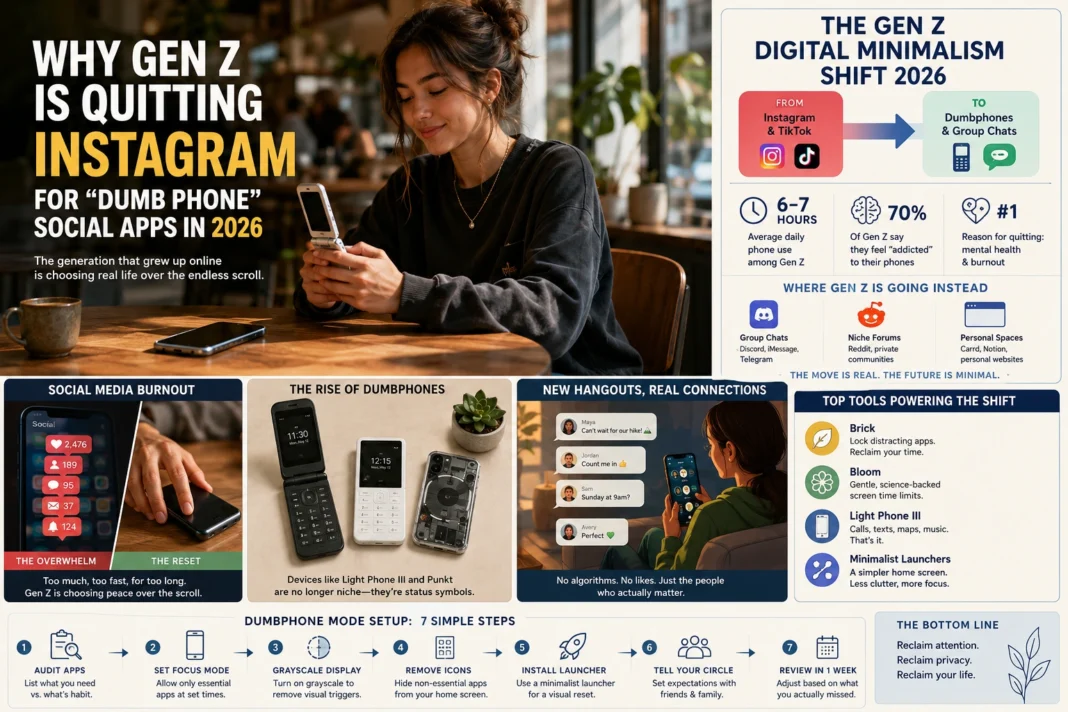
- Gen Z spends roughly 6-7 hours a day on their phones, and a growing share say they feel “addicted” to their devices.
- A wave of Gen Zers are buying flip phones, basic feature phones, and “dumbphone mode” apps to escape Instagram and TikTok.
- They aren’t going offline completely — they’re moving to group chats, Discord servers, and niche forums instead.
- The dumbphone market is no longer a niche hobby. Devices like the Light Phone III, plus app-blocking tools like Brick and Bloom, are turning into status symbols.
- Brands and platforms are starting to respond, but nobody has fully cracked how to win back attention without burning Gen Z out again.
Introduction
Picture a 19-year-old sitting in a coffee shop. No phone glow on her face. No thumb twitching toward an app. Instead, she’s doing a crossword. Five years ago, that scene would have looked like a stock photo from 2003. In 2026, it’s just… Tuesday.
Something strange is happening to the generation that grew up with a smartphone basically glued to their hand. Gen Z, the most “online” generation in history, is the one leading the charge away from Instagram, TikTok, and the endless scroll.
This isn’t about hating technology. It’s about hating what technology started doing to them. The constant comparison. The fake-perfect feeds. The feeling of checking your phone 200 times a day and not even remembering why.
In this article, you’ll learn exactly why Gen Z is quitting Instagram in 2026, where they’re going instead, what tools are powering the shift, and what this means if you’re a parent, a marketer, or just someone wondering if you should do the same.
Why Is Gen Z Actually Quitting Instagram?
1. Social Media Burnout Hit a Breaking Point
Gen Z grew up watching curated, “perfect” lives flood their feeds every single day. Years of that constant comparison built up like sediment, and by 2026, a lot of young people finally said “enough.”
Think of it like eating dessert for every meal for ten years straight. At some point, your body just… stops wanting sugar. That’s basically what happened with the algorithm-fed feed.
2. The “Slot Machine in Your Pocket” Problem
App blockers like Brick and Bloom have become genuinely popular purchases among Gen Z, and the comparison people keep making is telling: using Instagram and TikTok feels like pulling a slot machine lever. You don’t know what you’ll get, but your brain wants to pull again anyway.
That’s not an accident. Short-form video apps are designed around the same psychological hooks as gambling machines, and Gen Z, having lived inside that design their whole adolescence, is the first generation old enough and online enough to notice it clearly.
3. Influencer Fatigue Is Real
For years, the dream was to “go viral.” Now, plenty of young people would rather not be associated with influencer culture at all. Watching endless creators sell skincare routines and “relatable” life advice got old fast, and the new flex isn’t followers — it’s not being chronically online.
4. Privacy and Mental Health Are Pulling in the Same Direction
People who’ve quit social media in 2026 keep mentioning the same surprising side effect: privacy. Stepping away from constant posting gave them back a sense of being unwatched, which a lot of them hadn’t felt since childhood.
Expert Tip: If you’re trying this yourself, don’t frame it as “quitting forever.” Frame it as a 30-day experiment. Programs like Month Offline use this exact structure, and the lower-pressure framing makes people far more likely to stick with it.
So Where Is Gen Z Actually Going?
Gen Z isn’t going dark. They’re just going somewhere quieter.
| Old Hangout | New Hangout | Why |
|---|---|---|
| Instagram feed | Group chats (Discord, iMessage, Telegram) | No algorithm, no ads, real friends only |
| TikTok comments | Niche forums and Reddit | Smaller, less performative communities |
| Public posting | Personal websites (Carrd, Notion) | Full control, no likes/comments pressure |
| Influencer following | Micro-communities (Patreon circles, private servers) | Depth over reach |
This shift matters because it’s invisible to most marketers and brands. You can’t run an ad campaign inside someone’s group chat. That’s part of the appeal.
The Rise of “Dumbphone Mode”: How Gen Z Is Doing It
There are three main paths people are taking, ranging from extreme to gentle.
Path 1: The Full Dumbphone Switch
Devices like the Light Phone III ($600, launching with calls, texts, maps, photos, and music — no app store, no social apps at all) and Punkt phones from Switzerland are the hardware end of this movement. No notifications, no scrolling, no choice to relapse.
Path 2: The “Two-Phone” Strategy
Carry a dumbphone daily, but keep an old smartphone in the car or bag for GPS and mobile payments. This is the most popular middle-ground approach because it solves the “but I need Maps and banking” objection.
Path 3: Dumbphone Mode on Your Existing Smartphone
Not everyone wants to buy new hardware. So a wave of software is helping people fake a dumbphone using the device they already own:
- Minimalist launchers that strip your home screen down to plain-text buttons
- Grayscale display mode (built into iOS/Android accessibility settings) to remove visual triggers
- App blockers like Freedom and AppBlock for scheduled lockouts
- iOS “Dumb Phone” Focus modes that silence everything except calls and texts
Step-by-Step: Setting Up Dumbphone Mode on Your Smartphone
Requirements: A smartphone (iOS or Android), 10 minutes, and honesty about which apps are tools vs. distractions.
- Audit your apps. List which apps you actually need (Maps, banking, messaging) vs. which ones you open out of habit (Instagram, TikTok).
- Set up a Focus Mode or Digital Wellbeing profile that only allows the “needed” apps during certain hours.
- Switch your display to grayscale under Accessibility settings — color is a major trigger for compulsive checking.
- Delete app icons from your home screen (not the apps themselves) for anything non-essential, and bury them in a folder.
- Install a minimalist launcher if you want a more permanent visual reset.
- Tell your close circle you’ll be slower to respond on social platforms, so expectations are managed.
- Review after one week. Adjust which apps stay blocked based on what you actually missed — usually it’s almost nothing.
Common troubleshooting tip: If you keep disabling your own blockers, use an app that requires a friend’s approval to unlock, or set blocks for a fixed time window you can’t change mid-day.
Comparison: Dumbphone vs. Smartphone in “Dumb Mode” vs. App Blockers
| Feature | Full Dumbphone | Smartphone in Dumb Mode | App Blocker Only |
|---|---|---|---|
| Cost | $200–$600 upfront | Free (uses current phone) | $40–$60 device or app fee |
| Maps/Banking access | Limited or none | Full access | Full access |
| Commitment level | High | Medium | Low |
| Reversible instantly | No | Yes | Yes |
| Best for | People ready for a full reset | People who need flexibility | People testing the waters |
Benefits of the Dumbphone Shift
- Improved focus and attention span — fewer notifications means fewer interruptions to deep work or study.
- Better sleep — no blue light, no late-night scrolling spiral.
- Lower social comparison and anxiety — out of sight, out of mind.
- Real-world presence — more board games, more run clubs, more actual conversations.
Who should try this: Anyone who checks their phone compulsively, feels worse after scrolling, or wants better sleep and focus.
Who should be cautious: People whose job, safety, or social support genuinely depends on constant smartphone access (e.g., gig workers using delivery apps, people relying on a single device for emergency contact). The “two-phone” strategy solves most of these cases.
Common Mistakes to Avoid
- Going cold turkey without a plan. Most people relapse within days. Use a phased approach instead.
- Deleting apps instead of accounts. If the account still exists, redownloading takes 30 seconds in a weak moment.
- Not telling friends and family. This creates social friction and pressure that pulls you back.
- Replacing one addictive habit with another. Swapping Instagram for endless YouTube isn’t progress.
- Assuming it has to be permanent. Treating it as all-or-nothing makes people give up. A “work phone vs. personal dumbphone” split works for many.
Expert Tips Most Articles Don’t Mention
- Change your phone’s wallpaper to a plain color before starting a detox. Visual boredom on the lock screen reduces the urge to unlock “just to look.”
- Move your charger out of the bedroom. Most late-night scrolling starts in bed, not on the couch.
- Pick one analog replacement per habit you’re cutting — a physical book for the Kindle app, a real alarm clock for the phone alarm, a point-and-shoot camera instead of the camera app.
What’s Next: Future Trends in the Dumbphone Movement
- Hybrid devices will grow fastest. Phones like the Nothing Phone, which offer a more “essential” interface without going fully dumb, are likely to outsell pure dumbphones.
- Platforms will keep adding wellness features, but expect skepticism — Gen Z has heard “we care about your wellbeing” before.
- Brands will shift budget toward micro-communities (Discord, Patreon-style groups) as mass-reach platforms lose Gen Z attention.
- Legal pressure on social platforms will increase, as more lawsuits and regulatory scrutiny target addictive design patterns.
Conclusion
Gen Z isn’t anti-technology. They grew up inside it. What they’re rejecting is a specific kind of technology: the kind built to be impossible to put down. The dumbphone movement, the app blockers, the quiet move to group chats — it’s all the same instinct. Reclaim attention. Reclaim privacy. Reclaim a sense of self that isn’t shaped by a feed.
If you’re considering joining them, start small: one week of grayscale mode, one honest app audit, one analog swap. You don’t need a $600 flip phone to feel the difference.
FAQ
Why is Gen Z quitting Instagram in 2026? Burnout from constant comparison, algorithm fatigue, and a desire for privacy and real connection are the main drivers.
What are Gen Z using instead of Instagram? Group chats (Discord, iMessage, Telegram), niche forums, Reddit, and personal websites are replacing public social feeds.
What is a dumbphone? A basic feature phone that only supports calls, texts, and sometimes maps or music — with no app store and no social media access.
Is the dumbphone trend just a fad? It’s grown into a genuine market shift, with rising sales for devices like the Light Phone III and app blockers like Brick and Bloom.
Can I get the dumbphone effect without buying a new phone? Yes. Grayscale mode, Focus settings, minimalist launchers, and app blockers can simulate most of the benefits on your existing smartphone.
Is social media actually addictive, or is that exaggerated? Experts note that heavy social media use can keep the nervous system in a constant state of stimulation and comparison, though “addiction” in the clinical sense is debated.
What is the “two-phone” strategy? Carrying a dumbphone daily while keeping a smartphone for emergencies, GPS, or mobile payments.
Are teens or adults driving this trend more? Gen Z (roughly ages 14–28) is leading it, but interest is growing among older millennials and even some parents.
What happens to brands if Gen Z leaves social media? Marketers lose easy mass reach and have to shift toward smaller, trust-based communities instead of broad ad campaigns.
Will Instagram and TikTok change because of this? Platforms are adding wellness tools, but skepticism remains high about whether these changes meaningfully reduce addictive design.