LinkedIn announced on March 29, 2026 that it is killing spontaneous live streaming. Starting June 22, 2026, every live event on LinkedIn must be scheduled in advance. The instant go-live button that creators have relied on for years is being removed. LinkedIn framed the change as an evolution, saying it wants live video to be simpler, more discoverable, and more impactful. The framing matters because the substance is more disruptive than the company’s gentle messaging suggests.
The change has caused real concern among B2B marketers, thought leaders, sales professionals, and creators who had built workflows around the immediacy of LinkedIn Live. This article breaks down what is actually changing, why LinkedIn made the move, what it means for different types of users, and what creators should do instead to keep producing live content on the platform.
What Is Actually Changing
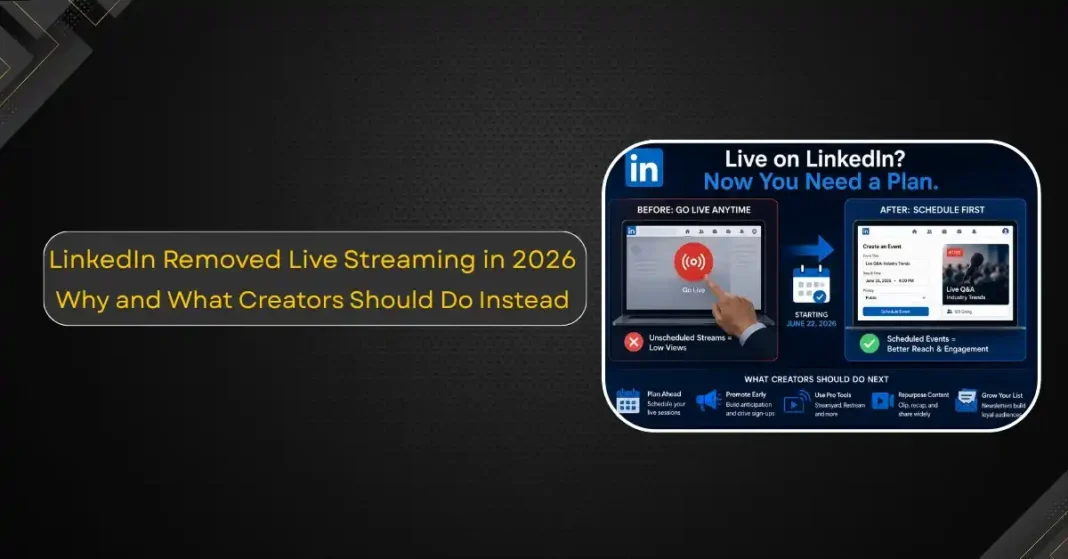
First, the precise scope. LinkedIn is not shutting down live video. Live streaming remains available for eligible members and Pages. The platform is removing the ability to go live without scheduling an event first. Beginning June 22, 2026, all live events on LinkedIn must be scheduled ahead of time, even if that scheduling happens only a few minutes before the stream starts.
In LinkedIn’s own words, while the ability to go live spontaneously will no longer be available, users can still go live on short notice by scheduling their event just minutes in advance. So the loophole exists. You can still produce something close to spontaneous live content. You just have to create a scheduled event first and then start streaming to it.
Other changes ride alongside this one. The dedicated Event feed, which used to be a separate space visible only to attendees, is going away. Live Events will now behave like any LinkedIn feed post. Private events that were scheduled before the change will still exist, but the ability to go live exclusively to attendees of a private event is also being removed. For members and Pages that have LinkedIn Live access, the integration with third-party streaming partners like Streamyard, Restream, Socialive, Vimeo, and Switcher continues to work.
Why LinkedIn Made This Move
Unscheduled Streams Got No Viewers
LinkedIn has not published a detailed rationale, but the reasoning is straightforward once you look at how live streaming was actually performing on the platform. Three forces are driving the change.
Unlike Twitch, Instagram, or TikTok, LinkedIn users do not hang around waiting for someone they follow to suddenly go live. The platform is professional, transactional, and used in short, focused sessions. People log in to check messages, post an update, or read industry news. They do not scroll endlessly looking for live content to drop into. The practical effect was that most spontaneous live streams had near-zero attendance. The streamer would wait around hoping for an audience, delay the start, and end up talking to a handful of people who happened to be online at exactly the right moment.
From LinkedIn’s perspective, this was a bad user experience for everyone involved. The creator wasted time on a stream with no audience. The platform served low-quality live content that did not drive engagement. The members of the audience who did show up often arrived halfway through and missed context. Forcing scheduling solves all three problems at once.
Quality Over Quantity
LinkedIn is increasingly positioning itself as a premium professional content platform. The algorithm rewards thoughtful posts, document carousels, and structured video. The platform has been deprecating features that produced low-quality content even when those features were technically popular. The end of spontaneous live streaming fits this pattern. By requiring scheduling, LinkedIn raises the bar for what counts as a live event. The creators who go live will be the ones serious enough to plan ahead. The output will look more like a professional webinar and less like a Twitch stream.
This positioning has paid off financially. According to Dreamdata’s LinkedIn Ads Benchmarks Report 2026, LinkedIn’s ROAS for B2B advertisers reached 121 percent in 2025, up from 113 percent the prior year, and the platform captures 41 percent of total B2B ad budgets. The premium positioning works, and live video is being aligned with the rest of that strategy.
Better Audience Targeting and Promotion
Scheduled events let LinkedIn surface them in search, recommend them to interested members, and let event ads run with two-week lead times that are now a best practice. None of this is possible with spontaneous live streams that nobody knows about in advance. Forcing scheduling unlocks the platform’s promotion machinery in ways that benefit creators and LinkedIn at the same time.
Who This Hurts Most
The impact of the change varies by who you are and how you have been using LinkedIn Live.
Spontaneous Personal Brands
The group hit hardest is individual creators who built their brand on impromptu broadcasts. These are the people who would see industry news, open the LinkedIn app, hit go live, and spend 15 minutes giving their take. Some of them built loyal audiences this way, especially in finance, marketing, and tech where breaking news cycles matter. For these creators, the workflow has to change. They can still do something similar by scheduling a few minutes ahead, but the immediacy is gone.
Reactive News Coverage
Marketing and PR teams that used LinkedIn Live for rapid reaction to industry news or competitor moves now have to add a planning step. By the time the event is scheduled and the audience is notified, the news cycle may have moved on. For genuinely time-sensitive content, third-party streaming platforms like YouTube Live or X Live now have a clearer advantage.
Internal Communications That Spilled Public
Some companies were using LinkedIn Live for internal town halls and team updates, then making them public after the fact. The change removes the ability to go live exclusively to attendees of a private event. Internal communications need to move to dedicated platforms like Zoom, Microsoft Teams, or Vimeo with proper access controls.
Who This Helps
The change is not bad news for everyone. Several types of creators and brands actually benefit from the new model.
Organisations That Already Scheduled Everything
Companies running structured webinars, product launches, panel discussions, and thought leadership events were already scheduling their LinkedIn Live sessions in advance. For them, the change requires almost no adjustment. They keep doing what they were doing. The added benefit is that their content is now competing with fewer low-quality spontaneous streams, which should improve discoverability for the events that do get scheduled.
Creators Who Build Audiences Properly
Live video on LinkedIn is becoming more like an event and less like a stream of consciousness. That favours creators who understand how to build anticipation, promote events, and deliver structured content. Newsletter writers, podcasters, course creators, and consultants who already think in terms of events have a clear advantage in the new system.
Brands With Established Live Strategies
Companies that have invested in LinkedIn Live as part of a broader B2B content strategy benefit from the higher bar. The competitive set for attention is smaller, the audience expectations are clearer, and the events that do happen will get better visibility on the platform.
What Creators Should Do Instead
The end of spontaneous LinkedIn Live forces creators to be more deliberate. Here is what is actually working in 2026 for people who want to keep producing live and live-feeling content on the platform.
Schedule Just Minutes in Advance
The simplest workaround is to use the minutes-in-advance scheduling option that LinkedIn itself has highlighted. If you have something time-sensitive to say, take 5 to 10 minutes to set up an event, post about it, and then go live. You lose some immediacy but you gain audience notification. This works for creators with engaged followings who can mobilise viewers quickly.
Pre-Schedule a Weekly or Monthly Show
The most effective LinkedIn Live strategy in the new model is a recurring show. Pick a regular time, schedule it well in advance, build a habit with your audience, and deliver consistent value. Weekly industry roundups, monthly Q and A sessions, and recurring expert interviews all work well in this format. The audience knows when to show up. The platform can promote the event series. The creator can prepare properly.
Use Third-Party Streaming Tools
Streamyard, Restream, Socialive, Vimeo, and Switcher all continue to integrate with LinkedIn Live for eligible members and Pages. These tools offer better production quality, multi-platform streaming, and features like multiple guests, screen sharing, and overlays. For creators who do serious live content, working through one of these tools is now the default approach. They also let you stream simultaneously to YouTube, X, and other platforms, which spreads your audience risk.
Repurpose Recorded Video
If your goal is the energy of live content without the constraints, native video that feels conversational often performs as well or better. Short-form video on LinkedIn has been growing significantly, with the LinkedIn algorithm in 2026 favouring video that gets watched through to the end. A well-produced 3 to 10 minute video that feels live can outperform an actual stream that nobody saw.
Lean Into Newsletters
LinkedIn Newsletters continue to grow as a distribution channel. They reach engaged subscribers reliably, drive return visits to your profile, and rank well in the platform’s AI search. For creators who used to rely on live streaming for direct audience contact, building a newsletter is the more durable strategy in 2026.
Use Other Live Platforms for Speed
For genuinely time-sensitive content, YouTube Live, X Live, and Instagram Live all still support spontaneous broadcasting. Creators with a multi-platform presence can use these for breaking content and keep LinkedIn for structured events. The cross-promotion is straightforward. Stream live on YouTube. Post a recap or highlight on LinkedIn.
What This Tells Us About LinkedIn’s Direction
The LinkedIn Live change is one of several signals about where the platform is headed in 2026. Reading them together gives a clearer picture than looking at any single update.
LinkedIn is doubling down on structured, thoughtful content. Document carousels, long-form articles, native video, and now scheduled events are all being prioritised. Quick, low-effort content is being deprioritised across the board. Creators who post twice a day with one-line hot takes are seeing reach decline. Creators who post twice a week with substantive content are seeing reach grow.
Video is becoming central to the platform. LinkedIn algorithm changes in 2026 have shown that video content gets 69 percent more reach than text-only posts. The platform is investing heavily in video discovery and playback features, including new playback speed controls and a more video-friendly mobile feed.
AI search is changing how content gets discovered on LinkedIn. The platform’s own AI search has rolled out more conversational tools, and LinkedIn content now ranks number two for citations across ChatGPT Search, Perplexity, and Google AI Mode, appearing in 11 percent of AI responses on average. This is huge for B2B brands. Content that gets cited by AI tools reaches audiences far beyond LinkedIn itself.
Verified users are getting more visibility. The platform now lets you filter replies by verified users, and verification appears to be a small but real factor in algorithm visibility. For serious creators and brands, getting verified is worth the effort.
Layoffs at LinkedIn itself have hit major teams despite revenue growth. The cuts mirror what is happening at Meta, Oracle, and Amazon. The implication is that the platform is consolidating around its highest-leverage features, including AI, video, and structured events, while quietly retiring features that were not paying off, like spontaneous live streams.
A Practical New Workflow for B2B Creators
For creators and brands using LinkedIn seriously in 2026, the new workflow looks something like this. Plan a recurring weekly or monthly live event series and schedule episodes weeks in advance. Use a tool like Streamyard or Restream for production quality and multi-platform streaming. Promote upcoming events through native LinkedIn posts, your newsletter, and direct outreach to your network in the days leading up to the event. Run event ads with two-week lead times for events you really want to fill.
On the day, go live to your scheduled event. After the event, clip the best moments into short-form videos for the LinkedIn feed and other platforms. Write a recap newsletter that summarises what was discussed and includes the full replay. Reuse insights from the event in posts over the next two weeks to extend the value beyond the live audience.
This workflow does more work per stream, but each stream produces more output and reaches a larger total audience than the old hit-go-live approach. For most creators, the math works out in their favour, even if the immediacy feels lost.
The Bottom Line
LinkedIn ending spontaneous live streaming on June 22, 2026 is not the end of live video on the platform. It is the end of a specific kind of live video that was not really working anyway. The change forces creators to be more deliberate, which is good for the people who already were and inconvenient for the people who were not.
The creators and brands who adapt their workflows around scheduled events, third-party streaming tools, and recurring live shows will end up producing better live content than they did in the spontaneous era. The audiences will be larger. The production quality will be higher. The replay value will be greater.
The creators who refuse to adapt and stick to platforms that still allow spontaneous broadcasts will have to decide which audience matters more. LinkedIn’s professional audience is uniquely valuable for B2B and thought leadership. Walking away from it because of one workflow change is probably the wrong move. The smarter response is to build a new workflow that respects the platform’s direction while still letting you do live content. The infrastructure is all there. The only thing that has changed is the order of operations.