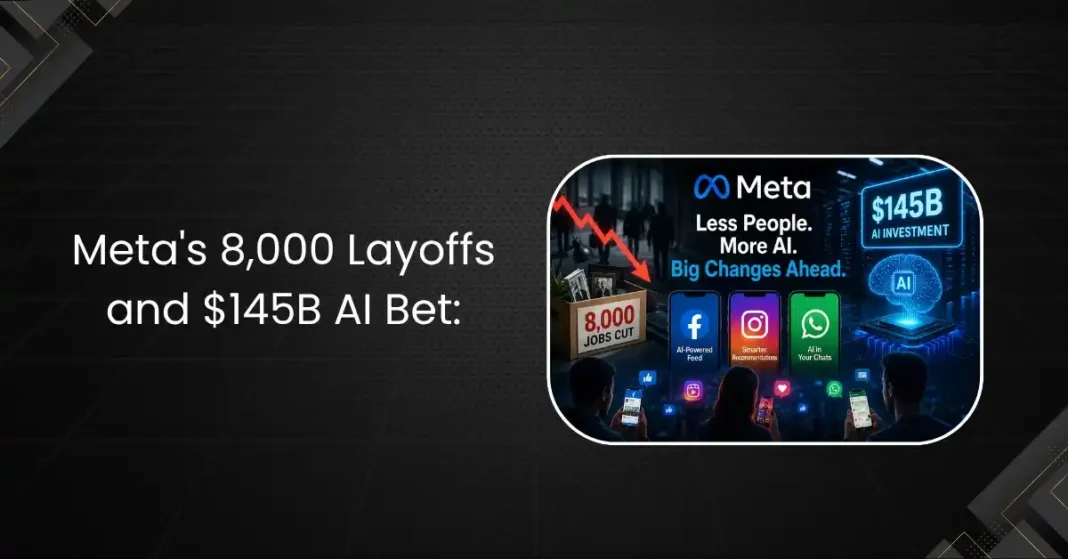
On May 20, 2026, Meta began cutting about 8,000 employees, roughly 10 percent of its 78,865-person workforce. The company also cancelled 6,000 open job requisitions, bringing the effective headcount reduction to 14,000 positions. At the same time, Meta raised its 2026 capital expenditure forecast to between 125 billion and 145 billion dollars, nearly double the 72 billion it spent in 2025. Most of that money is going to data centres, GPUs, and AI infrastructure.
The story has been covered widely as a business and labour story. What gets less attention is what this means for the roughly 3 billion people who actually use Meta’s apps every day. Facebook, Instagram, and WhatsApp users are about to see significant changes to how these apps work, what they look like, and how Meta makes money from them. This article breaks down what the layoffs and AI spending actually mean for users, what changes you should expect, and what you can do about the parts you control.
Why Meta Is Doing This
Meta is not cutting jobs because the business is struggling. The company reported record quarterly revenue of 56.31 billion dollars at the same time it announced the cuts. Mark Zuckerberg explained the logic at a company town hall in plain terms. The company has two major cost centres, compute infrastructure and people, and compute is winning. Nvidia’s vice president of applied deep learning Bryan Catanzaro said earlier this year that compute already costs more than the engineers on his team.
The 8,000-person layoff is expected to save roughly 2.4 billion dollars annually according to Wedbush estimates. That is a small fraction of the 125 to 145 billion Meta is spending on AI infrastructure this year. The payroll cuts are funding a small slice of the AI build-out, not actually closing the cost gap. The real story is that Meta has decided AI infrastructure is more important than headcount for the long-term future of the business.
The teams hit hardest in the May layoffs include recruiting, customer support, content moderation, and non-AI product teams. The teams getting more resources include the new Superintelligence Labs division under Chief AI Officer Alexandr Wang, plus the AI-focused pods being built across Facebook, Instagram, WhatsApp, Threads, and Reality Labs.
What Users Will Actually Notice
More AI Inside Every App
The user-visible changes from this restructuring will roll out over the next 12 to 24 months. Some are already showing up. Others are coming soon.
Facebook, Instagram, and WhatsApp are all becoming more AI-driven. Meta AI is being woven deeper into every product. On Instagram, AI is shaping the feed, recommending content, generating image and video editing tools, and powering search. On Facebook, AI Reels recommendations now drive most of the time users spend. On WhatsApp, Meta AI can be summoned in chats to answer questions, draft messages, and help with translation. The pace of these AI features rolling out is accelerating because the entire company has been reorganised to ship them faster.
The user experience implication is that what you see in your feed is increasingly chosen by AI, not by who you follow. This has been true for years on Reels and on the Discover feed, but in 2026 the algorithm is far more aggressive about pushing AI-recommended content, including content from accounts you have never seen, over content from your friends. Users who want to see updates from people they actually know have to work harder to find them.
More AI-Generated Content
Meta is not just using AI to recommend content. It is increasingly hosting AI-generated content created by users with Meta’s own tools. The Imagine with Meta AI feature for image generation, AI video creation tools, and AI-generated personas have all expanded significantly. The amount of AI-made content showing up in feeds is going up, and the line between human-created and AI-created posts is blurring fast.
The practical effect is that engagement and identity online are getting harder to interpret. The person who looks like a real friend’s friend might be an AI persona. The viral image with millions of views might be entirely synthetic. Users need to be more sceptical of what they see, especially in unfamiliar accounts and trending content.
Slower Human Support, Faster AI Support
Customer support and content moderation teams are among the hardest hit by the layoffs. For users, this means slower responses when something goes wrong with your account. Reaching a human at Meta for account recovery, ad disputes, or policy issues has been hard for years. After this restructuring, it gets harder.
The replacement is AI-powered support. Chatbots handle more queries. Automated systems decide more appeals. For routine issues, this often works fine. For complex problems, account hacks, or edge cases where the AI gets it wrong, users have less recourse than before. The advice from people who have been through this is to use any human contact you have through paid features like Meta Verified, which generally gets faster human support, before you actually need it.
More Ads, Better Targeted
Ad load is going up across Meta’s apps, partly because ad revenue funds the AI build-out. Users on Facebook and Instagram are seeing more sponsored content per session than they did a year ago. At the same time, ad targeting is getting more accurate because Meta’s AI is better at predicting which users are likely to engage with which ads. The ads you see are more likely to be relevant to you, which some users appreciate and others find unsettling.
For users who want to limit the amount of ad targeting, Meta’s ad preferences page lets you adjust some of the inputs. It does not eliminate ads, but it reduces the personalisation. EU users have stronger controls because of GDPR and the Digital Markets Act. Users in India and other markets have fewer options, though Meta has been adding new controls in response to regulatory pressure.
Threads Gets More Investment
Threads recently crossed 400 million users and is one of the few non-AI product areas getting more resources, not less. Adam Mosseri’s team has been pushing rapid feature development, integration with Instagram, and creator tools. For users, this means more changes to Threads in the coming year, including deeper AI features built on top of the platform’s growing scale.
What This Means for Facebook Users Specifically
Facebook has a different demographic profile than Instagram or WhatsApp, and the changes are landing differently on its user base. The platform has been gradually deprioritised relative to Instagram and Threads, even as it remains hugely profitable. Facebook still serves around 2 billion daily users, but the average age of those users is rising. Younger demographics have largely shifted to Instagram, Threads, and TikTok.
For older Facebook users, who tend to use the platform for family connections, community groups, and Marketplace, the AI push has been less welcome. Many of these users want a quieter, more chronological feed and stable features. They are getting an increasingly AI-driven experience with more video, more recommendations, and more changes. Tools like the Friends tab and the option to see most recent posts can help, but Meta keeps de-emphasising these in the main interface.
Marketplace, Groups, and Events remain valuable on Facebook and have not changed dramatically. These are the parts of the platform where the human-to-human use case is strong enough to resist the AI shift. Users who get most of their value from these features will probably notice the AI changes less.
What This Means for Instagram Users
Instagram is the centrepiece of Meta’s consumer strategy in 2026. The platform has the youngest demographics, the strongest creator ecosystem, and the most direct revenue per user. It is also the place where AI features are rolling out fastest.
Reels continue to expand. AI-powered creative tools for image and video editing are now built directly into the camera. The Edits app, Meta’s standalone video editor, is getting deeper AI features. Instagram’s algorithm is being driven by the three ranking factors Adam Mosseri confirmed earlier this year, which are watch time, sends per reach, and likes per reach. These signals are heavily AI-mediated.
For users, the practical implications are that engagement drives everything. Content that generates DM shares performs best because it signals interest worth showing to other people. Long watch times on Reels matter more than likes. The feed is increasingly built from accounts you do not follow, especially if your following list is small or inactive. Users who want a feed dominated by people they actually follow need to engage heavily with those accounts to keep them prioritised by the algorithm.
Creators on Instagram have to adapt faster than ever. The features that work in 2026 are different from what worked even six months ago. AI-generated content from competitors is everywhere. The bar for original, high-quality creative work has gone up.
What This Means for WhatsApp Users
WhatsApp has roughly 3 billion users globally, with India as the largest single market. The AI push on WhatsApp is significant because the platform was historically positioned as a private messaging service with minimal feature creep. That position is shifting.
Meta AI is now available inside WhatsApp chats. Users can summon it for translation, drafting messages, answering questions, and other tasks. Business accounts use AI to handle customer service automatically, which is changing how brands and users interact on the platform. For Indian users in particular, WhatsApp Business AI features are becoming a major channel for brand communication.
The biggest concern for users is the gradual blurring of the line between WhatsApp as a private messaging app and WhatsApp as a Meta service that processes your messages for AI features. End-to-end encryption remains intact for personal messages. But when you use Meta AI inside WhatsApp, your queries to the AI are processed on Meta’s servers, not encrypted to your contacts. Understanding this distinction is important for privacy-conscious users.
Channels and the Updates tab continue to expand, bringing more public broadcast content into what used to be a private messaging app. Users who do not want this kind of content can hide the Updates tab, though the option is buried in settings.
The Privacy and Trust Story
One of the most controversial aspects of Meta’s restructuring is internal surveillance software called MCI, which is being deployed on employee laptops to track mouse movements, keystrokes, and periodic screen captures. The data is used to train AI systems to replicate how employees perform digital tasks. Over 1,000 employees have signed petitions protesting the programme.
This matters to users because the same company building these systems for its own employees is the one running the largest AI models that interact with your data. The internal culture of how Meta approaches data and surveillance shapes how it approaches user data. Users who are concerned should review their privacy settings on each Meta app regularly, opt out of features they do not want to use, and consider how much of their digital life lives inside the Meta ecosystem.
On the other hand, Meta has been investing in privacy-safe AI training approaches, including processing happening within Apple’s Private Cloud Compute style infrastructure for some features. The reality is mixed. Users who want to stay on Meta’s platforms need to make active choices about settings and behaviour rather than assuming defaults are aligned with their preferences.
What This Means for Brands and Businesses
Many small businesses in India and globally depend on Meta’s platforms for customer acquisition and engagement. The AI push has direct implications for how these businesses operate.
Ad costs are going up because Meta is monetising harder to fund AI infrastructure. CPM rates have increased significantly through 2026. Small businesses with tight margins are feeling this. The flip side is that AI-driven ad targeting is more accurate, so the ROI on well-set-up campaigns is also better. Businesses that have invested in clean first-party data, conversion tracking, and Advantage Plus campaign setup are seeing better results. Businesses still running old-school manual targeting are struggling.
Organic reach continues to decline. The algorithm prioritises content that performs, and that increasingly means short-form video, AI-enhanced creative, and content that generates DM shares. Brands relying on traditional posts and stories without strong video are losing reach faster than ever.
Customer service through WhatsApp Business is becoming more important and more AI-mediated. Brands that set up AI-powered customer support on WhatsApp can handle higher volumes at lower cost, but they need to do it carefully to avoid the prompt injection and brand reputation risks that come with public-facing AI chatbots.
What Users Can Actually Do
Users have less control over the big-picture changes at Meta than they would like, but there are specific actions that help.
Manage Your Feed
Use the Following feed on Instagram when you want to see only accounts you follow. Mute or unfollow accounts you no longer want in your main feed. Engage actively with content from the people and accounts you actually care about so the algorithm prioritises them. The defaults are designed to maximise engagement for Meta, not your preferences. You have to actively shape your experience.
Review Your Privacy Settings
Audit your ad preferences, data sharing settings, and connected apps at least every six months. Settings change. New options appear. Old defaults shift. Users who set their preferences once and never check again often find that what they thought was off has been re-enabled or that new features have been added without their explicit consent.
Diversify Your Digital Presence
Any business or creator entirely dependent on Meta for distribution is taking on real risk. The algorithms, ad costs, and policies are all changing fast. Building an email list, a presence on other platforms, and direct relationships with your audience reduces dependence on any single platform. This is not new advice, but it is more important than ever in a year when the platform is being aggressively restructured around AI rather than around user or creator needs.
Be Sceptical of What You See
AI-generated content, AI-powered personas, and deepfake media are increasingly common in Meta feeds. The same scepticism users apply to spam emails and unknown websites now needs to apply to social media content. Especially trending content from accounts you do not know. Especially anything that triggers a strong emotional reaction. The information environment inside Meta’s apps has changed, and user habits need to adapt.
The Bottom Line
Meta’s decision to cut 8,000 jobs while spending up to 145 billion dollars on AI infrastructure is not just a labour story. It is a signal about how the company plans to operate for the next decade. AI is going to be at the centre of every product Meta runs. Human teams are going to be smaller. Compute will keep being the largest line item.
For Facebook, Instagram, and WhatsApp users, this means more AI features, more algorithm-driven feeds, more AI-generated content alongside human-made content, slower human support, and more ads. Some of these changes are improvements. Some are not. The apps in 2027 will look meaningfully different from the apps in 2025, and the direction of travel is clear.
Users who want to keep getting value from Meta’s platforms in this environment need to be more deliberate. Curate your feeds. Manage your privacy settings. Build relationships outside the platforms. Stay sceptical of what you see. The era of passive consumption on social media is ending, replaced by an environment where the platforms are aggressively optimised for what works best for the platforms, not necessarily what works best for the users. The 3 billion people who use Meta’s apps every day are about to find out exactly what that means in practice.