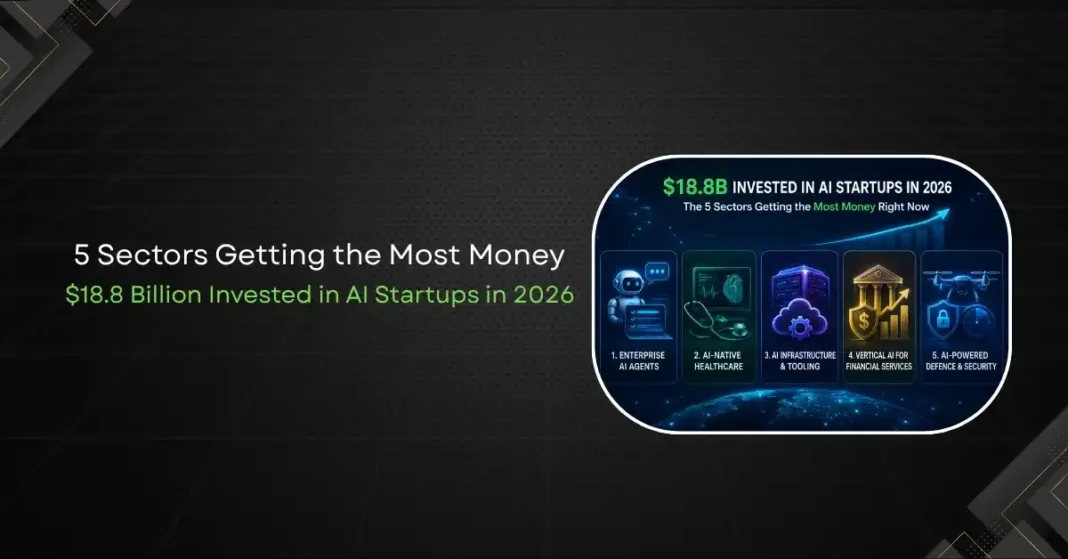
The first four months of 2026 saw $18.8 billion flow into AI startups globally, a figure that puts the year on track to exceed 2025’s record of $46 billion and would represent the largest annual venture investment in any technology category in history. That number sounds large until you see where it is concentrating. The money is not spreading evenly across the AI landscape. It is pooling in five specific sectors with unusual intensity, and understanding which sectors they are, and why investors are betting so heavily on them, tells you a great deal about where the practical value of AI is being extracted right now.
This is not a story about frontier model labs. Anthropic, OpenAI, and Google’s AI division are capturing significant capital, but they represent a separate stratum of the market. The $18.8 billion figure tracks downstream application and infrastructure companies, the startups that are building on top of or alongside foundation models to serve specific industries and use cases. That market is where the volume is, and it is also where the debate about whether AI valuations are sustainable is most directly relevant.
Sector 1: Enterprise AI Agents
The largest single slice of 2026 AI startup investment is going into enterprise AI agents, companies that build autonomous software agents capable of handling multi-step professional tasks without constant human oversight. This category includes startups building agents for legal document review, financial analysis, supply chain management, human resources processes, and customer operations.
The investment thesis is straightforward. White-collar knowledge work represents a massive cost centre for large organisations, and AI agents that can handle defined categories of that work at a fraction of the cost of human labour represent genuine economic value, not speculative value. The early enterprise agent startups that reached commercial scale in 2024 and 2025 produced revenue growth figures that validated the thesis, and 2026 investment is following those proof points.
The leading companies in this space raised rounds averaging $200 million to $500 million in the first quarter of 2026. Notable raises included Harvey AI in legal tech, which closed a $350 million round at a $3 billion valuation, and Cognition, the company behind the Devin AI coding agent, which raised $400 million. The valuation multiples in this space are high relative to current revenues, but investors are betting that the category grows fast enough to justify them.
Sector 2: AI-Native Healthcare
Healthcare is the second-largest recipient of AI startup investment in 2026. The category spans several distinct subcategories: diagnostic imaging AI, clinical trial optimisation, drug discovery and molecular design, medical records processing, and patient communication automation. Together these attracted approximately $3.2 billion in investment in the first four months of 2026.
The OpenAI and Novo Nordisk partnership announced in May 2026 was the highest-profile signal of the sector’s momentum, but it followed dozens of smaller deals that had been building throughout the year. The regulatory environment in healthcare is harder to navigate than in other sectors, which paradoxically makes it more attractive to investors who want durable competitive positions. A startup that has successfully navigated FDA approval pathways for an AI diagnostic tool has built a moat that is genuinely difficult for competitors to replicate quickly.
The healthcare AI companies that are raising the most capital in 2026 are not the ones with the most impressive model benchmarks. They are the ones with clinical validation data, reimbursement pathways in major markets, and partnerships with health systems that give them access to the proprietary patient data needed to train specialist models. Data access, not model architecture, is the primary competitive advantage in this segment.
Sector 3: AI Infrastructure and Tooling
The third sector is the picks-and-shovels layer of the AI economy: companies building the infrastructure that other AI companies need to function. This includes model evaluation and testing platforms, AI security and compliance tools, observability systems for AI applications in production, data labelling and curation services, and fine-tuning infrastructure for enterprises that want to customise foundation models on proprietary data.
Investment in this category accelerated sharply in late 2025 and has continued through 2026 as the number of companies deploying AI in production environments grew large enough to create a real market for enterprise AI operations tools. The parallel to earlier software markets is instructive: when cloud computing took off in the early 2010s, the companies that built monitoring, security, and cost management tools for cloud deployments, Datadog, CrowdStrike, CloudHealth, became very large businesses even though they were not cloud providers themselves.
The AI operations market is following the same pattern. Companies that help enterprises understand what their AI systems are doing, catch failures before they cause reputational damage, and manage the cost of inference at scale are solving real problems that enterprises are willing to pay to have solved. Average contract values in this space are growing rapidly as enterprises move from pilot projects to production deployments.
Sector 4: Vertical AI for Financial Services
Financial services is the fourth major concentration of AI startup investment in 2026. The sector is attracting capital for several distinct applications: fraud detection and anti-money laundering, algorithmic trading and portfolio management, credit underwriting and risk assessment, regulatory compliance automation, and wealth management personalisation.
What sets financial services apart from other enterprise verticals is the size of the transactions involved and the regulatory stakes of getting AI deployment wrong. A compliance error in a financial institution does not just damage a product; it can trigger regulatory action with multi-billion dollar consequences. That risk profile means financial institutions pay a significant premium for AI systems they can explain, audit, and defend to regulators, and that premium has created a specialised market where AI startups can charge prices that would be untenable in less regulated industries.
The leading financial AI startups raised capital at valuations that reflect the sector premium. Companies like Riskified, Featurespace, and Wayve (applied to vehicle risk scoring for insurance) commanded multiples of 20 to 30 times forward revenue in 2026 raises. Investors are accepting those multiples because the competitive landscape in financial AI is less crowded than in general enterprise AI, the switching costs for financial institution clients are very high, and the total addressable market is genuinely enormous.
Sector 5: AI-Powered Defence and Security
The fifth sector is the most controversial but also one of the fastest-growing: AI applications in national defence and cybersecurity. Google’s classified Pentagon contract, signed in April 2026, was the most visible example of this trend, but it sits on top of an ecosystem of smaller startups that have been building AI tools for military and intelligence applications for the past three years.
Investment in this space is harder to track than in consumer or enterprise AI because much of it flows through government contracts rather than venture capital rounds. But the VC-funded companies in the defence tech and cybersecurity AI space raised approximately $2.1 billion in the first four months of 2026, with notable rounds going to companies building AI-powered signals intelligence tools, autonomous drone navigation systems, and AI-accelerated cyber defence platforms.
The ethical complexity of this sector is real and deserves acknowledgment. The same AI capabilities that can defend networks against attacks can also be used offensively. The same autonomous decision-making systems that could reduce military casualties by keeping humans further from the front lines could also lower the threshold for initiating conflict. These are not abstract concerns, and the companies operating in this space are navigating serious reputational and regulatory risks alongside the financial opportunity.
What the Concentration Tells Us
The five sectors capturing the most 2026 AI startup investment share common characteristics. They all involve use cases where the economic value of AI is large and demonstrable rather than speculative. They all operate in markets with significant switching costs or regulatory barriers that protect early movers. And they all have early commercial deployments that give investors something to underwrite rather than pure technology bets.
The sectors that are not seeing the same investment intensity are equally instructive. Consumer AI applications, the apps and tools that individuals use, are raising less capital relative to their user numbers because the path to monetisation is harder to defend. When foundation model providers release capabilities that match what a consumer AI startup has built, that startup faces existential competition from companies with vastly larger infrastructure and distribution advantages.
The $18.8 billion figure for the first four months of 2026 will likely grow throughout the year as late-stage rounds close and additional sector leaders emerge. The more important question is not the total but the distribution: which of these sectors will produce the durable large companies of the AI era, and which will consolidate into the product lines of incumbents. The answer to that question is what investors are implicitly betting on when they deploy capital in 2026, and the answers they are reaching are visible in where the money is actually going.