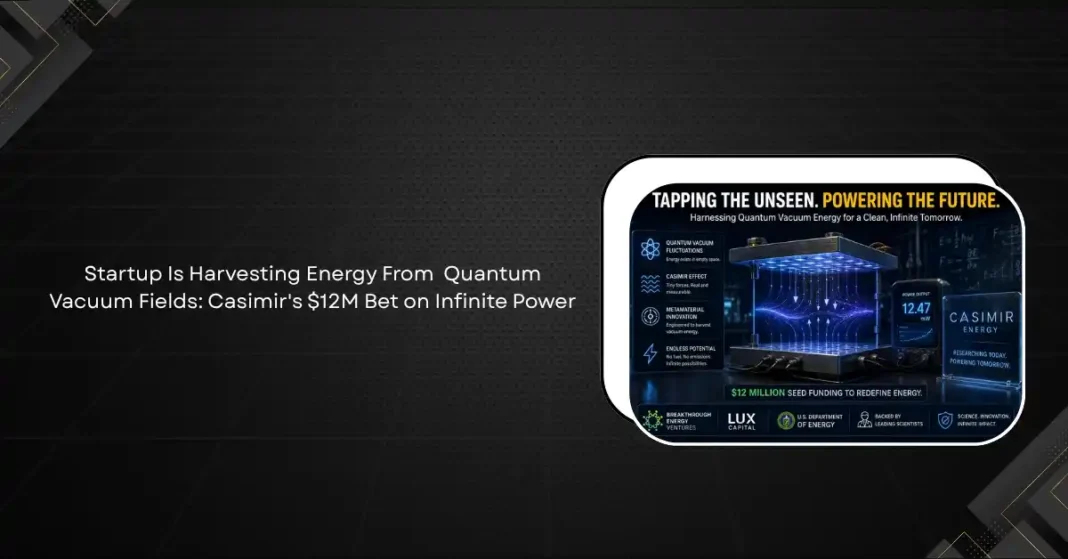
In January 2026, a New Mexico-based startup called Casimir Energy closed a $12 million seed round to pursue what its founders describe as energy extraction from quantum vacuum fluctuations. The investors include a mix of deep-tech venture funds, a US Department of Energy grant, and several physicists who have left tenured academic positions to join the company. The scientific and commercial claims are bold enough to prompt significant scepticism, and the scepticism is warranted. But dismissing the company entirely misreads both the state of vacuum energy research and the reasons serious people are putting money behind it.
To understand what Casimir is attempting, why it matters, and what the realistic prospects are for turning quantum physics into a power source, you need to understand the science, the current state of experimental evidence, and the very large gap between theoretical possibility and practical engineering.
What Quantum Vacuum Energy Actually Is
The quantum vacuum is not empty space. In quantum field theory, the vacuum state is the lowest energy state of a quantum field, but it is not zero energy. Quantum fields fluctuate constantly even at their ground state, a consequence of Heisenberg’s uncertainty principle, which means that even a perfect vacuum contains a constant bath of virtual particle-antiparticle pairs spontaneously forming and annihilating. These fluctuations have real, measurable physical effects.
The most famous of these effects is the Casimir effect, first predicted by Dutch physicist Hendrik Casimir in 1948. When two uncharged conducting plates are placed very close together, the quantum vacuum fluctuations between the plates are restricted to wavelengths that fit between them, while the fluctuations outside the plates are unrestricted. This asymmetry creates a net inward pressure on the plates, pushing them together. The Casimir force has been measured experimentally to a precision of better than 1 percent, confirming that the vacuum energy effect is real.
The idea that motivates companies like Casimir Energy is whether this force can be harvested, whether the energy imbalance that drives the Casimir force can be converted into usable electrical power rather than simply observed as a mechanical force. Most physicists treat this as either impossible by thermodynamic argument or extremely difficult by engineering argument. Casimir Energy’s founders believe they have identified a pathway around the thermodynamic objection using a specific class of metamaterials that alter how the vacuum interacts with conductive surfaces.
The Science Behind the Claim
Casimir Energy’s technical approach, described in a preprint published in February 2026 and currently under peer review at Physical Review Letters, centres on artificially structured metamaterials that exhibit negative permittivity and negative permeability in defined frequency ranges. The claim is that these metamaterials create a spatial asymmetry in vacuum fluctuation energy density that can be converted to electrical current through a specially designed circuit.
The theoretical underpinning draws on work by physicist Garret Moddel at the University of Colorado, who has been publishing on optical rectenna devices capable of harvesting zero-point energy for over a decade. Moddel’s work has been peer-reviewed and replicated to the extent that the small signals involved allow. The question is not whether the underlying physics is real, which it appears to be, but whether the energy output can be scaled to commercially meaningful levels.
Several independent physicists who reviewed the Casimir Energy preprint described it as rigorous in its theoretical framing but noted significant unanswered questions about efficiency at scale, the manufacturing tolerances required for the metamaterials to function as specified, and the thermal management challenges involved in operating the system at room temperature. None described it as fraudulent. Several described it as interesting but premature. That is a more generous reception than most zero-point energy claims receive from the physics community.
Why Serious Investors Are Backing It
The $12 million round is small by the standards of 2026 deep-tech investment, but the investor composition is notable. Breakthrough Energy Ventures, which was founded by Bill Gates and invests in climate and energy technology, participated in the round alongside Lux Capital, which has a strong track record in funding science-based companies that are working at the boundary of what is currently known to be possible. Neither fund is known for backing pseudoscience.
The investment thesis is explicitly long-horizon. The investors are not expecting Casimir Energy to have a product in five years. The investment is a bet on optionality: if the physics works at scale, the commercial implications are enormous enough that a $12 million early stake could generate extraordinary returns. If the physics does not work at the scale required, the company fails and the capital is lost. The expected value calculation, weighting a small probability of enormous success against a high probability of total loss, is the same calculation that justified early investment in nuclear fusion startups.
The Department of Energy grant component, reported to be approximately $2 million, is a ARPA-E award targeting breakthrough energy concepts. ARPA-E explicitly funds projects that are too speculative for traditional research funding but too technically serious to dismiss. The agency has funded a number of projects that seemed implausible and turned out to be real, including early solid-state battery research and several flow battery chemistries that are now in commercial deployment.
The History of Energy-From-Vacuum Claims
The history of vacuum energy extraction claims is almost entirely a history of fraud, self-delusion, and wishful thinking. Companies and inventors have been claiming to extract free energy from the vacuum for as long as quantum mechanics has been known, and essentially none of those claims have survived serious scrutiny. The most notorious example is Dennis Lee’s Better World Technology, which claimed to convert zero-point energy into electrical power in the 1990s and defrauded investors of millions before collapsing. There are dozens of similar stories.
Casimir Energy is aware of this history and goes to some lengths to distinguish its approach from previous claims. The key distinction its founders draw is that they are not claiming to violate thermodynamics. They argue that their device does not create energy from nothing but harvests a gradient in vacuum energy density that exists across their metamaterial interface, in the same way that a heat engine harvests a temperature gradient. Whether that distinction holds up under scrutiny is exactly what the peer review process will determine.
What Success Would Mean
If Casimir Energy’s approach works at scale, and the probability of that is not high but is not zero, the implications would be difficult to overstate. A device that extracts power from quantum vacuum fluctuations would have no fuel cost, no emissions, no moving parts in the conventional sense, and potentially no geographic constraints. It would work in space, underground, underwater, and in locations where all other energy sources are impractical.
The realistic scenario, if the science validates, is not immediate disruption of the global energy system. It is a very slow, very expensive journey through engineering development, manufacturing scale-up, regulatory approval, and infrastructure deployment that would take decades to play out. The nearer-term applications would likely be in specialised contexts where cost is secondary to reliability and off-grid operation: deep space probes, remote sensors, medical implants, and military applications.
The $12 million Casimir Energy raised is enough to fund a serious research programme for two to three years and to build the experimental apparatus needed to test the core claims under controlled conditions. The outcome of that research will either validate the core physical mechanism, in which case larger investment will follow, or fail to validate it, in which case the company will probably close. Science is supposed to work that way, and the willingness of serious investors to fund that test is how the deep-tech investment market is supposed to function, even when the ideas involved are speculative.
Conclusion
Casimir Energy’s $12 million bet on quantum vacuum energy is the kind of investment that most people will dismiss as eccentric and that a small number of physicists and investors are treating as worth serious attention. The scepticism is reasonable given the history of the field. The attention is also reasonable given the quality of the science involved and the magnitude of the potential outcome if it works.
The appropriate response to a company working at the frontier of established physics is not confident dismissal or credulous enthusiasm. It is watchful engagement with the peer review process. If the February 2026 preprint survives scrutiny and the experimental validation programme produces positive results, the story will look very different in 18 months. If the peer review process identifies fundamental flaws in the theoretical framework, the story ends there. Either outcome advances the state of knowledge, which is a reasonable outcome for a $12 million research bet.