The popular narrative about AI investment in 2026 is one of abundance. Billions of dollars flowing into the sector, valuations at historic highs, investors competing for positions in hot rounds. That narrative is accurate for a specific segment of the market: frontier model companies with proven technology and enterprise AI companies with strong revenue traction. For the broader population of AI startups, particularly the early-stage companies that are not yet generating significant revenue, the funding environment in 2026 is harder than it looks from the outside.
Data from PitchBook covering the first quarter of 2026 shows that while total AI startup investment reached record levels, the number of seed-stage AI funding rounds declined by 23 percent compared to the same period in 2025. The money is concentrating in fewer, larger rounds at later stages. Founding teams that would have raised a $3 million pre-seed round in 2023 or 2024 based on a compelling deck and a strong background are finding that investors want more before writing checks. Understanding what investors actually want has become a survival skill for AI founders.
Why the Market Tightened
The tightening at the early stage reflects a combination of factors. The first and most important is that the 2021 to 2023 vintage of AI seed investments produced a higher failure rate than anticipated. Many of the companies that raised early on the promise of fine-tuning or building applications on top of GPT-3 were competing in markets that became structurally difficult when the foundation model providers built similar capabilities directly into their APIs. Investors who wrote checks based on “we will wrap GPT-3 and charge for it” got burned, and that burn is now visible in their portfolio return calculations.
The second factor is benchmark inflation. Every AI startup in 2024 and 2025 claimed state-of-the-art performance on one or more benchmarks. Investors who funded companies based on benchmark claims frequently found that benchmark performance did not translate to customer satisfaction in production environments. Real-world AI performance is harder to measure than benchmark performance, and the correlation between the two is weaker than most pitch decks implied.
The third factor is wrapper risk. As foundation models have become more capable and more specialised, the market for startups that add a thin application layer on top of a foundation model has narrowed. If your company’s core product is a writing assistant built on ChatGPT, OpenAI can add that functionality to ChatGPT itself and undercut your pricing with minimal effort. Investors saw this pattern repeat across multiple categories and are now much more cautious about funding companies whose competitive advantage is primarily access to a good foundation model rather than a durable differentiation above or below that layer.
What Investors Actually Want: Proprietary Data
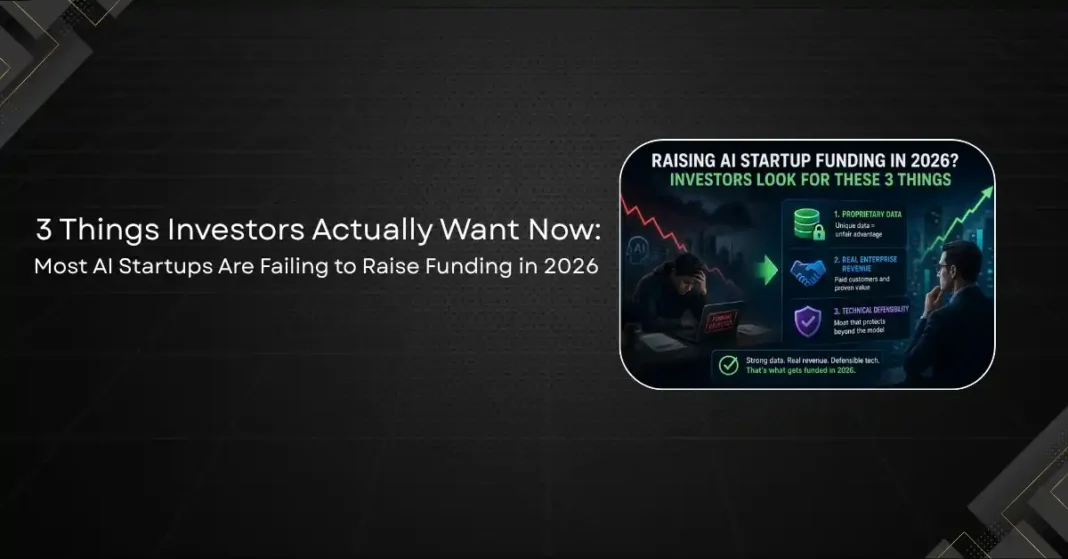
The first thing investors are looking for in 2026, the criterion that comes up most consistently in conversations with active seed and Series A investors, is proprietary data. Not access to data, not the ability to scrape publicly available data, but data that the company owns or has exclusive rights to use that cannot easily be replicated by a competitor or by a foundation model provider.
The reason is clear. If AI model quality is largely determined by training data quality, and if foundation model providers have access to most publicly available data already, the only way for an application company to build a model that outperforms what a foundation model provider can build in-house is to train on data that the foundation model provider does not have. That means patient records for a healthcare AI company, proprietary financial transaction data for a fintech AI company, or the accumulated output of a specific professional domain for a vertical AI company.
Investors are now asking founders: what data do you have that OpenAI, Google, and Anthropic do not have? If the honest answer is “nothing proprietary,” that is a significant weakness in the investment thesis. The companies that can credibly answer that question with specific data assets are raising successfully. The companies that cannot are struggling.
What Investors Actually Want: Demonstrated Enterprise Revenue
The second criterion that investors in 2026 are much stricter about is revenue. Specifically, enterprise revenue from customers that are not friends, family, or pilot programs with vague future commitment. In the 2021 to 2023 period, a letter of intent from a large enterprise customer was often sufficient for an investor to write a check at a generous valuation. In 2026, investors want contracts with commercial terms, actual payment, and retention data that demonstrates the product is generating real value.
The standard that is emerging at the seed stage for AI companies is $500,000 to $1 million in annual recurring revenue from at least three paying enterprise customers before raising a Series A. That threshold would have seemed aggressive in 2022, when many AI companies raised $10 to $20 million Series A rounds with no revenue. It now represents the floor expectation for most institutional investors at the Series A stage.
At the pre-seed level, the bar has also moved. Investors who previously funded teams based purely on credentials and an interesting problem are now looking for at least some evidence of customer demand, whether that is a waiting list, paid pilots, letters of intent with specific terms, or published research that demonstrates the technical approach works. The zero-to-product phase is largely self-funded or funded by angels and accelerators rather than institutional capital now.
What Investors Actually Want: Technical Defensibility Above the Model Layer
The third criterion is the hardest to satisfy but the most important for long-term company viability: technical defensibility that does not depend on the specific foundation model the company is currently using. Investors want to understand what happens to the company if the foundation model they are built on gets commoditised, if the model provider builds a competing product, or if a cheaper, better model from a different provider becomes available.
The companies that satisfy this criterion have built something technically significant above or below the model layer. Below the layer means infrastructure: tools for deploying and managing AI at scale, data pipelines for continuous model improvement, evaluation systems for monitoring AI quality in production. Above the layer means application intelligence: domain-specific knowledge graphs, proprietary feedback loops that improve the model on domain-specific tasks, integration networks that connect the AI tool to data sources and workflows that competitors cannot easily replicate.
What does not satisfy this criterion, and what investors are increasingly flagging as a warning sign, is a product whose differentiation is primarily a better prompt structure or a cleaner user interface. These advantages are real and they create short-term competitive advantages. They do not create the durable moats that justify the valuations AI startups need to command to succeed in a market with the level of competition that exists in 2026.
What Founders Can Do
For founders who are struggling to raise in the current environment, the path forward is not complicated, though it is often uncomfortable. The uncomfortable truth is that many companies that would have raised successfully in 2022 or 2023 have real product and team quality but do not yet have the combination of proprietary data, enterprise revenue, and technical defensibility that investors currently require. Attempting to raise from institutional investors before those criteria are met is usually a waste of time that is better spent building toward them.
The practical advice from investors who are still writing checks at the early stage is consistent. Build toward your first $1 million in contracted recurring revenue before approaching institutional investors. During that build phase, find and lock up the proprietary data access that will differentiate your AI from foundation model providers. Develop and document the technical architecture above or below the model layer that you will defend as your moat. Show the retention data that proves your product is actually solving the problem you claim.
None of that is new advice. It is the same advice that applied to enterprise software companies before AI. What is new is the degree to which the AI label itself no longer substitutes for business fundamentals. Investors learned from the 2021 to 2023 vintage that AI is not a business model. It is a capability. The business model still has to work. The companies raising successfully in 2026 are the ones that understood that lesson before they started building.
The Opportunity in the Harder Market
There is a counterintuitive opportunity in the tightening of early-stage AI funding. Markets where raising capital is hard are markets where fewer companies get funded, which means less competition for the companies that do meet the bar. The AI application markets that were most overcrowded in 2023 and 2024 are thinning out now as underfunded companies run out of runway. The companies that survive the funding tightening and reach product-market fit will find less competitive pressure than they would have in the peak years.
The investors who are most actively deploying at the early stage in mid-2026 are focused on the same categories they have been focused on throughout the year: enterprise AI agents, AI-native vertical software with proprietary data moats, and AI infrastructure tools that address the operational challenges of running AI at scale. Within those categories, the specific companies raising successfully have the three characteristics described in this piece. That pattern is clear enough that it constitutes actionable guidance rather than vague wisdom.