The TikTok algorithm has been through three meaningful changes in the past eighteen months, and if your views dropped in January 2026, that is probably why. The platform rewrote how content gets distributed in late 2025, and most of the advice circulating from 2023 and 2024 no longer applies.
Here is what actually changed, what the algorithm is actually looking for now, and what consistently works in 2026.
The Most Important Change: Followers First
This is the shift that caught a lot of creators off guard.
Before late 2025, TikTok tested new videos with a broad sample of users, mostly non-followers, and pushed content that performed well with that sample to wider audiences. Your follower count was not much of a factor in distribution. An account with 200 followers and a video that held attention could reach 200,000 people just as easily as an account with 200,000 followers.
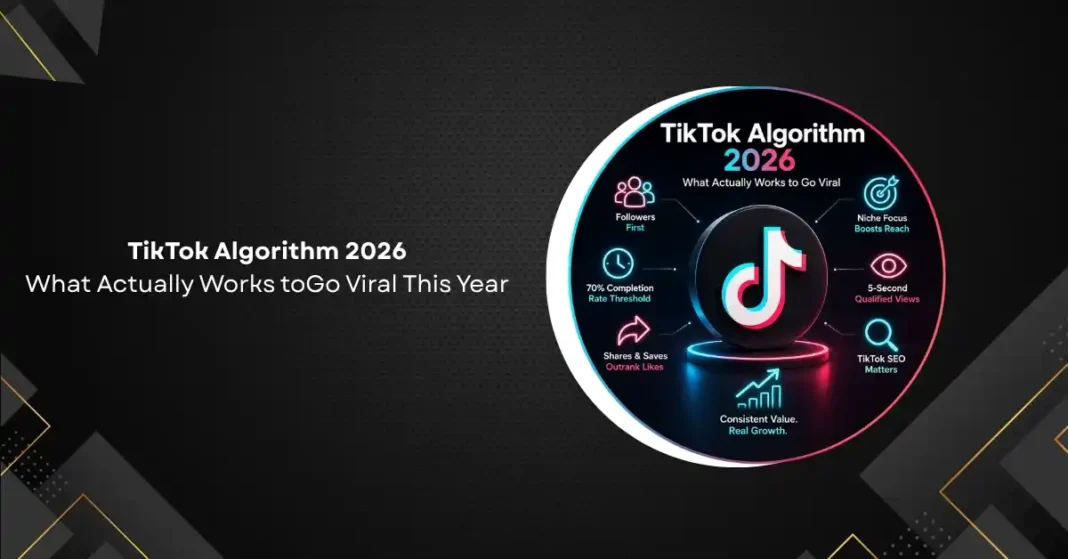
That changed. TikTok now shows your video to your existing followers first. If it performs well with them, it goes to a wider non-follower audience. If it does not, the video stays contained.
This has several implications. First, it means that follower quality now matters more than follower count. A small, engaged following is more valuable than a large, passive one because engaged followers are the ones who watch through, like, and share, which is what triggers the broader push. Second, it means the accounts with large followings built on viral moments but low regular engagement are now underperforming relative to accounts with smaller but more invested audiences.
Third, and most practically: if you have been treating your posting strategy as primarily aimed at non-followers (chasing trends, making content designed to be broadly relatable), you need to think about your existing audience first.
The Completion Rate Threshold Has Risen
For a video to get pushed to a broader non-follower audience in 2026, it needs to hit a completion rate of approximately 70 percent. That threshold was around 50 percent in 2024.
Completion rate means the percentage of viewers who watch the video all the way through. For a 60-second video, 70 percent completion means the average viewer watches at least 42 seconds. For a 30-second video, it means the average viewer watches at least 21 seconds.
The implication is that the first three seconds of your video are more critical than ever, and so is the middle section. Most creators focus heavily on the hook and neglect the point in the video where attention naturally drops off, usually around the 40 to 60 percent mark. That is where you need a re-engagement moment: a pattern interrupt, a new piece of information, a reveal, or a shift in pace.
If your completion rates are consistently below 70 percent and you want broader distribution, the problem is almost always one of two things. Either the hook over-promises something the video does not deliver, so viewers feel misled and drop off. Or the video loses its point after the first ten seconds and the middle section provides no reason to keep watching.
Shares and Saves Now Outrank Likes
In 2025, TikTok down-weighted likes as an algorithmic signal and elevated shares and saves. This shift became more pronounced in 2026.
The logic makes sense from TikTok’s perspective. A like takes one second and requires minimal genuine engagement. A share means someone found the content worth sending to another person. A save means someone wanted to return to it. Both signals suggest the content is genuinely useful or meaningful to the viewer, not just momentarily entertaining.
For creators, this changes what “good content” looks like. Content that gets shared tends to be: information someone wants to pass on to a specific friend (“this is literally your situation”), something funny or relatable that people use as a kind of social shorthand, or genuinely useful how-to content that viewers want to reference again.
Content that gets saved tends to be: educational content with practical steps, recipes or tutorials, reference information people will want to return to, and recommendation lists.
The question to ask when planning a video: will people want to send this to someone they know? That is now the single most valuable thing a TikTok video can do.
The Niche Penalty Is Real
Analysis by Socialync in early 2026 found that accounts posting across three or more unrelated topics suffer a 45 percent reach penalty. TikTok’s algorithm builds a content profile for each account, and that profile is what determines which users see your content in their For You pages.
An account that posts about coffee, personal finance, and workout routines confuses the profiling system. The algorithm cannot determine reliably which users would find any given video relevant, so it distributes more conservatively.
This does not mean every single video needs to be about the exact same topic. But the core theme of your account needs to be clear. If your account is about personal finance with an occasional coffee video, that is fine. If it is genuinely split three ways, you will see the reach effects.
The practical fix is to pick one to two closely related topics as your primary content area and treat everything else as occasional variations, not a second pillar.
The Qualified View Threshold
TikTok introduced the concept of “Qualified Views” as a key metric in 2026, which refers to views longer than five seconds. A video play that gets scrolled past in two seconds counts as a view in total view metrics but does not count as a Qualified View.
The algorithm uses Qualified Views to determine whether content is genuinely capturing attention or just getting auto-played. If your video has high total views but low Qualified Views, the system interprets this as a signal that the content is not engaging, even if the headline view number looks acceptable.
This means the five-second mark is a new critical threshold alongside the three-second mark. Your hook needs to work within the first 1.7 seconds (the point at which users make a stay-or-scroll decision). But you also need something in seconds three to five that converts an initial stay into a genuine watch. These are two different creative problems.
What Consistently Works in 2026
The edutainment formula is the most reliable path to virality on TikTok in 2026. Videos that deliver useful information in an entertaining format consistently outperform pure entertainment (which requires higher production value) and pure education (which typically suffers from lower completion rates).
The structure that works: lead with a surprising statement or counterintuitive claim (the hook), deliver the explanation or proof in a way that is fast-paced and clear, close with a practical takeaway or memorable line.
This structure works because it creates completion motivation. Once someone is curious about the claim in the first three seconds, they watch through to see if the explanation lives up to it. If the explanation is genuinely useful, they save or share.
Original audio continues to outperform trending sounds for accounts focused on sustained growth. TikTok rewards original sounds, and building an original sound that other creators use is a virality lever that has compounding effects. That said, for accounts just starting out, using trending sounds in the first few seconds (before switching to original audio or voiceover) can help with early algorithmic visibility.
TikTok SEO has become meaningful in 2026. The platform now scans keywords in captions, on-screen text, and spoken audio when categorizing content for search results. Forty percent of Gen Z now prefer TikTok over Google for search on lifestyle and product-related queries. Including the specific phrase someone would search for in your caption and on-screen text is now a distribution lever as much as a discovery one.
Series content compounds over time. Multi-part videos where each installment leaves a clear reason to check the next one build following more reliably than individual videos chasing virality. Part 1 brings viewers. Parts 2 through 5 convert them to followers.
What Does Not Work Anymore
Posting at high frequency does not help, and may hurt. TikTok’s data shows that posting five or more times per day increases shadowban risk. The accounts seeing the strongest growth in 2026 are posting one to three times per day with consistent quality, not flooding the feed.
Reposting content from other platforms with visible watermarks still reduces distribution. This has been true for a while, but the penalty is steeper in 2026.
Chasing individual virality without an existing engaged audience is a less reliable strategy than it was in 2022. The followers-first distribution model means a viral video on an account with zero engaged followers often fails to expand because there is no initial audience to trigger the broader push. Building a small engaged following before trying to go viral is now the smarter sequence.
Using engagement bait (“comment X if you agree”) in ways that feel manipulative is consistently flagged and reduces distribution. TikTok’s system has become better at identifying low-quality engagement signals versus genuine ones.
The Honest Expectation
Virality on TikTok in 2026 is harder than it was in 2022 and easier than most creators think. The platform still pushes zero-follower accounts to large audiences when the content is genuinely strong. The case of a small business getting 50,000 followers from a single well-crafted video still happens regularly.
What has changed is the consistency requirement. The accounts building durable growth are not the ones making one great video. They are the ones making consistently good videos at a regular cadence, on a clear topic, optimized for completion and sharing rather than likes.
Going viral is useful. Building a following that expects and engages with your content is more valuable. The TikTok algorithm in 2026 rewards the second more reliably than the first.