On May 12, 2026, exactly fifteen years and one day after the first Chromebook shipped, Google announced that its decade-old operating system is being replaced. The new platform, developed under the internal codename Aluminium, is built from the ground up on Android, with Gemini AI embedded at every level. It is the most ambitious operating system bet Google has made since Android itself, and it raises a fundamental question: is Google finally unifying its fragmented software strategy into one coherent platform?
What Is Aluminium OS?
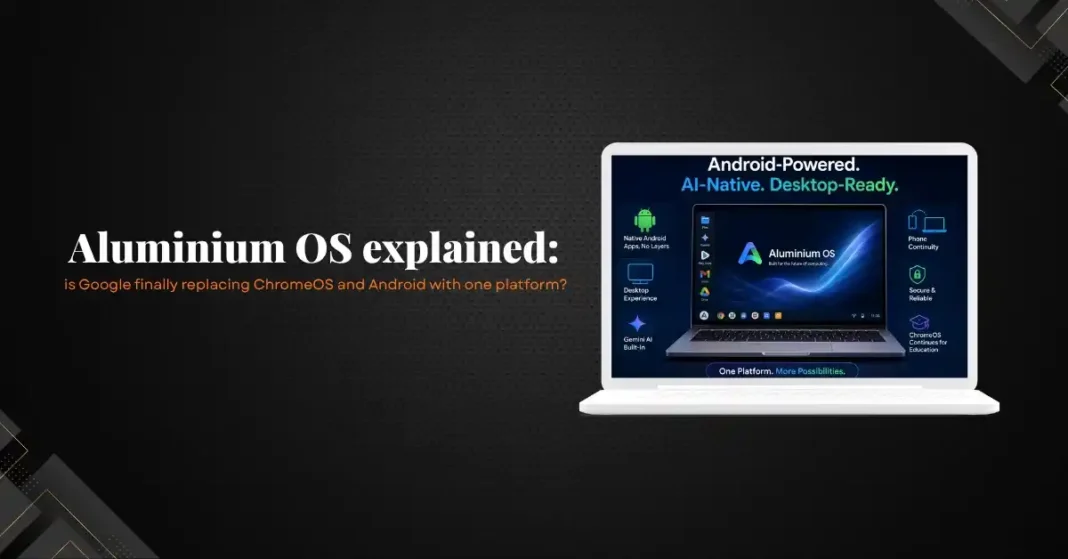
Aluminium OS is an Android 17-based desktop operating system designed specifically for laptops and desktop computers. It replaces ChromeOS for consumer devices, bringing a platform that runs native Android apps, supports a traditional desktop interface with a taskbar and virtual desktops, and has Gemini AI integrated into every layer of the system.
The company has clarified that Aluminium is a development codename and that the final product name will be unveiled later in 2026. Regardless of what it ends up being called, the platform represents a fundamental architectural shift. Previous attempts to run Android apps on Chromebooks used ARC, the App Runtime for Chrome, a compatibility layer that created friction and performance limitations. Aluminium OS eliminates that translation layer entirely. Android apps run natively, without containers or emulation.
What Happens to ChromeOS?
ChromeOS is not being killed, but it is being repositioned. Google has been explicit that ChromeOS will continue for enterprise and education users, where its management capabilities, security model, centralised administration through Google Admin Console, and browser-first approach remain highly valued. Chromebooks have been enormously successful in schools, and that market is not going anywhere.
ChromeOS Flex, the version that runs on non-Google hardware for organisations that want to extend the life of existing PCs, will also continue to be supported. What is changing is the consumer story. For personal laptops sold under the Googlebook brand, Aluminium OS is the future. The Chromebook brand for consumer devices is being retired.
What Is Different About Aluminium OS?
Native Android Apps Without a Compatibility Layer
The most significant technical difference from ChromeOS is the elimination of the translation layer. When Google first tried to run Android apps on Chromebooks through the Play Store, the experience was inconsistent because apps were being run inside a container designed for a different platform. Aluminium OS runs Android apps natively because the OS is Android, adapted for desktop hardware with keyboards, trackpads, and external displays.
Desktop Interface
Aluminium OS provides a proper desktop computing environment with a taskbar, multiple virtual desktops, windowed app management, and file system access that matches what users expect from a PC operating system. This is a meaningful departure from ChromeOS’s browser-centric model and addresses one of the main criticisms of Chromebooks: that they are limited to web apps and cannot replace a proper computer for demanding work.
Gemini Intelligence at Every Level
Gemini AI is not a feature added on top of Aluminium OS; it is part of the operating system’s architecture. This means the AI has access to context across apps, files, and system functions in a way that a browser-based AI assistant cannot. It can understand what you are working on across applications, suggest actions based on your current task, and integrate with Google services at a depth that goes beyond what is possible with a plugin or extension.
Phone Continuity
Because both Aluminium OS and Android 17 share the same codebase, the integration between a Googlebook laptop and an Android phone is significantly tighter than what ChromeOS could achieve. Files sync seamlessly, apps can be cast between devices, and the phone and laptop understand each other as part of the same ecosystem in a way that has historically been a strength of Apple but a weakness of Google.
Why Is Google Doing This Now?
The timing reflects several converging pressures. The desktop computing market is moving toward local AI processing, richer app ecosystems, and tighter phone-to-PC continuity. An operating system built on Android gives Google a faster path to that future than continuing to maintain ChromeOS as a separate codebase.
Platform consolidation is also a major driver. Today, Google maintains Android for phones, tablets, televisions, cars, watches, and foldables, while ChromeOS sits beside it with its own update model, Linux container support, Android app compatibility layer, and enterprise tooling. That split creates duplicated engineering effort and uncertainty for developers trying to build across both platforms. Merging them into one core simplifies everything.
The chromebook market is also growing substantially, projected to expand from around 14.7 billion dollars in 2025 to 42.85 billion dollars by 2034. Having a unified, more capable platform positions Google to capture a larger share of that growth, particularly at the premium end of the market where it has historically been absent.
What Do Critics Say?
Not everyone is convinced. Leaked footage of Aluminium OS from May 13, 2026, attracted significant commentary online, with some observers noting that many of Google’s own apps were not yet properly built for the desktop environment and appeared to be running as websites inside windows. One widely circulated post described it as resembling Samsung DeX, Samsung’s own Android-on-desktop feature that has existed for years without becoming mainstream.
The challenge for Google is the same one that has faced every attempt to bring a phone operating system to the desktop: apps designed for touch screens on small displays do not automatically become great desktop apps. Google will need its developer ecosystem to build Aluminium-native experiences if the platform is to fulfil its potential, and that takes time.
Who Should Pay Attention?
For Android users who want a laptop that genuinely integrates with their phone, Aluminium OS and the Googlebook are worth watching closely. The architecture is right, the ambition is clear, and the timing aligns with a genuine market shift toward AI-native computing. The question is execution.
For enterprise IT departments, the answer is simpler: ChromeOS continues, the management tools continue, and the Google Admin Console remains the same. There is no reason to consider migrating enterprise fleets to Aluminium OS in the near term, and Google has been clear it does not expect them to.
For educators and schools, the same logic applies. Chromebooks have won in education because of their security, simplicity, and cost. Aluminium OS is a premium consumer product that does not address the specific needs of a classroom.
Frequently Asked Questions
Is Aluminium OS available now?
Aluminium OS is not yet publicly available. The first consumer devices running the platform are expected to launch in autumn 2026 as Googlebook hardware.
Will Aluminium OS replace Android on phones?
No. Aluminium OS is a desktop operating system for laptops and desktop computers. Android continues on phones, tablets, and other mobile devices. Aluminium OS is built on the same Android foundation but is adapted specifically for the desktop form factor.
Can existing Chromebooks upgrade to Aluminium OS?
Google has indicated that many existing Chromebooks will be able to run the new operating system. Full compatibility details and upgrade paths are expected ahead of the autumn 2026 launch.
Is Aluminium OS the same as Android for desktop?
Aluminium OS is built on Android 17 but is not just Android running on a laptop screen. It includes a purpose-built desktop shell with a taskbar, windowed app management, virtual desktops, and deep Gemini AI integration. It is a distinct product experience designed for keyboard and trackpad input.
What happens to ChromeOS for schools?
ChromeOS continues for schools and enterprise customers. Google has been explicit that education deployments are not affected by the Aluminium OS transition. The Google Admin Console and all ChromeOS management tools remain fully supported.