Samsung’s Galaxy S26 Ultra arrived in March 2026 with one genuinely surprising new feature and a familiar story of incremental improvements elsewhere. The Privacy Display is the headline, and it is more impressive in practice than it sounded on paper. Whether that alone justifies upgrading from a Galaxy S25 Ultra or switching from an iPhone is a more complicated question. This review covers everything you need to know.
Galaxy S26 Ultra Specs Overview
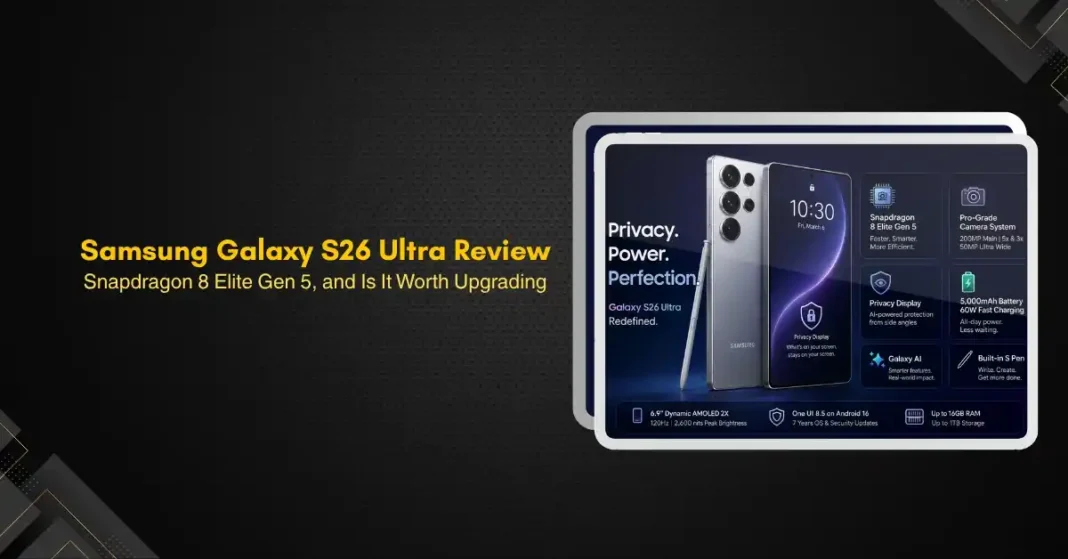
The Galaxy S26 Ultra ships with a 6.9-inch Dynamic LTPO AMOLED 2X display running at up to 120Hz, with a resolution of 1440 by 3120 pixels, delivering a pixel density of 500 pixels per inch. Peak brightness reaches 2,600 nits. The phone runs on the Qualcomm Snapdragon 8 Elite Gen 5 for Galaxy, built on a 3nm architecture, with memory configurations of 12GB RAM for 256GB and 512GB models and 16GB RAM for the 1TB version. Storage uses UFS 4.x technology. The battery remains at 5,000mAh as last year, but charging speed increases to 60 watts wired. The rear camera system includes a 200MP main sensor at f/1.4, a 50MP 5x telephoto at f/2.9, a 10MP 3x telephoto at f/2.4, and a 50MP ultrawide at f/1.9. The front camera is a 12MP shooter. Software ships as One UI 8.5 based on Android 16, with a commitment to seven major Android upgrades and seven years of security patches.
The Privacy Display: Samsung’s Boldest Innovation in Years
The Privacy Display is the feature that sets the S26 Ultra apart from every other smartphone on the market, and it represents a genuinely meaningful hardware innovation in an era when most flagship phones feel iterative.
The technology works by reducing screen visibility from the sides, meaning anyone looking at your screen from an angle sees significantly less than the person holding the phone directly. This is not a software filter or a screen protector trick. Samsung has integrated the privacy layer at the pixel level, using AI-powered display technology that can be toggled on through the settings or quick panel.
In practical terms, this is valuable any time you are handling sensitive information in a public space. Banking apps, passwords, private messages, and confidential work documents all become considerably harder for bystanders to read. The trade-off, noted in multiple independent reviews, is that enabling the full Privacy Display mode reduces screen brightness and can affect colour stability. For everyday use in public spaces, that trade-off is very much worth making. For media consumption alone at home, you would leave it switched off.
Snapdragon 8 Elite Gen 5 Performance
The Snapdragon 8 Elite Gen 5 for Galaxy delivers 39 percent faster AI processing, 24 percent better GPU performance, and 19 percent faster CPU speeds compared to last year’s chip. Built on a 3nm architecture, it is more power-efficient than its predecessor, which allows the phone to handle complex background tasks, run Privacy Display, and process AI features without significant thermal or battery penalties.
The NPU improvement is particularly relevant for Galaxy AI features. Tasks like Now Brief, Now Bar, real-time audio processing, and photo editing with AI all benefit from on-device processing that is faster and does not depend on a network connection. Samsung has redesigned the cooling system to ensure the chip can sustain peak performance during intensive workloads.
In day-to-day use, the S26 Ultra is predictably fast. Every app launches instantly, multitasking is seamless, and gaming performance is excellent. The honest assessment is that the S25 Ultra was also very fast, and the S26 Ultra is faster than something that was already more than sufficient. For most users, the chip upgrade alone is not a reason to upgrade.
Camera System
The camera hardware is largely unchanged from the S25 Ultra, but the new f/1.4 aperture on the main 200MP sensor makes a meaningful difference in low-light photography. Wider apertures let in more light, and the S26 Ultra’s main camera captures noticeably brighter, sharper images in challenging lighting conditions than its predecessor.
The 50MP 5x telephoto is one of the strongest zoom cameras in any smartphone, and the ultrawide at f/1.9 with dual pixel autofocus is excellent for architectural shots and group photos. Video performance is strong across all lenses, and the new Horizontal Lock feature, which stabilises footage even when recording while moving at a sharp angle, is one of the most practical additions to the camera suite. For anyone who records video while walking or in crowded environments, this alone is a significant quality-of-life improvement.
One UI 8.5 and Galaxy AI
The S26 Ultra ships with One UI 8.5, which introduced four new Galaxy AI features: Advanced Audio Eraser, Call Screening, Creative Studio, and an improved Photo Assist. These were initially exclusive to the S26 series before being rolled out to older Galaxy devices via the One UI 8.5 update.
Call Screening is the most genuinely useful new addition. The feature allows your phone to answer unknown calls on your behalf, ask the caller what they need, and present you with a live transcript so you can decide whether to pick up. For anyone who receives frequent spam or scam calls, this is an immediate quality-of-life improvement. Creative Studio allows users to generate AI images and stickers. Photo Assist lets you edit photos with text prompts, changing backgrounds, removing objects, and adjusting lighting through natural language rather than manual editing tools.
Advanced Audio Eraser has been upgraded in One UI 8.5 to function in real time during video playback on apps like Instagram, Netflix, and YouTube, allowing users to reduce background noise while watching, not just while editing recordings.
Design and Build Quality
The S26 Ultra is slightly lighter and thinner than the S25 Ultra, with a more rounded edge profile that makes it easier to hold despite its large 6.9-inch display. The frame is now aluminium rather than titanium, which has attracted criticism from some reviewers who feel it represents a downgrade in materials. Samsung would argue that the aluminium frame achieves the same structural integrity at a lower weight, which may be true, but the premium feel of titanium is difficult to replicate.
The built-in S Pen remains, providing note-taking and annotation functionality that no other Android competitor offers at this level. For productivity users, this remains one of the S Ultra line’s most compelling differentiators.
Battery Life and Charging
The 5,000mAh battery has not changed in capacity, but faster 60-watt wired charging means shorter time at the plug. Battery life in daily use is excellent, with most users reporting comfortable full-day performance with heavy use. The absence of Qi2 magnetic wireless charging is a notable omission given that the standard has been adopted broadly. Samsung’s wireless charging still works, but the lack of Qi2 means the magnetic accessory ecosystem available to iPhone users is not available here.
Who Should Upgrade?
If you are on an S23 Ultra or older, the S26 Ultra represents a genuinely meaningful upgrade across performance, camera, Privacy Display, and software support. The jump in AI processing capabilities and the practical utility of Call Screening and the Privacy Display are worth the investment.
If you are on an S24 Ultra, the case is weaker. The camera hardware is very similar, the performance difference is real but not dramatic for everyday tasks, and the Privacy Display, while impressive, may not justify the cost of upgrading a device you already own.
If you are on an S25 Ultra, the upgrade is very difficult to justify unless you specifically need the Privacy Display feature and cannot wait for Samsung to release a software approximation. The chip is faster, the camera aperture is wider, and the charging is quicker, but these are refinements, not transformations.
Frequently Asked Questions
What is the Samsung Galaxy S26 Ultra price?
The Galaxy S26 Ultra starts at 1,299 dollars for the 256GB model with 12GB RAM. The 512GB model and 1TB model with 16GB RAM carry higher prices. Samsung has not raised prices from the S25 Ultra generation, which is a positive development for consumers.
Does the S26 Ultra have a Privacy Display on all models or just Ultra?
The hardware-level Privacy Display is exclusive to the Galaxy S26 Ultra. The S26 and S26 Plus receive a software-only privacy masking layer through the One UI 8.5 update, which is less effective than the pixel-level hardware implementation on the Ultra.
What Android version does the S26 Ultra run?
The Galaxy S26 Ultra ships with Android 16 and One UI 8.5. Samsung has committed to seven major Android upgrades, meaning the device will receive updates through Android 23.
Does the S26 Ultra have MagSafe?
No. The Galaxy S26 Ultra does not support Qi2 or MagSafe wireless charging. Samsung’s wireless charging remains proprietary and is not compatible with the MagSafe accessory ecosystem.
How does the S26 Ultra compare to the iPhone 17 Pro Max?
Both are flagship smartphones with excellent cameras and processors. The S26 Ultra differentiates itself with the S Pen, Privacy Display, larger display, and Android flexibility. The iPhone 17 Pro Max offers tighter ecosystem integration, iOS exclusives, and the Apple silicon advantage. The right choice depends on your existing ecosystem and priorities.