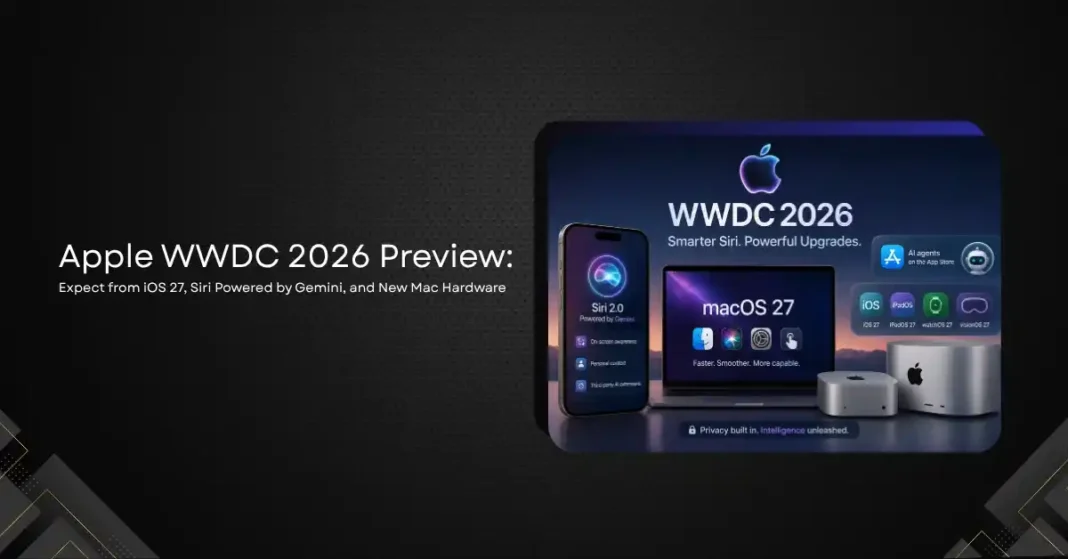
Apple’s Worldwide Developers Conference is scheduled for June 8 to 12, 2026, with the keynote at 10 a.m. Pacific Time. WWDC is Apple’s most important software event of the year, and in 2026 it carries more pressure than usual. The company needs to deliver on AI promises made at two previous WWDCs, transform Siri into a genuine intelligent assistant, and lay the groundwork for what could be a transformative product cycle. Here is everything expected at WWDC 2026.
The Biggest Story: Siri 2.0 and Gemini Integration
The most significant announcement expected at WWDC 2026 is a fundamentally rebuilt Siri powered by Google’s Gemini AI models. Apple and Google’s partnership on AI, which was hinted at throughout 2025, is expected to take centre stage at this year’s conference.
The rebuilt Siri is described as Siri 2.0 internally and has been in development for years. The core architecture combines Gemini’s cloud-based intelligence for complex queries with Apple’s Private Cloud Compute for privacy-sensitive tasks, and on-device processing for instant responses that do not leave the device at all. This three-layer approach is how Apple reconciles the power of frontier AI models with its longstanding privacy commitments.
In practice, Siri 2.0 is expected to function much more like ChatGPT or the Gemini app than the current Siri, which has long been criticised for failing basic queries that more capable AI assistants handle with ease. On-screen awareness, which would allow Siri to understand and act on whatever is displayed on the device at any moment, is one of the most anticipated features. Personal context understanding, where Siri can reference your emails, calendar, messages, and notes to give relevant answers, is another.
Apple is also expected to introduce Extensions, a framework that opens Siri to third-party AI chatbots. This would allow users to choose alternative AI models for specific tasks while staying within the Siri interface, a significant architectural shift that acknowledges no single AI model is best at everything.
iOS 27: A Snow Leopard Year
iOS 27 is shaping up to be what insiders are calling a “Snow Leopard year,” a reference to the Mac OS X 10.6 update in 2009 that focused entirely on performance, stability, and under-the-hood improvements rather than splashy new features. After iOS 26 introduced the controversial Liquid Glass design language, which received mixed feedback, iOS 27 is expected to refine rather than reinvent.
The exception to the refinement-focused strategy is Siri. The AI assistant overhaul is significant enough that it constitutes a major feature launch even in a year designed around stability. Additionally, iOS 27 is expected to include multitasking and UI frameworks for the long-rumoured iPhone Fold, giving developers two months to build foldable-optimised experiences before the hardware launches in September.
AirPods users will benefit from improved settings management within iOS 27, with a redesigned personal audio control interface. Satellite messaging features are also expected to see enhancements, building on the 5G satellite capabilities Apple has been developing.
macOS 27
The next major version of macOS, expected to be numbered 27 to match the iOS release, will focus on stability and performance improvements alongside the integration of Siri 2.0. macOS Tahoe was described as one of the most controversial Mac updates in recent years, making a clean-up and refinement cycle a sensible priority for the engineering team.
Touch support in macOS 27 is a rumoured but unconfirmed addition. With Apple developing its first touchscreen MacBook, the MacBook Ultra expected in early 2027, it would make sense to begin introducing touch-aware UI elements in the software well before that hardware launches. If touch support appears in macOS 27 previews, it would confirm the MacBook Ultra’s existence more firmly than any leak.
iPadOS 27, watchOS 27, and visionOS 27
All of Apple’s platforms will receive new versions at WWDC, following the same refinement and AI integration theme. iPadOS 27 is expected to align more closely with iOS and macOS, particularly around AI features and app behaviour. The same Siri 2.0 capabilities previewed on iPhone will appear on iPad, and the Extensions framework for third-party AI chatbots will be available across all platforms.
watchOS 27 is expected to be incremental, featuring new watch face designs including a variation of the Modular Ultra design and improvements to health and fitness tracking. visionOS 27 will continue building the software foundation for spatial computing, with developer tools for new mixed reality experiences.
Mac Hardware at WWDC 2026
Hardware announcements at WWDC are not guaranteed but are historically possible, and 2026 offers genuine candidates. The Mac mini and Mac Studio, both powered by M4 chips, are overdue for an M5 upgrade. Developer-favourite machines, they receive significant attention at the conference each year.
The M5 chip features Neural Accelerators in each GPU core, delivering 3.5 times faster AI performance, 30 percent faster graphics, and 30 percent higher memory bandwidth compared to M4. An M5 Mac mini would be a significant performance upgrade for developers and video producers who use the machine as a workhorse rather than a portable device. The Mac Studio M5 Ultra, combining two M5 Max dies, would represent the most powerful desktop Apple has sold outside of the Mac Pro.
The MacBook Ultra, Apple’s first MacBook with a touchscreen and OLED display, has been postponed to early 2027, meaning it will not appear at WWDC 2026. However, software groundwork for touch support may be visible in the macOS 27 preview.
The Stakes for Apple
Apple is under genuine competitive pressure in the AI space. ChatGPT, Claude, and Gemini have each demonstrated AI capabilities that surpass what Siri currently offers. The Samsung Galaxy S26 Ultra with Perplexity AI already delivers the kind of conversational task automation that Apple promised for Siri two years ago. Android users with Gemini can place restaurant orders through DoorDash by voice, something Siri cannot do reliably.
WWDC 2026 is being described as a make-or-break moment for Siri. After two consecutive WWDCs where Apple previewed intelligent Siri features that did not materialise on schedule, developers and consumers need to see actual, working software this June, not future promises. The Gemini partnership gives Apple access to a frontier AI model that it could not have built internally in the required timeframe, and using it openly, rather than building a compromise solution, is being read as a sign that the company understands what is at stake.
It is also worth noting that WWDC 2026 may be the last conference chaired by Tim Cook. Reports suggest Cook will hand leadership to hardware chief John Ternus in September 2026, making the keynote a significant personal milestone for the CEO who transformed Apple into the most valuable company in the world over fifteen years.
Frequently Asked Questions
When is WWDC 2026?
WWDC 2026 runs from June 8 to 12, 2026. The keynote presentation, where Apple reveals its new operating systems and any hardware announcements, is scheduled for Monday June 8 at 10 a.m. Pacific Time and will be streamed free globally on apple.com and the Apple TV app.
Will iOS 27 be a major update?
iOS 27 is expected to focus on stability and refinement rather than sweeping visual changes, following the Liquid Glass redesign in iOS 26. The major additions are Siri 2.0 powered by Gemini, the Extensions framework for third-party AI chatbots, and multitasking APIs for the iPhone Fold.
Is Siri getting Gemini in iOS 27?
Multiple credible reports indicate that Siri 2.0 will be powered in part by Google’s Gemini models for complex queries, combined with Apple’s Private Cloud Compute and on-device processing for privacy-sensitive tasks. Official confirmation is expected at the WWDC 2026 keynote on June 8.
Will new Mac hardware be announced at WWDC 2026?
New M5-powered Mac mini and Mac Studio models are the most likely hardware additions. The MacBook Ultra with a touchscreen OLED display has been postponed to early 2027 and will not appear at WWDC.
What is the App Store AI agents feature expected at WWDC 2026?
Apple is expected to open the App Store to AI agents, allowing third-party developers to build autonomous AI apps that can take actions across the device on behalf of users. This would create an ecosystem of specialised AI tools operating within Apple’s security and privacy frameworks.