
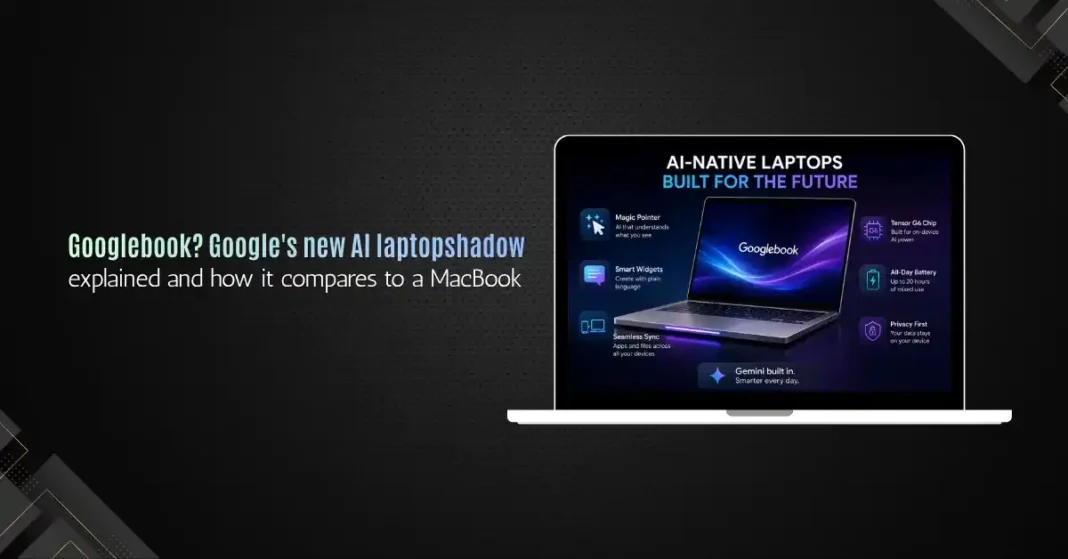
Google has officially entered the premium laptop market with Googlebook, a brand-new category of AI-native laptops announced on May 12, 2026, at The Android Show. Unlike anything the company has built before, the Googlebook is not a Chromebook with a coat of fresh paint. It is a full rethinking of what a laptop should do in an age where artificial intelligence has become the most important feature a device can offer.
What Is Googlebook?
Googlebook is Google’s new line of premium AI-first laptops designed to run Gemini Intelligence at their core. Announced by Alex Kuscher, Google’s Senior Director of Laptops and Tablets, the device embodies a philosophy the company has summarised in five words: “Intelligence is the new spec.” The name Googlebook is a deliberate departure from Chromebook, signalling that this is not a cloud-only, browser-centric machine but a full-featured AI powerhouse.
Where older laptops competed on CPU benchmark scores, RAM configurations, and display resolution, the Googlebook’s primary selling point is the depth of its AI integration. Every major feature on the device, from the cursor to the widget system to the file-sharing capabilities, has been designed around Gemini from the ground up, not added as an afterthought.
Key Features of the Googlebook
Magic Pointer
One of the standout hardware and software innovations is the Magic Pointer. This feature allows the cursor to act as an intelligent assistant. By pointing at anything on the screen, users can trigger contextual AI suggestions, complete tasks faster, and interact with content without needing to type queries into a separate search box. It is, in essence, a pointer that understands what you are looking at and what you might need next.
Natural Language Widget Creation
Googlebook allows users to create custom widgets using plain language Gemini prompts. Instead of digging through menus to configure a productivity dashboard, a user can simply describe what they want, and the device builds it. Gemini can search the web, connect with Google apps like Gmail and Calendar, and generate a personalised dashboard on demand. This makes the Googlebook feel more like a collaborative tool than a traditional computer.
Cross-Device App Casting and File Sync
The Googlebook is designed to work seamlessly alongside Android phones running Android 17 or above. Files sync automatically between devices, and apps can be cast between the phone and the laptop without friction. This kind of continuity, which Apple users have enjoyed between iPhone and Mac for years, is now a core promise of the Googlebook ecosystem.
Glowbar Design
Google has also introduced a signature hardware element called the Glowbar, a unique visual design feature that runs along the chassis and serves both an aesthetic and functional purpose. The specific partner devices will carry this design language, giving Googlebook a recognisable identity in a crowded market.
On-Device AI Processing
Reports suggest the Googlebook will use a custom Tensor G6 processor featuring a next-generation Neural Processing Unit built specifically for local AI execution. This means Gemini Nano and optimised versions of Gemini Pro can run entirely on the device, without relying on a cloud connection. Early estimates put the battery life at around 20 hours of mixed usage, making it viable for full working days away from a charger.
How Does Googlebook Compare to a MacBook?
The comparison to Apple’s MacBook is inevitable. Apple has spent years refining the integration between its hardware and software, and the MacBook Pro and MacBook Air remain the gold standard for premium laptops. Here is how the Googlebook stacks up across the areas that matter most.
AI Integration
This is where the Googlebook makes its strongest claim. While Apple Intelligence has been steadily improving since its 2024 introduction, it remains a set of features layered onto macOS rather than the operating system itself. The Googlebook has been built from day one around an AI model. Gemini is not a feature; it is the operating principle of the machine. Apple’s comparable offering, which is expected to get a significant boost through its Google Gemini partnership at WWDC 2026, still treats AI as a supplement to traditional computing workflows.
Ecosystem
Apple’s ecosystem is arguably the strongest in consumer tech. The integration between iPhone, Mac, iPad, Apple Watch, and AirPods creates a seamless experience that is difficult to replicate. Google is attempting to close this gap with the Googlebook’s deep Android integration, but Android users will need to be running Android 17 or above to access the most advanced cross-device features. For existing Android users, this could be a genuine selling point. For iPhone users, it adds nothing.
Hardware Chips
Apple’s M-series chips remain among the most efficient and powerful laptop processors available. The M4 and M5 MacBooks deliver industry-leading performance-per-watt numbers that have not been matched by any x86 or ARM Windows device. Google’s Tensor G6 is promising, but detailed benchmark data is not yet available. The Googlebook will also be available with Intel, AMD, and Qualcomm processors across its hardware partner lineup, which could mean more variety but less consistency than Apple’s tightly controlled chip roadmap.
Price
Apple’s MacBook Neo, launched earlier in 2026, starts at 599 dollars, making it the most affordable Mac laptop to date. Google has described the Googlebook as a premium device, which suggests pricing will be competitive with mid-to-high-end MacBooks rather than positioned as a budget alternative. Whether Google can justify that price against the depth of Apple’s ecosystem will be a key question when the first Googlebook devices arrive in autumn 2026.
What About ChromeOS?
The arrival of the Googlebook coincides with the retirement of ChromeOS for consumer devices. At the same event, Google announced Aluminium OS, an Android 17-based desktop operating system that replaces ChromeOS on the Googlebook hardware. ChromeOS is not being killed entirely. Google has confirmed it will continue to support ChromeOS for enterprise and education users, where its management capabilities, security model, and browser-first approach remain compelling. However, for consumer laptops, Aluminium OS and the Googlebook brand are the future.
When Is the Googlebook Available?
Google has confirmed a fall 2026 launch window for the first Googlebook devices. Hardware partners will include leading manufacturers, all featuring the signature Glowbar design and running Aluminium OS. Specific pricing, storage configurations, and display specifications have not yet been confirmed as of late May 2026, though more details are expected around the devices’ formal launch.
Should You Buy a Googlebook?
If you are an Android user who lives inside the Google ecosystem, uses Gmail, Google Calendar, Google Drive, and Google Meet daily, the Googlebook could be the most cohesive computing experience you have ever had. The tight integration between your Android phone and the Googlebook, combined with on-device Gemini AI that understands your apps and workflows, represents a genuinely new kind of laptop.
If you are an iPhone user, the appeal is considerably weaker. You would be buying into a device whose strongest features depend on Android integration, and you would be leaving behind the established Mac ecosystem without a clear replacement. For most iPhone users, the MacBook Neo or MacBook Air remains the more sensible choice.
If you are a Windows user who is already exploring alternatives, the Googlebook is worth watching. The combination of AI-native design, extended battery life estimates, and the open hardware ecosystem could make it a genuine contender by the time reviews arrive in autumn 2026.
Frequently Asked Questions
Is Googlebook replacing Chromebook?
Yes, for consumer devices. The Googlebook brand replaces Chromebook for premium consumer laptops, running Aluminium OS instead of ChromeOS. However, Google will continue supporting ChromeOS for schools and enterprise customers.
What operating system does Googlebook run?
Googlebook runs Aluminium OS, a new Android 17-based desktop operating system announced by Google at The Android Show on May 12, 2026. It is not ChromeOS, and it is not standard Android. It is a new desktop platform built specifically for laptops and Googlebook hardware.
Can you run Microsoft Office on a Googlebook?
Because Aluminium OS is based on Android 17, it can run Android versions of Office apps. Full desktop-class Microsoft 365 applications that require Windows or macOS would not be natively available, though web-based Office access through a browser remains an option.
How does Googlebook compare to the MacBook Neo?
Apple’s MacBook Neo starts at 599 dollars, is powered by the A18 Pro chip, and offers deep integration with the Apple ecosystem. The Googlebook is positioned as a premium product with AI-first design. For Android users, the Googlebook offers tighter AI integration. For Apple ecosystem users, the MacBook Neo offers a more mature and cohesive experience.
Will existing Chromebook users be able to upgrade to Aluminium OS?
Google has indicated that many existing Chromebooks will be able to update to the new operating system, though this will depend on the hardware specifications of individual devices. Full details on compatibility and upgrade paths are expected closer to the autumn 2026 launch.
Does the Googlebook require an internet connection for AI features?
The Tensor G6 processor is specifically designed for on-device AI processing, meaning core Gemini features can run without an internet connection. Some cloud-based Gemini capabilities, such as real-time web search and integration with cloud services, will still require connectivity.
)