Key Takeaways
- AI marketing tools in 2026 have moved past simple copywriting assistants into full workflow automation, agentic ad management, and predictive analytics.
- There’s no single “best” tool — the right pick depends on your biggest bottleneck: content, SEO, email, paid media, automation, or brand monitoring.
- This guide covers six standout tools, one per core marketing function, so you can build a focused stack instead of collecting subscriptions you’ll never fully use.
- Most small teams should start with one or two tools tied to their biggest time sink, not a dozen overlapping platforms.
Introduction
Marketing teams aren’t short on AI tools anymore. They’re drowning in them. Search “AI marketing tool” and you’ll find lists with 30, 40, even 50 entries, most of which do roughly the same three things with a different logo on top.
That’s the real problem in 2026: not finding an AI tool, but figuring out which six or seven actually deserve a seat in your stack. A lean, well-chosen toolkit consistently beats a sprawling one — fewer logins, fewer overlapping subscriptions, and a clearer sense of what’s actually driving results.
This guide picks one standout tool for each of the six functions that matter most to a modern marketing team: content creation, SEO optimization, email and lifecycle marketing, paid advertising, workflow automation, and brand/social monitoring.
How These Tools Were Chosen
Rather than ranking everything on a single scale, each tool here was selected as the strongest option within its specific job. The criteria:
- Real adoption — tools marketing teams are actually using in production, not just demoing.
- Clear use case — each tool solves one job well rather than promising to do everything.
- Reasonable cost-to-value — accessible to small and mid-sized teams, not just enterprise budgets.
- Staying power — platforms with consistent updates and a track record through 2025–2026, not a flash-in-the-pan launch.
1. ChatGPT / Claude — Best for Content Creation and Strategy
General-purpose AI assistants remain the backbone of most marketing workflows, and by 2026 they’ve become far more than chatbots. Marketers use them to draft blog posts and ad copy, build content briefs, summarize research, and increasingly, to power custom internal tools and automations through coding features like Claude Code or ChatGPT’s agent capabilities.
What makes it stand out: Flexibility. A single tool can draft an email sequence, debug a script, analyze a spreadsheet of campaign data, and turn a rough idea into a structured content calendar. Many marketers also connect these models to other apps (Google Drive, Webflow, ad platforms) using integration layers, letting the AI work directly inside an existing workflow instead of in a separate window.
Best for: Strategy, drafting, research synthesis, and increasingly, building lightweight internal tools without a developer.
Watch out for: Generic-sounding output if used without brand guidelines or examples. Pairing it with a documented style guide or “brand voice” instructions noticeably improves consistency.
2. Surfer SEO — Best for SEO Content Optimization
For teams whose growth depends on organic search, Surfer SEO remains one of the most reliable tools for turning a draft into something built to rank. It analyzes top-performing pages for a target keyword and gives writers a data-backed structure: word count ranges, headers to include, related terms competitors are using, and a content score that updates as you write.
What makes it stand out: It removes the guesswork from on-page optimization. Instead of debating whether an article is “thorough enough,” writers get a concrete checklist grounded in what’s currently ranking.
Best for: Teams running a content-led SEO strategy who need every article to hit a baseline level of topical coverage.
Watch out for: Optimization scores are a floor, not a ceiling — chasing a perfect score can produce mechanical, keyword-stuffed writing if the team isn’t careful to keep prose natural.
3. Klaviyo AI — Best for Email and SMS Marketing
For DTC and e-commerce brands especially, Klaviyo has become the default platform for AI-assisted email and SMS marketing. Its AI features handle subject line generation, send-time optimization, audience segmentation based on predicted behavior (like likelihood to churn or repurchase), and automated flow recommendations.
What makes it stand out: Deep integration with e-commerce data. Because Klaviyo plugs directly into store and purchase data, its AI recommendations are grounded in actual customer behavior rather than generic best practices.
Best for: E-commerce and DTC teams where email/SMS is a primary revenue channel.
Watch out for: It’s built around commerce data, so the value drops off for B2B or service-based businesses without a transactional backend.
4. Google Performance Max — Best for AI-Driven Paid Advertising
Google’s Performance Max (PMax) campaigns use AI to automatically test and serve ad creative across Search, Display, YouTube, Gmail, and Maps from a single campaign setup. The system continuously identifies which asset combinations perform best for a given audience and reallocates budget accordingly, with newer “AI Max for Search” capabilities extending this to understand real-time search intent rather than relying purely on keyword matching.
What makes it stand out: Scale and automation. Instead of manually managing bids and placements across five different ad surfaces, PMax handles asset testing and budget allocation continuously, in real time.
Best for: Teams with meaningful ad spend who want to reduce manual bid and placement management.
Watch out for: Less granular control and visibility than traditional campaign types — it’s a tradeoff of control for automation, and teams with very specific targeting needs may find it too much of a black box.
5. Gumloop — Best for Marketing Workflow Automation
Gumloop sits in the same category as Zapier but adds a native AI layer, letting marketers connect any large language model (ChatGPT, Claude, Gemini, and others) directly to internal tools and workflows without writing code. Think automatically routing inbound leads, summarizing meeting notes into CRM fields, or generating first-draft social posts the moment a blog goes live — all without manual handoffs.
What makes it stand out: It removes the API-key friction. Many automation platforms expect users to bring their own OpenAI or Anthropic accounts; Gumloop bundles model access directly into the platform, which lowers the barrier for non-technical marketers to build genuinely useful automations.
Best for: Lean teams looking to eliminate repetitive manual work — lead routing, reporting, content repurposing — without hiring a developer.
Watch out for: Like any automation tool, it’s only as good as the workflows you design. It takes some upfront thinking to map out where automation actually saves time versus adding complexity.
6. Brand24 — Best for AI-Powered Social Listening and Brand Monitoring
Brand24 scans news sites, social platforms, blogs, forums, and video content to track brand mentions in real time, then layers AI-driven sentiment analysis on top — distinguishing not just how often you’re mentioned, but how people actually feel about it, including sarcasm and regional slang across dozens of languages.
What makes it stand out: Speed and depth of sentiment detection. Beyond a simple mentions counter, it flags spikes in negative sentiment early enough for a team to respond before a small issue becomes a larger PR problem, and it can correlate mention spikes with ad or campaign performance to show which messaging is actually resonating.
Best for: Brand and PR-focused marketing teams, or any company managing reputation across multiple markets and languages.
Watch out for: It’s a monitoring and insight tool, not a content or campaign execution tool — pair it with one of the tools above rather than expecting it to replace your content or ad stack.
How to Build Your Stack (Without Overspending)
Most marketing teams don’t need all six of these at once. A practical way to prioritize:
- Identify your biggest bottleneck first. If content production is the constraint, start with a writing assistant and an SEO optimization tool. If it’s paid spend, start with automated ad management.
- Add one tool per function, not three. Overlapping tools that do 80% the same thing create subscription fatigue without adding proportional value.
- Budget realistically. For a small team (1–5 people), a combined AI tooling budget in the low hundreds of dollars per month is usually enough to cover one paid-media tool, one content tool, and a general-purpose AI assistant. Past that point, additional tools should be replacing manual work, not just adding another login.
- Revisit every quarter. This space moves fast — a tool that was the best option six months ago may have a stronger competitor today, and your bottleneck may have shifted too.
Frequently Asked Questions
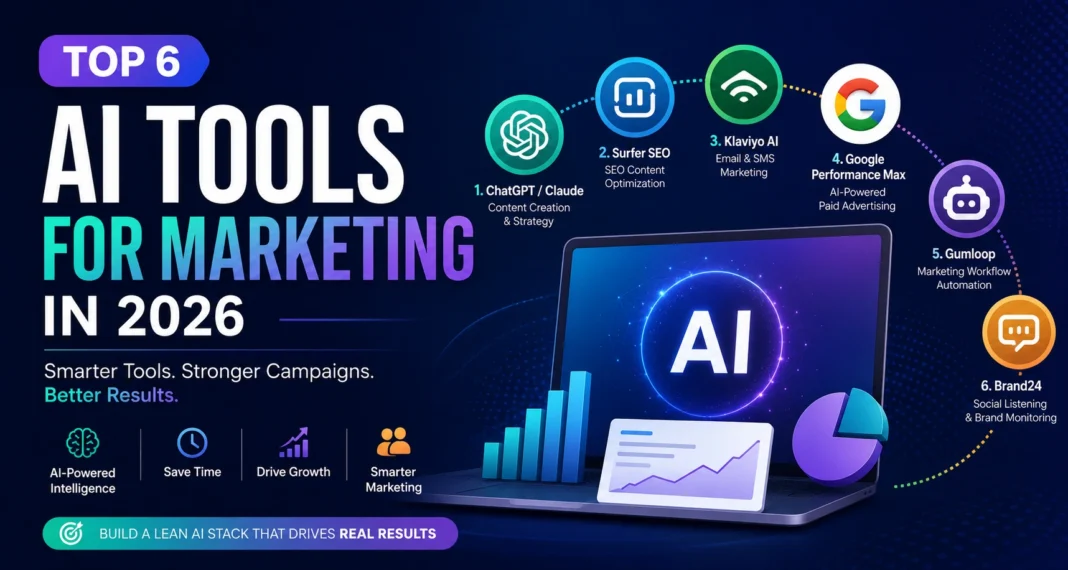
What is the best AI tool for marketing in 2026? There isn’t one universal “best” — the right tool depends on your primary bottleneck. ChatGPT/Claude is strongest for content and strategy, Surfer SEO for organic search optimization, Klaviyo AI for email/SMS, Google Performance Max for paid ads, Gumloop for workflow automation, and Brand24 for social listening.
Do I need all six of these tools? No. Most teams get the most value from two or three tools tied directly to their biggest constraint — for example, a content-heavy team might only need a writing assistant and an SEO tool.
Are AI marketing tools worth the cost for small teams? Generally yes, when scoped correctly. A modest monthly budget covering one or two well-matched tools typically replaces hours of manual work per week, but enterprise-tier tools are often overkill for teams under 5 people.
What’s the difference between an AI marketing tool and an AI marketing agent? Tools assist a marketer with suggestions — drafting copy, scoring emails, generating creative. Agents act more autonomously on the marketer’s behalf, such as launching campaigns or adjusting ad bids without manual approval at each step.
Is ChatGPT or Claude better for marketing? Both are strong general-purpose options; the better fit often comes down to workflow integration, team preference, and whether you need specific features like coding assistants or connected tools, rather than a clear capability gap for typical marketing tasks.
Can AI tools fully replace a marketing team? No. These tools are best understood as efficiency multipliers — they remove repetitive work and surface insights faster, but strategy, brand judgment, and creative direction still require human oversight.