Introduction
For years, ChatGPT was one of the few major consumer platforms with no ads at all. That changed on February 9, 2026, when OpenAI began testing sponsored placements inside ChatGPT for the first time.
If you’re a marketer, this matters more than a typical platform update. ChatGPT isn’t a feed you scroll — it’s where people go to actively research, compare, and decide. That means an ad shown there arrives at a genuinely different moment than a Google search ad or an Instagram promoted post: mid-conversation, right when someone is working through a decision.
This article walks through exactly how OpenAI Ads work today, who sees them, what it costs, and — most usefully — a step-by-step guide to setting up your own campaign in ChatGPT Ads Manager.
Key Takeaways
- OpenAI began testing ads in ChatGPT on February 9, 2026, starting in the U.S.
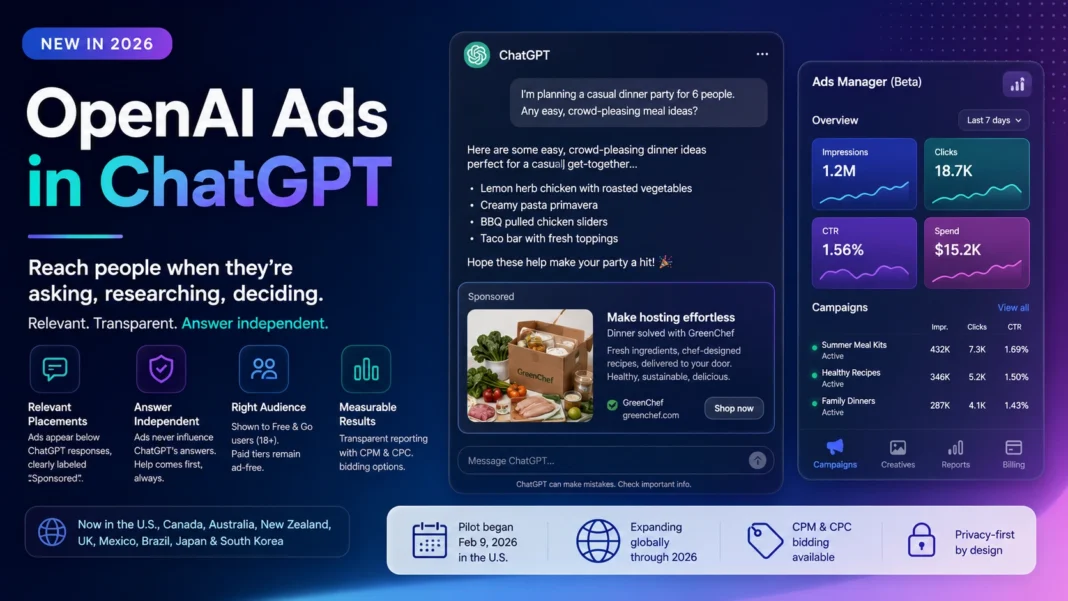
- Ads appear below ChatGPT’s response, clearly labeled “Sponsored” — never inside the answer itself.
- Only Free and Go tier users see ads. Plus, Pro, Business, Enterprise, and Edu users do not.
- OpenAI calls this principle “answer independence”: advertisers cannot pay to change what ChatGPT says.
- A self-serve Ads Manager opened in beta on May 5, 2026, supporting both CPM and CPC bidding.
- The pilot has expanded beyond the U.S. — first to Canada, Australia, and New Zealand (March 2026), then to the UK, Mexico, Brazil, Japan, and South Korea (May 2026).
- Ads are excluded from sensitive topics like health, mental health, and politics, and are not shown to users under 18.
How OpenAI Ads in ChatGPT Actually Work
The Ad Format
Ads show up as a distinct unit below a ChatGPT response — not woven into the answer text itself. OpenAI’s official example shows a user asking about potluck planning, with ChatGPT’s normal answer followed by a clearly labeled sponsored listing for a meal-kit brand, complete with product image, price, and a short description.
Answer Independence
This is the principle OpenAI has repeated across every official announcement: ChatGPT generates its answer first, based purely on what’s most helpful. Only afterward does a separate system decide whether a relevant ad should appear beneath it. Advertisers cannot buy their way into influencing the actual response text.
Who Sees Ads
- Eligible: Logged-in adult users on the Free and Go ($8/month) tiers.
- Not eligible: Plus, Pro, Business, Enterprise, and Education plan users — these tiers remain ad-free.
- Never shown to: accounts OpenAI identifies or predicts belong to users under 18.
- Not shown in: the ChatGPT Atlas browser, during this test phase.
How Ads Are Matched to Conversations
OpenAI matches ads primarily using the topic of your current conversation. If a user has personalization turned on, OpenAI may also factor in past chats and prior ad interactions. If multiple advertisers are eligible for a given conversation, the system selects the most relevant one to show first — OpenAI has described this as a relevance-weighted, second-price auction.
Category Restrictions
Ads are not eligible to appear near sensitive or regulated topics such as health, mental health, or politics. This is an explicit safeguard from OpenAI’s own policy, not a third-party guess.
Privacy Boundaries
Advertisers never see a user’s actual chats, chat history, memories, or personal details. They only receive aggregate performance data — impressions, clicks, spend, and similar metrics. If a user messages an advertiser directly through an ad (for example, to ask a product question), the advertiser only sees what the user chooses to send them directly.
Timeline: How the Rollout Has Progressed
| Date | Milestone |
|---|---|
| Feb 9, 2026 | Ads pilot begins in the U.S. for Free and Go tier users |
| Mar 26, 2026 | OpenAI reports positive early trust/relevance signals; announces expansion to Canada, Australia, New Zealand |
| May 5, 2026 | Beta self-serve Ads Manager launches with CPM and CPC bidding, plus a Conversions API and pixel-based measurement |
| May 7, 2026 | Pilot expands to the UK, Mexico, Brazil, Japan, and South Korea |
Each expansion has followed the same pattern: OpenAI monitors trust metrics and ad relevance in one market before opening the next.
How to Advertise on ChatGPT: Step-by-Step Guide
Requirements before you start:
- A registered business with a work email address
- Billing information ready to save to your account
- Creative assets (product images, titles, descriptions, landing page URLs)
- A clear sense of the conversational contexts where your product is relevant (this replaces traditional keyword lists)
Step 1: Register Your Interest
Visit openai.com/advertisers and submit your business information. Access has expanded in phases by market and advertiser type, so registering puts you in the pipeline even if you’re not immediately approved.
Step 2: Access Ads Manager
Once approved, go to ads.openai.com and sign in with the work email you registered with. This is the self-serve portal where you’ll manage everything — campaigns, budgets, creative, and reporting.
Step 3: Set Up Your Billing Profile
Add and save a billing profile. Your account needs an active billing profile before you can launch any campaign.
Step 4: Add Team Members (Optional)
If others on your team need access, use “Invite user” inside Ads Manager and assign roles (for example, Admin for full account and billing access).
Step 5: Define Your Campaign Objective and Bidding Model
Choose between:
- Reach campaigns — billed on a CPM (cost per thousand impressions) basis
- Clicks campaigns — billed on a CPC (cost per click) basis, charged only when someone clicks
For CPC campaigns, OpenAI’s own guidance recommends starting with a maximum bid in the $3–$5 range per click, though actual competitiveness will vary by category.
Step 6: Add Context Hints Instead of Keywords
At the ad-group level, describe the conversations, topics, or themes where your product should appear — not a list of search keywords. Think about the questions your buyers actually ask ChatGPT, not the terms they’d type into Google.
Step 7: Upload Creative
Add your product details — you can bulk upload via a feed or create ads directly in the tool. Make sure titles, descriptions, pricing, and images are accurate and complete, since the ad format pulls directly from this structured data.
Step 8: Set Up Conversion Measurement
Connect a measurement pixel or use the Conversions API for server-side attribution, so you can track what happens after someone clicks — a purchase, a sign-up, or another meaningful action.
Step 9: Launch and Monitor
Once live, Ads Manager reporting includes impressions, clicks, spend, click-through rate (CTR), average CPC, average CPM, and conversions. Check this regularly during the first weeks — early performance data is how you’ll refine your context hints and creative.
Best practice: Write ad copy that sounds native to a conversation, not like a traditional banner ad. OpenAI has indicated that overly aggressive, misleading, or visually jarring creative is more likely to be rejected or underperform in this format.
Troubleshooting tip: If your account shows no delivery, double-check that your context hints are specific enough — overly broad targeting can mean you’re competing against far more advertisers in the auction, and overly narrow targeting can mean too few eligible conversations to show ads at all.
Comparison: ChatGPT Ads vs. Google Ads vs. Meta Ads
| Factor | Google Ads | Meta Ads | ChatGPT Ads |
|---|---|---|---|
| User intent | Keyword-driven search intent | Interruptive feed discovery | Conversational, decision-oriented intent |
| Targeting unit | Keywords | Interests/demographics | Conversation context/topic |
| Ad placement | Above/beside search results | In-feed | Below the AI’s response |
| Bidding models | CPC, CPM, and more | CPC, CPM, and more | CPM and CPC (as of May 2026) |
| Self-serve access | Yes, long-established | Yes, long-established | Beta, opened May 2026 |
| Minimum spend | None | None | None confirmed publicly |
Who Should Consider Advertising Here (and Who Shouldn’t Yet)
Good fit:
- Brands selling products or services people actively research and compare (electronics, travel, meal kits, software)
- Businesses already running Google Ads or Meta campaigns looking to test an emerging, high-intent channel
- Teams that can produce native-feeling, informational ad copy rather than repurposed banner creative
Not a fit yet:
- Brands in health, mental health, or political categories — ads aren’t currently eligible near these topics
- Businesses without measurement infrastructure in place, since attribution data is still more limited than on mature ad platforms
- Teams expecting granular audience targeting comparable to Meta — ChatGPT Ads currently relies on conversational context, not detailed demographic targeting
Common Mistakes to Avoid
- Treating context hints like keyword lists. Copy-pasting your Google Ads keyword list won’t work well — think in terms of the conversations people have, not search phrases.
- Ignoring the answer independence boundary. Don’t expect to influence ChatGPT’s actual response — that’s explicitly not how this system works, and trying to game it isn’t possible by design.
- Using traditional banner-style creative. Ad copy that reads like a display ad will feel out of place in a conversational thread.
- Skipping conversion measurement setup. Without the pixel or Conversions API connected, you’ll be flying blind on what happens after the click.
- Assuming your category is eligible. If you’re in health, mental health, or political advertising, confirm eligibility before investing time in creative and setup.
What’s Next for OpenAI Ads
OpenAI has been explicit that this is still an early-stage pilot, not a mature ad platform. Watch for:
- Broader geographic rollout. OpenAI has said it expects to “continue to expand to many more markets this year,” beyond the countries already added.
- New bidding and buying models. OpenAI has stated it plans to support additional formats, objectives, and buying models over time — CPM and CPC are described as a starting point, not the final state.
- Expanded measurement. More detailed reporting is a stated priority, following the addition of the Conversions API and pixel tracking.
As with any early-stage ad platform, expect the rules, pricing dynamics, and available formats to keep shifting over the next several months.
Conclusion
OpenAI’s move into advertising is deliberately cautious — a phased, market-by-market rollout with hard boundaries around answer independence, privacy, and category eligibility. For brands, that caution is actually useful: it means the platform is still forming, and the businesses that learn the format now — native creative, conversational context targeting, proper measurement setup — will have a real head start once broader self-serve access opens more widely.
If you’re considering this channel, start by registering interest at openai.com/advertisers, and treat your first campaign as a learning exercise rather than a scaled bet.
FAQ
Q: When did OpenAI launch ads in ChatGPT? A: The pilot officially began on February 9, 2026, starting with Free and Go tier users in the U.S.
Q: Do Plus or Pro subscribers see ads? A: No. Plus, Pro, Business, Enterprise, and Education plan users do not see ads.
Q: Can advertisers influence what ChatGPT says in its answers? A: No. OpenAI’s “answer independence” principle means ChatGPT generates its response first; ads only appear as a separate, clearly labeled unit afterward.
Q: How do I sign up to advertise on ChatGPT? A: Register your business at openai.com/advertisers, then access the self-serve Ads Manager at ads.openai.com once approved.
Q: What bidding models are available? A: As of May 2026, both CPM (cost per thousand impressions) and CPC (cost per click) bidding are supported.
Q: Is there a minimum ad spend? A: OpenAI hasn’t publicly confirmed a required minimum spend for the self-serve Ads Manager.
Q: What targeting options exist instead of keywords? A: Advertisers provide “context hints” — descriptions of the conversations or topics where their product is relevant — rather than traditional keyword lists.
Q: Are there restricted ad categories? A: Yes. Ads are not eligible to appear near sensitive or regulated topics such as health, mental health, or politics.
Q: Can I track conversions from ChatGPT ads? A: Yes. OpenAI added a measurement pixel and a Conversions API in May 2026 for tracking post-click actions like purchases or sign-ups.
Q: Which countries currently have ChatGPT ads? A: The pilot started in the U.S., then expanded to Canada, Australia, and New Zealand, followed by the UK, Mexico, Brazil, Japan, and South Korea.
Q: Does OpenAI sell my conversation data to advertisers? A: No. OpenAI states it does not share individual conversations with advertisers and never sells user data; advertisers only receive aggregate performance metrics.
Q: Can users turn off ads or personalization? A: Free and Go users in the U.S. can manage ad controls, including personalization, through Settings, and can delete their ads data at any time.