Introduction
For fifteen years straight, the marketing technology industry did basically one thing: grow. New tools launched constantly, categories multiplied, and the running joke among marketers was that nobody could keep up with the number of new logos crowding the “martech landscape” chart every year.
That streak just ended.
According to new industry research, the number of commercial martech products grew by less than one percent this year, the smallest increase in the tool’s entire fifteen-year history of tracking the space. On the surface, that sounds like the industry is slowing down. Underneath the surface, something much more interesting is happening.
What you’ll learn:
- The actual numbers behind the martech slowdown
- Why “flat” doesn’t mean “quiet”
- What’s driving tools out of the market
- What this shift means for how you should think about your own stack
Key Takeaways
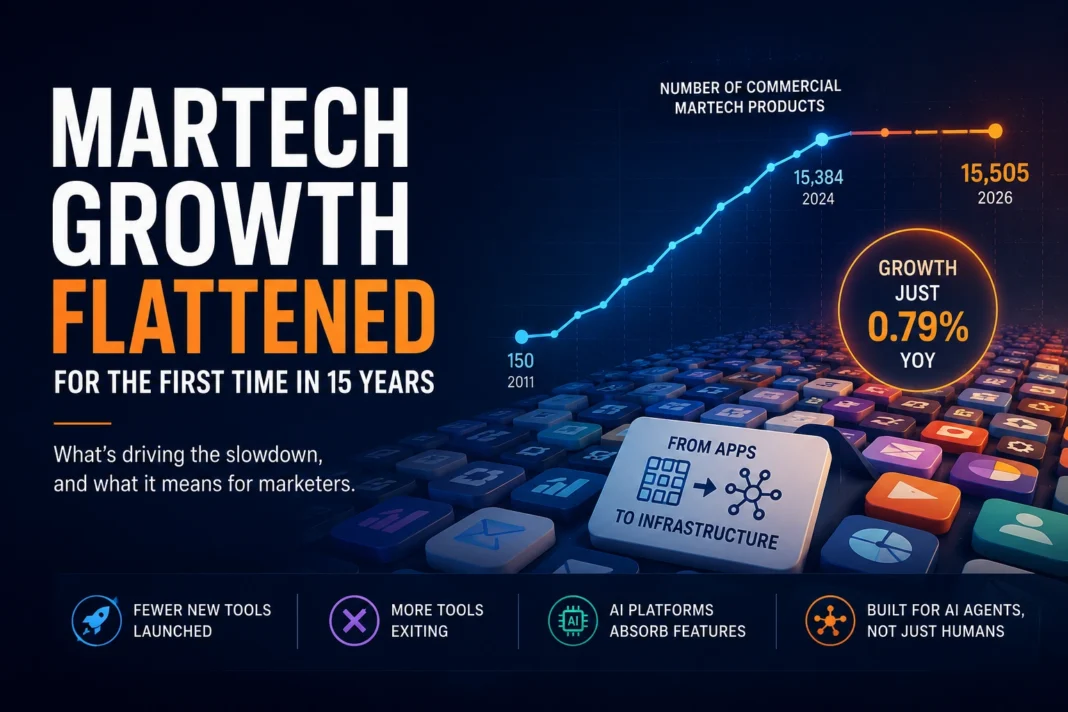
- The number of commercial martech products grew from 15,384 to 15,505 this year, a net increase of just 0.79%, the flattest growth on record.
- That flat number hides serious churn: nearly 1,500 new products launched while over 1,300 existing products were removed.
- New product launches dropped sharply, while the rate of products shutting down or getting acquired increased.
- Content marketing tools were hit hardest, largely because AI chat assistants and major software platforms absorbed much of that functionality directly.
- The bigger long-term shift is that martech is moving from being a collection of apps humans click through to infrastructure that AI agents operate.
The Numbers Behind the Slowdown
For a decade and a half, the martech landscape only moved one direction: up. It grew from around 150 tracked products in 2011 to more than 15,000 by last year, expanding faster almost every single year.
This year, that pattern broke. The total count grew from 15,384 to 15,505, an increase of just 121 products, or 0.79%. To put that in perspective, that’s the smallest year-over-year growth the industry has ever recorded.
At first glance, that might look like the martech boom is finally cooling off. It’s more accurate to say it’s changing shape.
Why “Flat” Doesn’t Mean “Quiet”
Here’s the part that gets missed when people only look at the headline number: underneath that near-zero net growth, there was enormous movement. Roughly 1,488 new products launched this year, while about 1,367 existing products were shut down, acquired, or otherwise removed from the market.
New product launches fell sharply, down about 40% from the prior year. At the same time, the rate of products leaving the market climbed by around 13%.
In plain terms: fewer new tools are being built, and more existing tools are dying or getting absorbed. The market isn’t calm, it’s consolidating.
Which Category Got Hit Hardest, and Why
Content marketing tools took the biggest single hit this year, losing more products than any other category. That’s a notable reversal, since content marketing was one of the fastest-growing categories in the two years right after generative AI first went mainstream.
The reason is fairly simple. Basic content generation, “write a blog post,” “turn this into a LinkedIn caption,” “repurpose this video into three short clips”, has become a standard feature inside major AI chat tools and productivity platforms. When a capability becomes table stakes inside tools people already use every day, the standalone products built around that single feature lose their reason to exist.
It’s the same pattern that’s played out in other tech categories before: a feature becomes a platform capability, and the specialist tools built around that one feature either evolve into something bigger or disappear.
The Bigger Shift: From Apps to Infrastructure
The most important trend hiding inside this data isn’t about any single category, it’s about how martech itself is being rebuilt.
For most of the last twenty years, martech was organized around applications that marketers personally used: log in, click through a dashboard, configure a workflow, launch a campaign, check the results. The interface was the product.
That’s starting to change as AI agents take on more of that day-to-day work. The important question shifts from “can a marketer use this app well?” to “can an AI agent safely and reliably access the right data, content, and permissions to take the right action at the right time?”
One of the clearest signals of this shift is the explosive growth of a technical standard that lets AI systems connect directly to different tools and data sources. There are now tens of thousands of these connections listed across various registries, built in a remarkably short window of time, evidence that the plumbing for an agent-driven martech world is being built quickly, even if most marketers haven’t noticed it happening.
Comparison: Old Martech Growth Pattern vs. New Pattern
| Aspect | 2011–2024 Pattern | 2025–2026 Pattern |
|---|---|---|
| Overall growth | Consistent, often double-digit | Nearly flat, under 1% |
| New product launches | Steadily increasing | Down roughly 40% year over year |
| Product removals | Relatively low and stable | Up roughly 13% year over year |
| Hardest-hit category | N/A (mostly growth everywhere) | Content marketing tools |
| Core organizing principle | Apps for humans to operate | Infrastructure for AI agents to use |
Benefits of Understanding This Shift
Main benefits: Better timing on renewal and consolidation decisions, less risk of investing heavily in a tool category that’s about to get absorbed by a bigger platform, and earlier positioning for the shift toward agent-friendly infrastructure.
Who should pay close attention: Marketing operations leaders managing renewal cycles, and anyone evaluating a new standalone point solution in a category that AI tools are rapidly encroaching on.
Who can watch from a distance for now: Very small teams with a lean stack and no immediate plans to expand tooling; the near-term impact on them is smaller.
Common Mistakes to Avoid
- Reading “flat growth” as “nothing is changing.” The churn underneath the flat number is the real story, and it’s significant.
- Investing heavily in a narrow point solution without checking if a major platform is about to absorb that feature. Content marketing tools are the clearest recent cautionary tale.
- Ignoring the infrastructure shift because it feels technical. Whether your tools can safely work with AI agents is quickly becoming a practical, not just technical, concern.
- Assuming consolidation only affects vendors, not buyers. Every acquisition or shutdown potentially disrupts a workflow your team depends on.
- Waiting for “the dust to settle” before adjusting strategy. Consolidation periods like this tend to reward companies that adapt stack decisions early.
Expert Tips
- When evaluating any new standalone martech tool, ask directly: “What happens to this product’s core feature if a major AI platform builds it natively next year?” If the answer is uncomfortable, factor that risk into your decision.
- Keep a simple internal list of every tool that’s a strong acquisition or shutdown candidate based on this year’s trend, and have a lightweight contingency plan for each.
- Start asking vendors whether their platform can be safely accessed by AI agents, not just by human users through a dashboard. That question is going to matter more every quarter.
What’s Next for the Martech Industry
Expect consolidation to continue, with more standalone tools getting folded into larger platforms rather than shutting down outright.
Expect content marketing tools to keep shrinking as a standalone category, while adjacent categories like campaign orchestration and customer data absorb more attention and investment.
Expect the conversation to shift further away from “which app should we buy” and toward “which infrastructure can our AI agents safely operate on,” a genuinely new kind of martech decision most teams haven’t had to make before.
Conclusion
Martech growth flattening for the first time in fifteen years isn’t a sign the industry is slowing down, it’s a sign the industry is reorganizing. Fewer new tools are launching, more existing tools are disappearing, and the reason in both cases is largely the same: AI capabilities are moving from standalone products into the platforms people already use every day.
The practical takeaway for marketers isn’t to panic about consolidation, it’s to get ahead of it. Look hard at any narrow, single-feature tool in your stack, and start asking whether your infrastructure is ready for a future where AI agents, not just people, are doing the clicking.
FAQ
Has martech growth actually stopped? Not entirely, but overall product count growth has flattened to under 1% this year, the smallest increase on record after fifteen years of consistent expansion.
How many martech products exist right now? Roughly 15,505 commercial martech products are currently tracked, up from 15,384 the prior year.
Why did martech growth slow down? New product launches dropped sharply while the number of tools being shut down or acquired increased, largely because AI platforms absorbed features that used to require separate standalone tools.
Which martech category shrank the most? Content marketing tools saw the largest net loss of products, mainly because major AI chat tools and productivity platforms built similar content generation features directly into their existing products.
Does flat martech growth mean the market is stable? No. Underneath the flat total, there’s significant churn, with nearly 1,500 new products launched and over 1,300 removed in the same period.
What does “martech infrastructure” mean? It refers to the shift of marketing technology value away from human-facing apps and dashboards and toward systems that AI agents can directly and safely access to complete tasks.
Should I worry about the tools in my current stack disappearing? It’s worth reviewing any narrow, single-feature tools in your stack, especially in categories where AI platforms are rapidly adding native capabilities.
Is AI responsible for the martech slowdown? Largely, yes. AI has both reduced the need for certain standalone tools and reshaped what companies expect their martech stack to be able to do.
What should marketers do in response to this shift? Review point solutions for consolidation risk, ask vendors about AI-agent compatibility, and avoid over-investing in narrow tools in categories AI platforms are quickly absorbing.
Will martech growth pick back up? It’s possible growth could resume in new categories built specifically for AI-agent infrastructure, even as older, human-facing app categories continue to shrink.