Something quietly significant happened in AI search over the past six months. LinkedIn went from being outside the top 20 most-cited sources on ChatGPT to ranking among the top five, and for professional queries it is now the number one most-cited domain across every major AI search platform. That includes ChatGPT, Google AI Overviews, Google AI Mode, Perplexity, Microsoft Copilot, and Gemini.
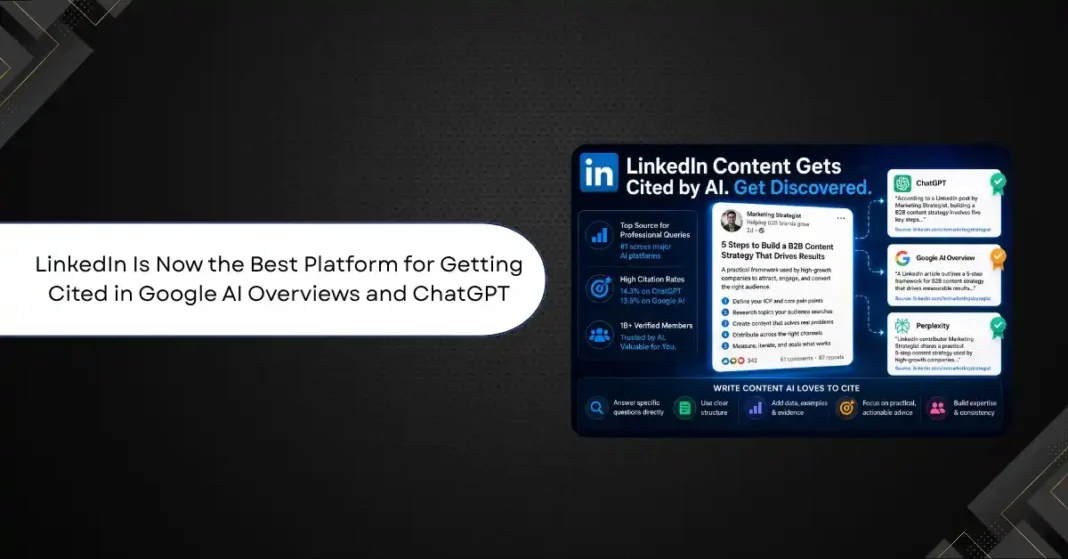
This is not a small shift. Profound’s analysis of 1.4 million citations called it the largest domain authority shift they had observed all year. Separately, Semrush analysed 325,000 unique prompts across major AI tools and identified 89,000 LinkedIn URLs being cited in AI-generated responses. LinkedIn appeared in 14.3 percent of ChatGPT responses, 13.5 percent of Google AI Mode responses, and 11 percent on average across all platforms. That puts LinkedIn ahead of Wikipedia, YouTube, and every major news publisher for the kinds of questions professionals actually ask AI tools.
If you have been treating LinkedIn as a place to network and post the occasional update, the data says you have been missing a much bigger opportunity. This article explains why LinkedIn has become so important for AI search, what kinds of content get cited, and exactly how to write LinkedIn posts and articles that AI tools want to pull from.
Why LinkedIn Suddenly Became So Important
It Is the Largest Verified Professional Knowledge Base
The rise of LinkedIn as a top AI citation source did not happen by accident. Three things came together to make it the obvious choice for AI tools answering professional questions.
LinkedIn has over one billion members, the majority verified through their employers, with detailed profiles, work histories, and topic expertise. When an AI tool needs to answer a question about business, technology, careers, marketing, or finance, it needs sources that look credible. A blog post from an unknown writer is hard to trust. A LinkedIn post from a verified product manager at a known company is much easier to trust. The AI models have learned this and now lean on LinkedIn heavily for professional topics.
The Content Format Matches How AI Searches
AI tools cite content they can parse cleanly. Structured posts with clear answers, headlines, and supporting context work much better than meandering articles. LinkedIn long-form posts and articles tend to be well-structured by their nature. People write to be read by busy professionals, which means clear opening lines, short paragraphs, organised arguments, and direct conclusions. This is exactly the format AI retrieval systems can extract from cleanly.
Research shows ChatGPT cites only about 15 percent of the pages it retrieves, favouring content with clear H1, H2, and H3 structure, direct answers, FAQ-style formatting, and claims that are clearly stated. LinkedIn content tends to score well on these dimensions almost automatically.
Recent and Updated Content
AI tools prefer recent content for queries about trends, tools, and current best practices. Most websites publish a blog post and forget about it. LinkedIn is a continuous stream of fresh perspectives on whatever topics professionals are discussing right now. For questions about the latest trends in AI marketing, the current state of remote work, or the best tools for sales teams, LinkedIn has much more recent and relevant content than most static websites.
Aggregated Authority Through the Platform
LinkedIn as a domain has accumulated massive authority signals. The platform ranks well in traditional search, has been around for over two decades, and is widely trusted. When AI tools weight sources by trust, LinkedIn benefits even if individual posts on the platform are written by people the AI has never heard of. The platform borrows credibility for its members, which is a powerful structural advantage.
What Kinds of LinkedIn Content Get Cited
Not all LinkedIn content has equal pull with AI tools. The research on what actually gets cited is consistent across multiple studies.
Long-Form Articles and Long Posts
LinkedIn long-form articles, in the 500 to 2,000 word range, make up the bulk of AI citations. Shorter posts contribute too, but the long-form pieces do the heavy lifting. The reason is that long-form content has room to make arguments, provide context, and back up claims with evidence, which is exactly what AI tools look for when they need to cite a source.
Practical, Actionable Advice
Content that shares specific, practical advice gets cited most. Posts that explain how to do something, how a process actually works, or what specific tactics produced specific results are pure gold for AI tools. Generic motivational content, vague leadership advice, and brand-promotion posts do not get cited.
The pattern is clear when you look at what kinds of queries LinkedIn shows up for. Questions like how to write a cold email that gets replies, what the best tools are for managing remote teams, or how to structure a B2B SaaS pricing page all pull heavily from LinkedIn answers. The content that ranks for these queries is concrete, specific, and useful.
Expert Voice With Real Experience
Posts from people with verifiable expertise in the topic they are writing about get cited more often than posts from people writing outside their area. The AI tools are not directly evaluating expertise, but they are picking up signals from engagement quality, profile information, and topical consistency that correlate with expertise. Someone who has been posting consistently about B2B sales for three years and works in B2B sales is a better citation than a brand new account writing on the same topic.
Notably, virality is not the main factor. Some of the most-cited LinkedIn content has modest engagement, with a few hundred reactions and a quiet comment section. The platform’s algorithm and the AI tools’ citation algorithm are not the same. Content that the platform’s algorithm thinks is engaging is not always the content AI tools find most useful, and vice versa.
Specific Claims With Specific Numbers
AI tools heavily favour content that includes specific data points, percentages, dates, and named sources. A post that says we tested this approach across 200 sales emails and improved reply rates by 34 percent will get cited more often than a post that says this approach works well. Numbers signal credibility and give the AI something concrete to quote in its answer.
The Strategy: Writing LinkedIn Content That Gets Cited
If you want your LinkedIn content to show up in AI answers in 2026, here is the practical approach that is working for professionals and brands.
Pick Specific, Searchable Topics
Write about topics that people actually ask AI tools about. The way to figure this out is to think about the questions your customers, peers, and target audience are likely typing into ChatGPT or Perplexity. How do I evaluate a B2B SaaS contract? What is the difference between a Series A and a seed round? How do I structure a sales compensation plan for SDRs? These are the kinds of specific, professional questions where LinkedIn content gets cited.
Avoid vague topics like the future of marketing or the importance of leadership. These are too broad to map cleanly to specific queries, and AI tools tend to cite more focused content.
Open With a Direct Answer
The first one to two lines of your post should answer the question directly. Do not warm up with a story or a setup. Lead with the conclusion. The AI retrieval systems read the opening of content first and weight it heavily. If your direct answer is in line one, you have a much better chance of being cited than if it is buried 500 words in.
A post answering how to write a cold email that gets replies should not start with cold emails are a topic close to my heart. It should start with The cold emails that get replies in 2026 are short, personalised, and ask a specific question. The opening line tells both human readers and AI tools exactly what the post is about.
Use Clear Structure
Break your post into clearly defined sections. Use line breaks generously. If your post is more than 300 words, use mini-headings or numbered points to organise the content. AI tools can extract structured information far more easily than they can extract insight from a wall of text.
Long-form LinkedIn articles benefit even more from structure. Use H2 subheadings to define the major sections. Use H3 subheadings for sub-points. Number specific steps, list specific items, and call out specific data points. The cleaner the structure, the more likely the article gets pulled into AI answers.
Include Specific Data and Evidence
Back up every claim with something concrete. A specific number from your own experience. A study you can name. A specific tool or method. Even anecdotes about specific situations work better than abstract assertions. The goal is to give the AI tool something it can cite as a discrete claim, rather than vague advice that does not stand alone.
Write at the Right Length
Posts in the 200 to 400 word range work well for daily content and get cited. Long-form articles in the 500 to 2,000 word range do the heavy lifting for AI citations. Writing significantly shorter often means there is not enough content for the AI to extract a useful claim. Writing significantly longer often means the content is too unfocused. Aim for the length that lets you cover one specific topic thoroughly.
Be Consistent on Topics
Topical consistency matters. A LinkedIn account that posts about B2B sales week after week builds a stronger citation signal in that topic than an account that posts about random business topics. The AI tools and LinkedIn’s algorithm both build models of what topics each account is credible on. The more focused your account, the stronger the signal.
Building Your LinkedIn AI Citation Program
For brands and professionals serious about getting cited by AI tools, this requires more than occasional posting. Here is what a working programme looks like in 2026.
Identify Your Target Queries
Make a list of the 20 to 30 questions you want to be the cited answer for. These should be questions where, if a potential customer or employer typed them into ChatGPT, you would want your content to be the source the AI quotes. Start with questions your sales team hears, your support team handles, or your target audience asks publicly. This list becomes the editorial calendar for your LinkedIn content.
Create a Mix of Posts and Articles
Each target query should have at least one supporting piece of content. For broad or important topics, write a long-form article that answers the question comprehensively. For more focused points, write a daily post that answers a specific aspect. Together, this creates a network of content on your account that builds topical authority and gives AI tools multiple options to cite.
Optimise Your Profile
Your LinkedIn profile is the source of the credibility signal that makes your content citable. Make sure your headline includes the keywords for your area of expertise. Make sure your About section clearly states what you do and what topics you write about. Make sure your work history shows the experience that backs up your claims. AI tools and human readers both use these signals to evaluate whether your content is worth trusting.
Track What Gets Cited
Tools like Profound, Semrush AI search reports, and Peec AI can show you what content from your domain or LinkedIn account is getting cited by AI tools. This data lets you double down on what is working and improve the content that is not. For most professionals, the early signals come from referral traffic from AI tools, mentions in summaries, and direct questions from people who found you through an AI answer.
Refresh and Update Old Content
Posts and articles that worked once often work again with a refresh. If a long-form article you wrote a year ago is no longer current, update it with new data and republish it. LinkedIn allows article editing, and AI tools tend to favour recent content. A 2025 article updated for 2026 with new numbers and new examples is much more citable than the original.
How This Fits Into Your Broader AI Search Strategy
LinkedIn is the highest-leverage single platform for AI citation in 2026, but it is not the only one. A complete AI search strategy treats LinkedIn as one pillar alongside others.
Your own website still matters. AI tools cite branded domains and trust signals that come from your own site. Make sure your website has the structured content, FAQs, and schema that AI tools look for. The traffic from AI citations to your own site converts at high rates, with Perplexity visitors reportedly converting at around 11 times the rate of traditional organic search.
Reddit and YouTube are the other top citation platforms. Reddit ranks first in many studies, followed by YouTube. If your topic fits these platforms, having presence there alongside LinkedIn multiplies your AI visibility. Industry-specific platforms like G2 for B2B reviews and Yelp for local businesses also matter for their specific query types.
The common thread is that AI citation rewards platforms where credible, structured, recent content lives. LinkedIn has become the dominant platform for professional content, which is why it is so heavily cited. Your strategy should match the platforms to the topics where your content can earn citation authority.
The Common Mistakes to Avoid
Several patterns hurt rather than help when you are trying to get cited by AI tools.
Vague leadership content does not get cited. The motivational posts about resilience, mindset, and grit that fill so much of LinkedIn might get engagement but do not match how people search for information from AI tools. Stick to specific, practical topics.
Pure promotional content does not get cited. AI tools are specifically tuned to avoid citing content that is obviously marketing. Posts about your product, your company’s achievements, or your industry awards will get engagement from your network but not from the AI.
Inconsistent posting hurts. If you post about marketing one week, leadership the next, and personal stories after that, your account does not build topical authority. Pick your lane and post in it consistently for several months before expecting AI citation results.
Skipping the long-form articles costs you. Daily posts are easier to write, but the long-form articles are what do the heavy lifting for AI citation. A serious programme needs at least one long article per month, ideally more.
The Bottom Line
LinkedIn’s emergence as the top AI citation source for professional content is one of the most important shifts in digital visibility in 2026. The platform now appears in 11 percent of AI responses on average across major platforms, with much higher rates for professional and B2B queries. This is a structural change in how professional content is discovered, not a temporary trend.
For professionals, the implication is clear. The LinkedIn posts and articles you write now are not just reaching your immediate network. They are being read by AI tools and potentially cited in answers to questions from people who have never heard of you. A well-written long-form article on a specific professional topic can drive traffic, leads, and reputation for years.
For brands, LinkedIn is no longer just a place to run B2B ads and recruit. It is a publishing platform that needs to be treated with the same seriousness as your owned website. The content you publish on LinkedIn is now part of the answer engine that potential customers are using to research solutions in your space.
For Indian professionals and businesses in particular, the opportunity is large. LinkedIn has fewer authoritative voices on Indian business topics, regional markets, and India-specific challenges than it does for North American topics. The competition for AI citation in these niches is significantly lower, which means a focused content programme can move the needle faster. The professionals who start now will own the topics they write about for years to come.