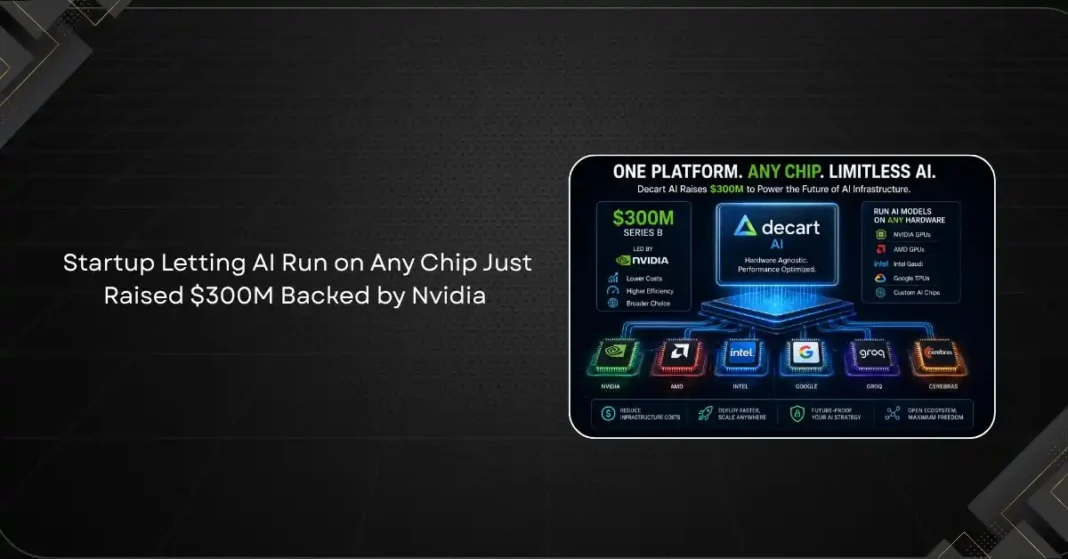
The announcement was carefully worded but its significance was hard to miss. In April 2026, Decart AI closed a $300 million Series B round with Nvidia leading the investment. The combination of a nine-figure raise and a strategic investment from the company that makes the chips Decart is partly designed to work around created enough cognitive dissonance that most coverage focused on the paradox rather than the substance. That was a mistake. The Decart story is one of the more interesting competitive dynamics in the AI infrastructure market right now.
To understand why Nvidia is investing in a company that threatens its dominance, you need to understand what Decart actually does, how Nvidia thinks about its competitive position, and why the AI chip market in 2026 is more complicated than the “Nvidia wins everything” narrative suggests.
What Decart Does
Decart AI has built a software layer that allows large AI models to run efficiently on a wide range of hardware, not just Nvidia’s H100 and H200 GPUs that currently dominate AI training and inference workloads. The company’s core technology is a compilation and optimisation system that takes a model and automatically generates hardware-specific execution code for different chip architectures, including AMD GPUs, Intel Gaudi accelerators, Google TPUs, and several custom AI chips from companies like Groq, Cerebras, and Tenstorrent.
The practical impact is significant. Running large language models on Nvidia hardware currently requires substantial engineering work to optimise performance for each specific chip variant and software stack. Doing the same on non-Nvidia hardware requires even more work, and the performance gap between optimised Nvidia deployments and optimised deployments on alternative hardware is large enough that many customers default to Nvidia simply because the engineering cost of optimising for alternatives is too high.
Decart’s system reduces that engineering cost substantially. Companies using Decart’s platform can deploy the same model on multiple hardware types with significantly less custom engineering, and the system’s optimisation algorithms close a meaningful portion of the performance gap between Nvidia hardware and alternatives. The pitch is not that alternative chips become as good as Nvidia’s current best. The pitch is that they become good enough that the price difference justifies the performance trade-off.
Why the Nvidia Investment Is Not as Contradictory as It Seems
Nvidia investing in a company that reduces hardware lock-in sounds like a tobacco company funding cancer research. The apparent contradiction dissolves when you understand Nvidia’s actual competitive concerns in 2026.
Nvidia’s dominant position in the AI chip market is real but under genuine threat from two directions. On the high-performance training side, Google’s TPU v6 chips and AMD’s MI300X accelerators have closed the gap with Nvidia’s H100 to a degree that was not true two years ago. On the inference side, purpose-built inference chips from Groq and Cerebras are demonstrating throughput and latency advantages over Nvidia GPUs for specific model architectures.
The risk Nvidia faces is not losing performance leadership. It is losing the ecosystem lock-in that amplifies that performance leadership into pricing power. The CUDA ecosystem, the software stack that ties AI developers to Nvidia hardware, is a more powerful competitive moat than the chip performance itself. If a company like Decart makes it easy to run optimised AI on non-Nvidia hardware, CUDA lock-in weakens, and Nvidia’s ability to charge premium prices for its chips erodes.
By investing in Decart, Nvidia is not betting that Decart will fail. It is buying a seat at the table in the company defining how hardware portability works in the AI infrastructure market. An Nvidia-backed Decart has incentives to ensure that Nvidia hardware performs best on Decart’s platform even as alternatives are supported. It also gives Nvidia visibility into how enterprise AI buyers think about chip economics, which informs Nvidia’s own product roadmap and pricing strategy.
The Decart Business Model
Decart operates as a software subscription business, charging enterprise customers for access to its compilation and optimisation platform. The pricing model is structured around compute savings: Decart charges a percentage of the cost reduction it enables compared to optimised Nvidia deployments. For a company running large inference workloads where Decart’s system delivers a 30 to 40 percent cost reduction through hardware diversification, the value proposition is clear.
The company’s customer base includes cloud providers, AI infrastructure companies, and large enterprises running proprietary AI applications. Cloud providers are particularly important customers because they make hardware purchase decisions at scale and have strong financial incentives to reduce dependence on any single chip supplier. If Decart enables a major cloud provider to shift 20 percent of its AI inference workload from Nvidia GPUs to cheaper alternatives, the dollar value of the contract required to capture a fraction of those savings is substantial.
The $300 million round reportedly values Decart at approximately $2.5 billion, which represents a significant multiple of current revenues. The valuation reflects investor belief that hardware portability will become a standard requirement for enterprise AI infrastructure as the chip market matures and alternative hardware improves. If that belief is correct, the total addressable market is the entire cost of AI infrastructure globally, which runs into the hundreds of billions annually.
The Competitive Landscape
Decart is not the only company working on AI hardware portability. Apache TVM is an open-source compilation stack that addresses similar problems. OnnxRuntime from Microsoft provides cross-platform model execution. Hugging Face’s Optimum library supports hardware-specific optimisations for a range of chip architectures. The MLIR compiler infrastructure from Google provides lower-level tools for building hardware portability systems.
What distinguishes Decart from these alternatives, according to its customers, is the degree of automated optimisation and the quality of the results on specific production workloads. The open-source alternatives require more manual tuning to achieve good performance on specific hardware targets. Decart’s system produces better results with less engineering effort, which is the value proposition that enterprise customers are paying for.
The risk for Decart is that the open-source alternatives improve faster than Decart can maintain its lead, or that chip manufacturers develop better software stacks for their own hardware that reduce the portability premium Decart captures. AMD has been investing heavily in ROCm, its GPU software stack, and the gap between ROCm and CUDA has narrowed considerably since 2023. If AMD’s software ecosystem reaches parity with Nvidia’s on its own, a significant part of the use case for Decart’s platform disappears.
What It Means for the AI Chip Market
Decart’s $300 million raise and Nvidia’s participation in it tells you something important about where the AI chip market is heading. The days of Nvidia having unchallenged dominance in AI inference are numbered, not because Nvidia will lose performance leadership, but because the cost economics of AI at scale will force buyers to look for cheaper alternatives for workloads where maximum performance is not required.
The AI chip market in 2026 is beginning to develop the kind of tiered structure that characterises mature hardware markets. Premium chips for maximum performance training and low-latency inference, where Nvidia currently leads. Mid-tier chips for cost-optimised inference, where AMD and Intel are competitive. Specialised chips for specific architectures, where companies like Groq and Cerebras can win on specific metrics. Software that abstracts across these tiers and routes workloads to the most cost-effective hardware is valuable precisely because the hardware landscape is fragmenting.
Decart is betting that its software layer becomes the operating system for this tiered AI hardware market. If that bet is right, the company becomes a critical piece of infrastructure with significant pricing power and switching costs. If the bet is wrong because the market consolidates around fewer hardware standards, Decart becomes an interesting but niche tool. The $300 million round is a bet on the former outcome, and Nvidia’s participation suggests that even the company most threatened by that outcome thinks it is the more likely one.