Key Takeaways
- GEO means optimizing your content so AI tools like ChatGPT, Gemini, Perplexity, and Google AI Overviews mention and cite your brand.
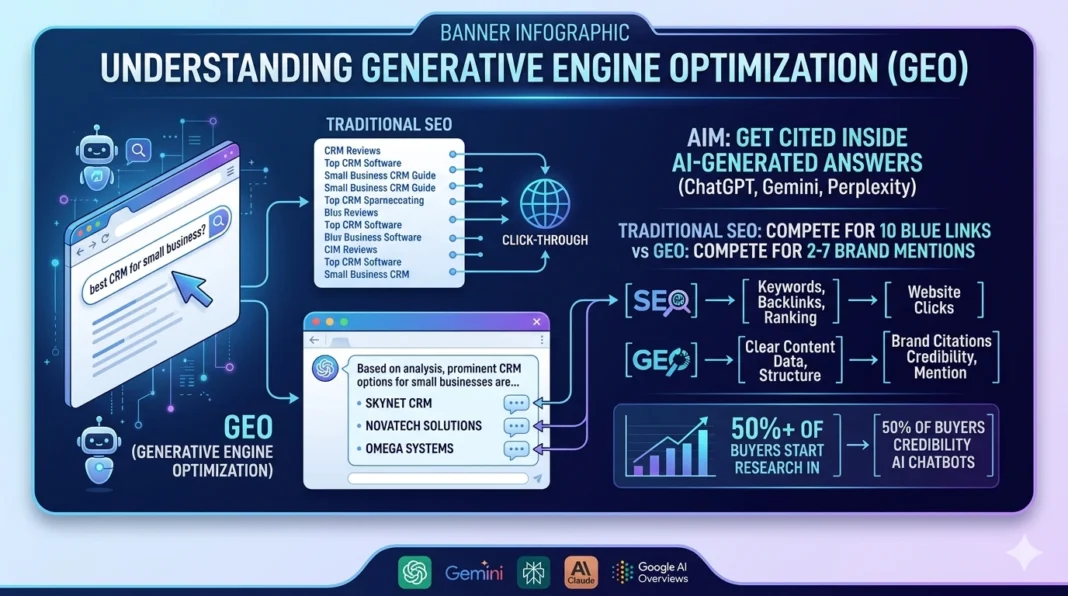
- It’s different from traditional SEO: instead of competing for 10 blue links, you’re competing to be one of 2–7 sources an AI model quotes in a single answer.
- More than half of buyers now start their research inside an AI chatbot instead of a search engine.
- AI engines favor clear, well-structured, original content — especially content with real data or expert insight.
- GEO doesn’t replace SEO. The strongest performers usually have both.
Introduction
Picture someone asking ChatGPT, “What’s the best CRM for a small business?” The AI gives a confident answer and names two or three companies. Your brand is either one of them, or it isn’t. There’s no scrolling past page one. No second chance lower down the page. You’re in the answer, or you’re invisible.
That’s the new reality marketers are dealing with in 2026, and it has a name: Generative Engine Optimization, or GEO. If you’ve spent years mastering Google rankings, this is a genuinely different game with new rules. This article breaks down what GEO actually is, why it matters right now, and what you can practically do about it — in plain English.
What Is Generative Engine Optimization (GEO)?
GEO is the practice of structuring your brand’s content and online presence so AI systems — ChatGPT, Gemini, Perplexity, Claude, and Google AI Overviews — can find it, understand it, and cite it when answering someone’s question.
Think of the difference this way:
- Traditional SEO: You create content → optimize for keywords → earn backlinks → compete for a ranking spot → a person clicks through to your website.
- GEO: You create content → structure it so AI can extract it cleanly → build credibility signals → get cited inside an AI-generated answer → a person sees your brand recommended by the AI, whether or not they ever click through.
The term was formalized through academic research from Princeton, Georgia Tech, the Allen Institute for AI, and IIT Delhi. By 2026, it’s gone from niche concept to a real budget line for many marketing teams.
Why GEO Matters Right Now
A few numbers explain the urgency:
- AI Overviews now show up on roughly a third to 60% of search results pages, depending on the query type, often answering questions without anyone clicking a website at all.
- More than half of customers say they now start their buying research inside an AI chatbot rather than a traditional search engine.
- ChatGPT alone reaches hundreds of millions of weekly active users asking detailed, conversational questions — exactly the kind of question where a brand mention matters.
If your content strategy is built entirely around ranking in classic search results, you’re optimizing for a shrinking share of how people actually find information now.
How AI Engines Decide What to Cite
AI tools that pull live information from the web (a method called retrieval-augmented generation, or RAG) generally go through four steps:
- Query breakdown — the AI splits a question into smaller sub-questions.
- Retrieval — it searches for and pulls specific passages from pages it can read cleanly.
- Synthesis — it blends information from multiple sources into one answer.
- Citation — it credits the sources it used. This is the moment your brand either appears, or it doesn’t.
Content that’s easy for an AI to “lift” cleanly — clear headings, direct answers up top, well-organized data — has a real advantage here.
Comparison: SEO vs. GEO
| Aspect | Traditional SEO | GEO |
|---|---|---|
| Goal | Rank in top 10 search results | Get cited inside an AI-generated answer |
| Success metric | Ranking position, click-through rate | Citation frequency, share of voice |
| Content structure | Keyword-optimized, long-form | Direct-answer-first, scannable, data-rich |
| Authority signal | Backlinks | Backlinks + original research + clear expertise |
| User outcome | Clicks to your site | May never click — but sees your brand “endorsed” |
Who Should Care About GEO
- B2B and SaaS companies, since high-intent comparison questions (“best CRM for X”) are exactly what GEO targets.
- Marketing and content teams who already invest in SEO and want to protect visibility as search shifts.
- Smaller brands with strong expertise — GEO rewards original data and clear authority over sheer ad spend, which can level the playing field.
- Brands relying purely on paid search may see less direct benefit short-term, but should still monitor how AI engines describe them.
Common Mistakes to Avoid
- Treating GEO as a replacement for SEO — They work together. Strong technical SEO (fast, crawlable, trustworthy pages) is still the foundation.
- Burying the answer — AI engines weigh a page’s opening content heavily. Don’t make readers (or AI) wait paragraphs for the actual answer.
- Publishing generic, lookalike content — Original research, benchmark data, and clear expert commentary get cited far more often than generic explainer posts.
- Ignoring measurement — Many teams have detailed Google Analytics dashboards but zero visibility into AI citation performance. That gap needs closing.
- Chasing high-volume, low-intent keywords — A smaller search term that drives real buying decisions is often more valuable than a high-traffic term that gets fully answered inside the AI response itself (meaning no one ever visits your site).
Expert Tips
- Put the direct answer to your main topic in the first 200 words of any article — don’t build up to it.
- Add a clear “last updated” date and refresh cornerstone content regularly. AI engines tend to favor recency.
- Test your own brand’s visibility by asking ChatGPT, Perplexity, and Google AI Overviews relevant questions yourself, and see who gets cited and why.
- Target comparison and evaluation queries (“X vs. Y,” “best Z for [specific situation]”) rather than broad definitional questions that AI can fully answer without needing your site.
Future Trends: What’s Next
Expect GEO tooling to mature quickly — tracking “prompt volume” and AI citation share the way teams have tracked keyword rankings for years. Expect more overlap with “agentic search,” where AI doesn’t just answer questions but actively browses, compares, and completes purchases, making structured, machine-readable content (clear pricing tables, feature comparisons) even more important. And expect GEO and SEO to keep merging into one combined discipline, rather than staying separate specialties.
Conclusion
GEO isn’t a buzzword — it reflects a real, measurable shift in how people find information and make decisions. Search hasn’t disappeared; it’s just splitting into two tracks: the one where people click through ranked links, and the one where an AI answers the question directly and either mentions your brand or doesn’t. Brands that adapt their content strategy now — clear structure, original data, real expertise — are positioning themselves to be the ones AI actually recommends.
Key recommendation: Pick three high-intent questions your customers actually ask, test how ChatGPT and Google AI Overviews currently answer them, and rework your content around what’s missing.
FAQ
What is Generative Engine Optimization (GEO)? GEO is the practice of structuring content so AI tools like ChatGPT, Gemini, Perplexity, and Google AI Overviews cite your brand when answering questions.
Is GEO replacing SEO? No. GEO works alongside SEO. Strong technical SEO foundations (fast, crawlable, trustworthy pages) still help with AI citations too.
How do AI engines decide which sources to cite? They break a question into smaller parts, retrieve relevant passages from sources they can parse cleanly, combine the information, and credit the sources used.
What kind of content gets cited most often by AI? Original research, benchmark data, clear expert commentary, and content that directly answers the question early on.
How can I measure my brand’s GEO performance? Manually test relevant questions across ChatGPT, Perplexity, and AI Overviews, and consider dedicated AI-visibility tracking tools as this space matures.
Does GEO mean people will stop visiting my website? Not necessarily. Many AI-cited brands still earn referral clicks from people who want more detail — but some visibility now happens without a click at all.
Is GEO only relevant for big companies? No — smaller brands with strong original data or niche expertise often have a real opportunity here, since AI engines reward substance over ad budget.