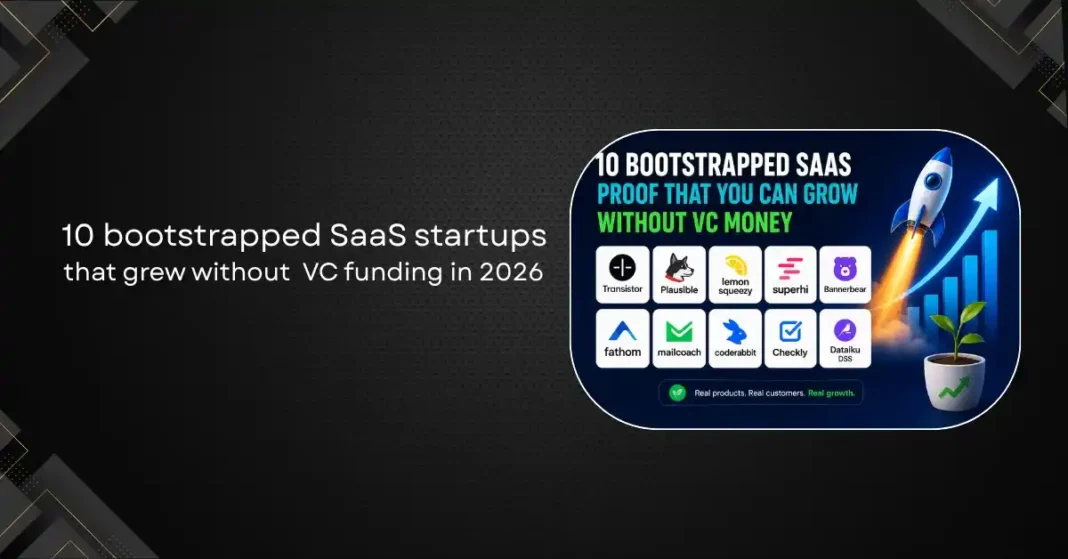
The venture capital conversation in 2026 is dominated by $100 billion mega-rounds and billion-dollar valuations. But a substantial portion of the most resilient software businesses being built right now are growing without any of that capital. Bootstrapped SaaS companies, funded by revenue rather than investment, are thriving in an environment where niche markets, AI-powered productivity, and global remote customer acquisition have made it possible to build sustainable businesses without ever pitching a partner at a growth equity firm. These ten companies represent a cross-section of what is working in bootstrapped SaaS in 2026.
1. Transistor.fm
Transistor is a podcast hosting and analytics platform that has remained fully bootstrapped since founding. The company serves tens of thousands of podcasters with a clean interface, reliable infrastructure, and strong analytics. Its founders have been transparent about their revenue and business model, publishing monthly metrics that have become a reference point for bootstrapped SaaS operators. In 2026, Transistor continues to grow through SEO and word-of-mouth without paid acquisition, a demonstration of what sustainable unit economics look like when revenue from day one drives every infrastructure decision.
2. Dataiku DSS Personal Edition
While Dataiku has raised institutional capital for its enterprise product, several companies in the data science tooling category are demonstrating that bootstrapped alternatives to expensive enterprise platforms can compete effectively on features for specific user segments. The pattern in 2026 is that AI-assisted development tools reduce the engineering cost of building complex software enough that a small team can build a product that would have required 20 engineers in 2020.
3. Plausible Analytics
Plausible is a privacy-focused Google Analytics alternative that reached significant annual recurring revenue without venture funding. The company operates from two people, maintaining infrastructure for tens of thousands of paying customers. Its positioning against cookie tracking and its GDPR compliance makes it a direct beneficiary of the privacy regulation wave that has complicated life for larger analytics vendors. In 2026, first-party data strategy has become central enough to digital marketing that tools like Plausible are seeing renewed interest from privacy-conscious operators.
4. Lemon Squeezy
Lemon Squeezy is a merchant of record platform that handles global payments, tax compliance, and digital product distribution for software businesses. Its bootstrapped growth was built on the pain that developers feel when trying to sell SaaS products internationally while complying with VAT, GST, and local tax requirements across dozens of jurisdictions. Being acquired by Stripe in 2024 was a successful exit for the founders, but its pre-acquisition trajectory as a bootstrapped company demonstrated that deeply functional infrastructure products can reach substantial revenue without external capital.
5. Superhi
Superhi is an online education platform focused on design and development skills. Built without venture funding, it has grown a paying student base through course quality and community rather than paid acquisition. In 2026, the online education market has been disrupted by AI-generated content, but platforms that built genuine community alongside curriculum have retained students in ways that purely AI-generated alternatives have not replicated.
6. Bannerbear
Bannerbear is an API-first automated image and video generation tool. It was built by a solo founder and grew to significant monthly recurring revenue without any external capital. The product automates the creation of personalized social media images, email headers, and dynamic content using templates and data inputs. Its API-first design makes it a natural component in AI-powered content workflows, which has increased its relevance in 2026 as more businesses build automated content pipelines.
7. Fathom Analytics
Fathom is another privacy-focused analytics platform in the same space as Plausible. Both companies have grown substantially by positioning against Google Analytics’ complexity and data ownership model. Fathom reached significant ARR as a bootstrapped company before accepting a small outside investment. Its growth demonstrates that two competing bootstrapped companies can both succeed in the same niche without cannibalizing each other when the total addressable market is expanding due to regulatory pressure on tracking.
8. Mailcoach
Mailcoach is an email sending platform built by the team at Spatie, the well-known Laravel development house. Rather than competing with Mailchimp on features, Mailcoach targets developers who want a self-hosted or managed email platform with full data ownership. In 2026, email list ownership has become more valuable as social platform reach continues to decline, and Mailcoach benefits from that structural shift.
9. Coderabbit
Coderabbit is an AI code review platform that integrates with GitHub and GitLab. The tool provides automated pull request reviews using large language models, identifying potential bugs, security issues, and code quality improvements before human reviewers see the code. It has grown through developer word-of-mouth and GitHub marketplace visibility without institutional capital, demonstrating that AI-native developer tools with strong feedback loops can build distribution through the communities they serve.
10. Checkly
Checkly is a monitoring and testing platform for developers, focused on synthetic monitoring of APIs and browser-based applications. The company has built a sustainable business in the developer infrastructure space serving customers who need confidence that production APIs and user flows are working continuously. Its growth through organic developer community engagement rather than paid acquisition reflects the broader pattern in bootstrapped developer tooling: technical quality and community trust compound into distribution that paid channels cannot replicate.
What These Companies Have in Common
Looking across these ten examples, several patterns emerge. Each company chose a niche specific enough to be ownable without massive marketing spend. Each built a product where technical quality was the primary growth mechanism rather than sales and marketing. Each avoided the growth-at-all-costs logic that venture funding creates, which allowed them to maintain unit economics that made the business genuinely profitable without needing an exit to justify the founder’s time investment. In 2026, that combination of specificity, quality, and disciplined growth has produced outcomes that are arguably more durable than many of the venture-backed companies in adjacent spaces that raised large rounds at high valuations and now face pressure to justify them.