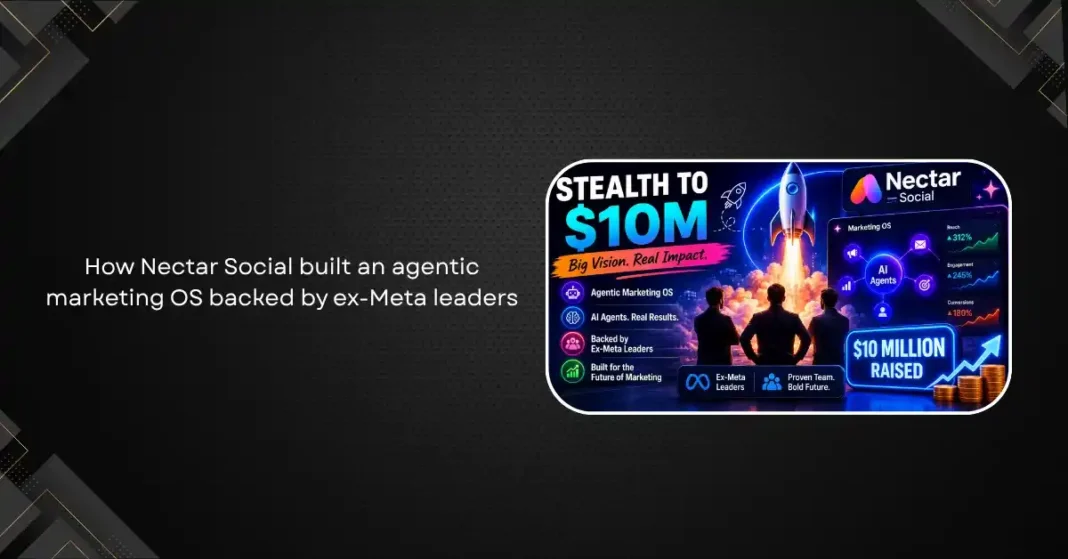
Most startup origin stories follow a familiar arc. A founder identifies a problem, builds a minimal product, finds early customers, raises money. Nectar Social’s path to its $10 million seed round was shaped by a different thesis: that agentic AI was about to fundamentally change how marketing operations run, and that the first company to build a true operating system for that shift, with the right team behind it, could capture a category before incumbents noticed it existed.
What Nectar Social Actually Built
Nectar Social describes its product as an agentic marketing OS, a platform where AI agents coordinate marketing workflows across channels, tools, and data sources rather than requiring human operators to switch between disconnected applications. The system ingests performance data from advertising platforms, social media, email, and web analytics, then deploys AI agents to make recommendations, execute optimizations, and generate reports without requiring manual handoffs between tools.
The term agentic is specific in this context. Nectar is not building a dashboard that surfaces AI-generated insights for human action. It is building a system where agents take actions autonomously within defined parameters, escalating to human review only when confidence thresholds require it. The platform handles creative briefing, audience segmentation, budget allocation, and performance reporting through agents that run continuously rather than responding to individual user prompts.
The Ex-Meta Connection
The leadership team’s background is the detail that gave the company its fundraising credibility. Several of Nectar’s co-founders and senior executives came out of Meta’s advertising and growth teams, where they had firsthand experience with the scale and complexity of automated marketing systems that handle billions of dollars in ad spend. That experience is not incidental. The architecture of Nectar’s agent system reflects deep familiarity with how performance marketing actually works at scale, including the failure modes that most AI marketing tools built by engineers without marketing operations experience get wrong.
The Meta pedigree also provided an investor network that accelerated the fundraising process. Backers for the $10 million round included former Meta product and engineering leaders with a perspective on where marketing automation was headed and a direct line to the enterprise sales contacts that early SaaS companies need to close their first major accounts.
The Market Timing Argument
Nectar’s pitch is timing-specific. The argument is that 2026 is the first year where agentic AI systems are reliable enough to run production marketing workflows without constant human supervision. The tools required, reliable function calling, multi-step reasoning, and persistent memory across sessions, have matured enough in the past 12 months that what was previously a demonstration capability is now a deployable one.
The startup’s founders have been explicit in interviews about what they see as the window: the period between when agentic capability becomes viable and when large incumbents like Salesforce, HubSpot, and Adobe build equivalent systems into their platforms. That window is likely 24 to 36 months, which is enough time to build a customer base and distribution advantage before the competitive environment changes again.
What Nectar’s Bet Signals About the Startup Market
Nectar Social is one of several agentic infrastructure companies raising early-stage capital in the marketing technology space in 2026. Its $10 million seed round is notable not for its size but for the investor profile and the timing of the thesis. The fact that ex-Meta leaders specifically chose agentic marketing infrastructure as the category to back with their own capital and reputation signals something about where people who ran marketing systems at the highest existing scale think the leverage point lies.
For founders evaluating adjacent spaces, the signal is that the 2026 startup market is rewarding teams with deep domain expertise in a specific operational function who are building agent-native systems for that function, rather than adding AI features to existing workflow tools. Nectar’s fundraising is one data point in a pattern visible across startup funding rounds from Q4 2025 through Q2 2026: the market is selecting for specificity, operational depth, and the kind of team background that credibly demonstrates they know the problem they are solving from the inside.