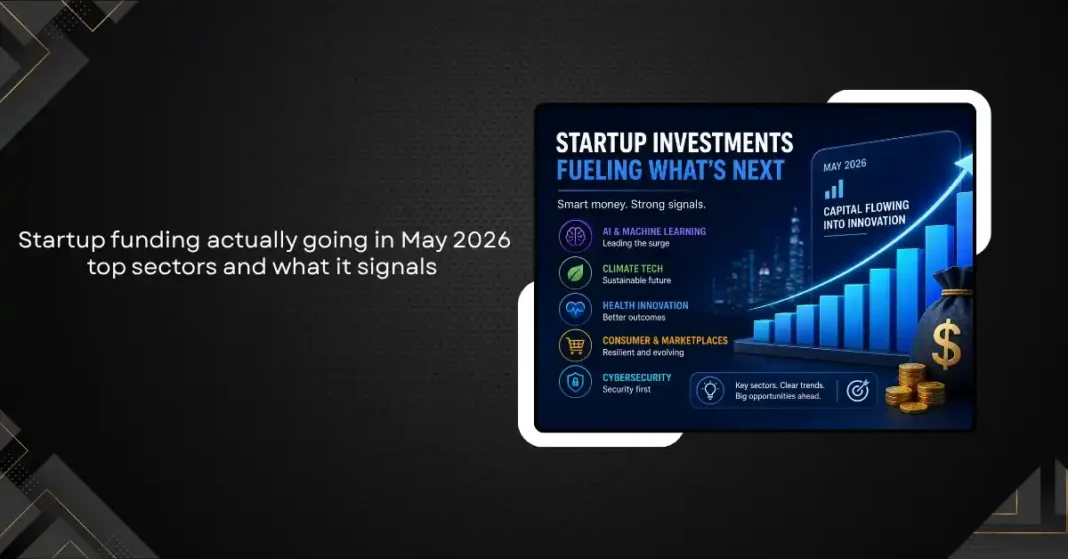
Q1 2026 shattered global venture capital records. Total startup funding exceeded $300 billion in the quarter, according to Crunchbase data, with US-based companies raising $250 billion, or 83% of the global total. Just four companies, OpenAI, Anthropic, xAI, and Waymo, accounted for 65% of all global venture investment in Q1. The concentration is extraordinary. So is the question it raises: where is the rest of the capital going, and what does the pattern of deal flow in May 2026 actually signal about where founders and investors think the next decade of value creation sits?
AI: The Dominant but Maturing Category
Roughly 50% of all global venture funding in 2025 went to AI-related companies, according to Crunchbase. In early 2026, that share has held but the composition has shifted. The mega-rounds going to frontier labs, OpenAI’s recent $110 billion raise at a reported $800 billion valuation being the most visible, reflect a different category of investment from the broader AI funding market. Investors who spoke to Crunchbase in January 2026 concurred that funding will continue to concentrate in AI-related companies but will shift away from AI wrapper companies, those building thin products on top of foundation models without significant proprietary differentiation. The lesson from 2025 is that it is difficult to survive as an AI wrapper when the underlying model improves to cover your core value proposition.
The May 2026 deal flow shows a pivot toward what analysts are calling verticalized autonomy: embedding high-level AI capabilities into legacy industrial sectors that have historically resisted digital transformation. Specialized platforms for real estate due diligence, construction management, legal document review, and industrial maintenance are attracting capital that would have gone to general-purpose productivity tools two years ago.
Infrastructure and Agentic Plumbing
As frontier labs reach valuations approaching $730 billion, investors are systematically pivoting toward the infrastructure layer. Companies that handle the plumbing of the AI ecosystem are attracting significant capital. AI-native search infrastructure, agent orchestration platforms, memory management systems for long-running AI agents, and evaluation frameworks for testing model reliability all represent the supporting infrastructure that production-scale AI deployment requires.
Mercury, a fintech company serving as the financial backbone for many AI startups, saw substantial valuation increases in recent funding rounds, reflecting the flight to stability that Crunchbase describes as the market’s response to speculative excess. Investors are prioritizing platforms that handle the ledger of record for the AI ecosystem over experimental consumer AI products.
Robotics and Defense Tech
Investors citing geopolitical necessity point to robotics and defense technology as sectors benefiting from structural tailwinds beyond pure AI excitement. The tightening of US-China relations has accelerated reshoring of manufacturing, creating demand for AI-driven production of hardware components. Several large multi-hundred-million dollar rounds in robotics startups reflect institutional capital backing the physical AI thesis that SoftBank’s Masayoshi Son has made central to his public messaging.
Defense technology, broadly defined to include cybersecurity, autonomous systems, and communications infrastructure, is attracting venture capital that explicitly targets the national security implications of AI capability. DARPA interest in quantum computing advances by IonQ and similar companies illustrates the government side of this trend. Private investors are following the same thesis, with cybersecurity alone seeing companies like Ocean Security raising $28 million for AI-agent-led email defense in May 2026.
What Is Losing Funding
The sectors losing venture interest in 2026 are instructive. Climate tech, which attracted significant capital in 2021 and 2022, is receiving less funding than AI-adjacent sectors despite continued regulatory tailwinds. Crypto and Web3 remain depressed from their 2021 peak. General-purpose vertical SaaS without a strong AI moat is struggling to raise at the valuations that seemed reasonable two years ago. Consumer social applications without a compelling differentiated data advantage are facing pressure.
The Signal for Founders
The clearest signal from May 2026 deal flow is that the market has moved from being excited about AI as a category to evaluating AI companies on the specificity and defensibility of their wedge. A startup that automates a specific high-friction workflow in a regulated industry, that generates proprietary training data through its operations, and that builds infrastructure other AI applications depend on is a more fundable company in mid-2026 than one that aggregates existing AI capabilities into a general-purpose tool. The venture capital market is selecting for depth over breadth, and the founders raising capital are the ones who have picked their specific problem precisely enough to build a moat around it.