Most startup ideas die in spreadsheets. Founders spend weeks modeling revenue projections and mapping out product roadmaps before speaking to a single potential customer. By the time they talk to the market, they have already fallen in love with a version of the product that nobody asked for. The lean validation method exists to break that pattern. In 2026, it has evolved significantly, shaped by faster AI-assisted research tools, shifting investor expectations, and a startup funding market that no longer rewards ambition alone.
This guide walks through the full validation process from idea to evidence, the way it actually works in practice, not in theory.
Why Most Startup Validation Advice Is Wrong
The standard advice is to run a survey, set up a landing page, and collect email addresses. That worked in 2012. Today, anyone can spin up a landing page in twenty minutes using a no-code tool and run ads to it for fifty dollars. A list of emails tells you people were curious enough to click, not that they would actually pay for what you are building.
The problem with most validation approaches is that they measure interest instead of intent. Interest is cheap. Intent, the kind that involves a credit card or a signed letter of commitment, is the only signal that matters. A founder who collects five thousand email addresses has a marketing list. A founder who gets twenty people to pre-pay for a product that does not exist yet has validated a business.
In 2026, the bar for what counts as genuine validation has risen. Investors who were burned by the 2021 to 2023 cycle, when billions flowed into ideas that could not find product-market fit, now want to see evidence before they write checks. The lean method has had to sharpen accordingly.
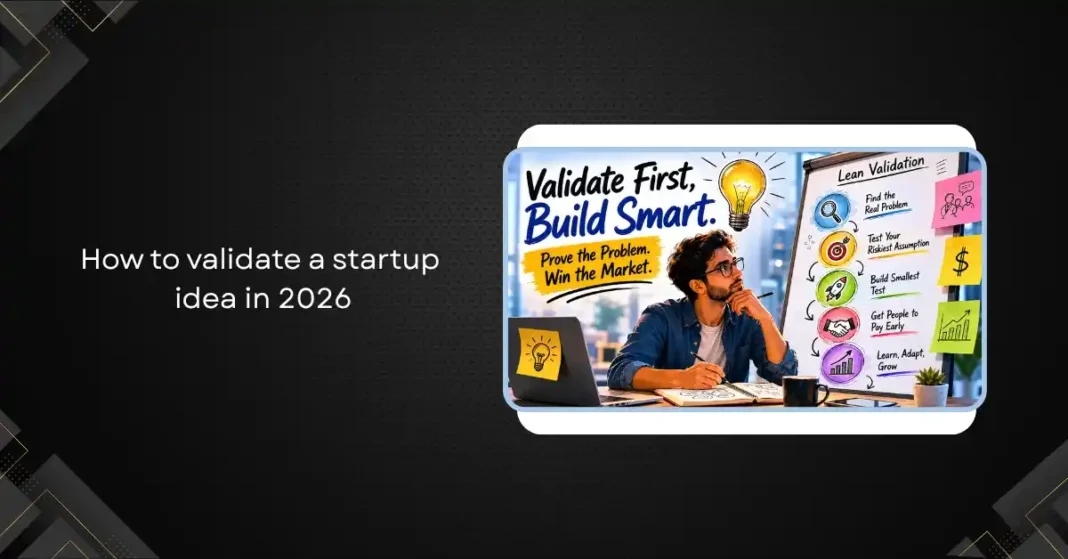
Step One: Nail Down the Problem Before Touching the Solution
Every startup idea starts as a solution looking for a problem. The first job of validation is to reverse that order. Before you write a single line of code or design a single screen, you need to be able to describe the problem you are solving in a way that a real person would say out loud.
The test is simple. Can you describe the problem without referencing your product? If you say something like, ‘The problem is that people don’t have a way to use our AI scheduling tool,’ that is not a problem statement, it is a product pitch in disguise. A real problem statement sounds like this: ‘Freelance designers spend four to six hours every week on client communication that does not directly generate revenue, and most of that time goes to scheduling, rescheduling, and following up on project feedback.’
To get to that kind of specificity, you need to talk to people. Not twenty people. Start with five to ten conversations with individuals who match your target customer profile, and go deep. Ask about their current workflow, where time goes, what they have already tried, and what they wish existed. Do not mention your idea in these conversations. Listen for patterns in the pain, not openings to pitch.
In 2026, founders are using AI tools like Claude and Gemini to synthesize these early conversations quickly, identifying recurring themes and gaps. That is legitimate. What you cannot outsource to AI is the conversations themselves. The insight that changes your entire direction rarely comes from a survey. It comes from an offhand comment in a thirty-minute call.
Step Two: Define Your Riskiest Assumption
Every startup idea rests on a stack of assumptions. Your job in validation is not to test all of them at once. It is to identify the single assumption whose failure would kill the entire business, and test that first.
These are called leap-of-faith assumptions, a term popularized by Eric Ries in The Lean Startup and still the most useful concept in early-stage thinking. For most startups, the riskiest assumption is either about the problem or about willingness to pay, not about the technology.
A fintech founder building a savings app for Gen Z might assume that their target users actually want to save money. That sounds obvious, but if behavioral research says that users in that demographic consistently prioritize spending over saving despite stating the opposite in surveys, the whole premise falls apart. Testing the technology before testing that assumption wastes months.
Write down every assumption your idea requires, from ‘users have this problem’ to ‘users will pay this price’ to ‘we can acquire users at this cost.’ Rank them by risk: how likely is this assumption to be wrong, and how badly would it hurt if it were? The top-ranked assumption on that list is where you start.
Step Three: Build the Smallest Possible Test
A minimum viable product in 2026 looks different from what the term originally described. The original MVP concept, popularized around 2008 to 2010, was about shipping a stripped-down version of a product quickly. That framing still holds, but the tools available now mean the bar for ‘minimum’ has shifted.
For many ideas, you do not need to build anything at all for the first test. A concierge MVP means you manually deliver the experience your product would eventually automate. A B2B software founder who wants to validate an AI-powered contract review tool can start by reviewing contracts manually using a combination of ChatGPT and their own judgment. They charge a real client a real fee. If the client pays and returns, the core value proposition is validated before a single line of product code is written.
The Wizard of Oz approach takes this further. You build a front end that looks like a real product, but the back end is operated by humans. Dropbox famously validated file syncing demand with a video before the technology existed. In 2026, founders are using tools like Framer, Webflow, and Bubble to build convincing product interfaces in days. The back end can be a spreadsheet, a Notion database, or a human running the process manually.
The criterion for a valid test is not whether it looks polished. It is whether it gives you accurate data about the riskiest assumption. A landing page with a payment form is better evidence than a landing page with an email signup form, because it tests willingness to pay rather than just curiosity.
Step Four: Get People to Pay Before You Build
The gold standard of validation in 2026 is pre-revenue: getting customers to pay for something before the full product exists. This is harder than collecting signups, which is exactly why it is more meaningful.
Pre-selling works across almost every category. B2B SaaS founders can close pilot agreements where customers pay a reduced rate in exchange for being early design partners. Consumer founders can use crowdfunding platforms or direct pre-order pages. Service businesses can collect deposits. The mechanism matters less than the underlying principle: you are asking someone to put money down on a promise.
A useful benchmark from the 2025 startup class, based on data from Y Combinator and Techstars cohorts, is that a B2B startup with ten paying pilot customers in the range of one thousand to five thousand dollars per month has enough signal to start raising a pre-seed round from most angel investors. Reaching that benchmark before writing a pitch deck changes the entire funding conversation.
If you cannot get anyone to pay, that is data too. The right response is not to lower the price until someone agrees. It is to understand why they will not pay. Price objections are usually hiding a more fundamental problem: either the pain is not acute enough, the solution does not fit their workflow, or you are talking to the wrong people.
Step Five: Run a Structured Learning Loop
Validation is not a single experiment. It is a series of increasingly specific tests, each one building on what the last one taught you. The build-measure-learn loop from lean methodology remains the best framework for structuring this, but in practice, most founders skip the ‘measure’ step and treat every outcome as confirmation rather than data.
Before you run any test, write down what you expect to see if your assumption is correct. Be specific. Not ‘people will be interested,’ but ‘at least six out of ten people I demo the product to will ask how they can get access.’ Then run the test, record what actually happened, and compare it to your prediction.
When the result does not match your expectation, you face a decision: pivot or persevere. A pivot is a structured change in strategy while keeping the core mission. You might change the customer segment, the pricing model, the channel, or the core feature. Perseverance means you believe the assumption is still valid and the test design was flawed. Most founders who fail conflate perseverance with denial. The lean method keeps you honest by forcing you to write the expected outcome before you run the test.
In 2026, AI tools are being used to accelerate the synthesis step between experiments. Founders running customer interviews can use transcription and summarization tools to extract themes in minutes rather than days. That speed matters. A team that can run a full build-measure-learn cycle in a week instead of a month gets four times as many shots at finding the right direction before money runs out.
The Role of AI in Modern Startup Validation
The validation toolkit has changed meaningfully in the past two years. AI has compressed timelines in several areas without changing the underlying logic of what validation is supposed to achieve.
Market research that once took a team of analysts weeks to compile can now be assembled in hours. A founder can use AI-assisted tools to scan public datasets, Reddit threads, App Store reviews, and industry reports to map the problem space before making a single call. This does not replace primary research, but it makes the calls more focused. You go into a customer conversation already knowing which questions matter most.
Synthetic user testing has also emerged as a useful early-stage tool. Companies like Synthetic Users and Outset use AI-powered personas to simulate customer responses before a product exists. The outputs should be treated as directional rather than conclusive, but they can help founders eliminate obviously bad ideas faster, which frees up time for the real conversations that actually validate.
Where AI cannot help is in building trust with early customers. The relationships you form during validation, the ten customers who believed in the product when it was barely real, are often the ones who become your longest-term advocates, your best referrals, and sometimes your first hires. Those relationships require a human on the other end of the phone.
How Investors Evaluate Validation in 2026
The funding market has shifted the goalposts on what constitutes enough validation to raise money. In the peak of the 2021 cycle, a credible founding team with a compelling deck could raise a pre-seed round on narrative alone. That era is over.
Pre-seed investors in 2026 typically want to see some combination of the following before committing capital: direct evidence that the problem exists, at least one form of early customer engagement (interviews, pilots, letters of intent), and ideally some signal on willingness to pay. The stronger each of these signals, the better the terms you will negotiate.
Seed-stage investors, who typically invest at the one to three million dollar level, expect more. The standard in most sectors has moved to a point where seed rounds require either meaningful revenue (ten thousand to thirty thousand dollars per month for B2B, often higher) or an extremely clear early retention signal from a small cohort of users who are deeply engaged with the product.
What investors are trying to determine is whether you understand your customer deeply enough to build something they will use repeatedly and pay for over time. The validation artifacts you have collected, interview notes, payment receipts, usage data, churn rates, are the evidence for that claim. Founders who can walk an investor through a clear narrative of what they tested, what they learned, and how it changed their approach consistently outperform those who simply present a polished pitch.
Common Validation Mistakes and How to Avoid Them
Validation bias is the most common failure mode. Founders select interview subjects who are likely to validate rather than challenge their assumptions. They ask leading questions. They discount negative feedback as outliers. The fix is structured interviews using a script that includes at least three questions designed to surface disconfirming evidence.
Friends and family feedback is almost always misleading. The people who care about you will not tell you the product is a bad idea even when they believe it. Early customer discovery should be with strangers who match your target profile and have no social reason to be kind.
Feature creep during validation is another common trap. Founders who talk to ten potential customers often hear ten different feature requests. The impulse is to add all of them. The lean approach is the opposite: look for the single core behavior that all ten customers share, and build only what enables that.
Finally, treating validation as a one-time event rather than an ongoing discipline destroys early-stage companies. The market, customer needs, and competitive context change. Companies that continue running structured customer conversations even after they have found initial product-market fit consistently adapt faster when conditions shift.
What Good Validation Evidence Looks Like
Strong validation evidence tells a coherent story. It shows that a specific group of people has a specific problem, that they have tried and failed to solve it with existing tools, that they are willing to pay a specific amount for a better solution, and that your approach is meaningfully different from what they have already tried.
The format of that evidence matters less than its specificity. Fifty hours of customer interview transcripts, a folder of signed letters of intent, a cohort retention chart showing eighty percent thirty-day retention from fifteen early users: any of these, presented with the reasoning that led you to collect them, demonstrates the kind of disciplined thinking that investors are looking for in 2026.
The founders who get through early-stage fundraising consistently are not the ones with the most polished decks or the most impressive academic credentials. They are the ones who can demonstrate, in granular detail, that they understand their customer better than anyone else in the room. Validation is how you earn that understanding.