Every year, two flagship phones compete for the title of best smartphone in the world. Every year, the honest answer is that both are excellent, the differences are real but smaller than the marketing implies, and the right choice depends heavily on your existing ecosystem, your priorities, and occasionally on factors that have nothing to do with the hardware itself.
The Samsung Galaxy S26 Ultra and the iPhone 17 Pro Max are the 2026 edition of this annual comparison. Both are outstanding phones. The S26 Ultra starts at $1,299 and the iPhone 17 Pro Max starts at $1,199 in the UK at current exchange rates. Depending on what you value in a smartphone, one of them is clearly the better choice for you. Here is the breakdown after extended testing of both devices.
Design and Build
The Galaxy S26 Ultra maintains the distinctive rectangular design language of its predecessors, with flat sides, a titanium frame, and a large-format display that makes it a genuinely different physical object from most smartphones. The S Pen slot on the lower right edge is still present, and Samsung has upgraded the stylus itself with improved pressure sensitivity and reduced latency compared to the S25 Ultra. For anyone who uses the S Pen regularly, the S26 Ultra remains the only flagship phone that supports it.
The S26 Ultra’s new Privacy Display is the most discussed design feature of the 2026 generation. At the touch of a software button, the screen shifts to a viewing angle that limits visibility to roughly 30 degrees, making it effectively unreadable to anyone who is not looking at it directly. In practice, this works as advertised in testing in offices, on public transport, and in coffee shops. It reduces screen brightness slightly when active, which is a minor trade-off for the genuine privacy benefit.
The iPhone 17 Pro Max continues the titanium and glass construction introduced with the iPhone 15 Pro Max, with refinements that make it marginally thinner and lighter than last year’s model. Apple’s build quality remains the industry standard. The ProMotion display, which dynamically adjusts refresh rate between 1Hz and 120Hz, is as smooth as any smartphone display. The Action Button, now in its third iteration, supports more customisation options than before.
On pure build quality, the two phones are comparable. The S26 Ultra feels more substantial and premium in hand due to its size and weight. The iPhone 17 Pro Max feels more refined and consistent. The choice between them is largely personal preference about form factor rather than an objective quality judgment.
Display
The S26 Ultra uses a 6.9-inch Dynamic AMOLED 2X display with a peak brightness of 2,600 nits, a 120Hz refresh rate, and the Privacy Display hardware described above. The display is genuinely excellent, with saturated, accurate colours and deep blacks that benefit from the AMOLED panel. It is among the brightest smartphone displays available in direct sunlight.
The iPhone 17 Pro Max uses a 6.9-inch Super Retina XDR OLED display with a peak brightness of 2,000 nits and ProMotion. Apple’s colour calibration is consistently regarded as more accurate than Samsung’s in its default mode, particularly for photography and video work where colour accuracy matters. Samsung’s Vivid mode oversaturates compared to Apple’s default, though Samsung’s Natural mode is competitive.
For media consumption, both displays are exceptional. For photography and video editing, the iPhone’s colour accuracy is a meaningful advantage. For reading sensitive documents in public, the S26 Ultra’s Privacy Display is a genuine differentiator with no equivalent on the iPhone.
Performance
The S26 Ultra runs on the Snapdragon 8 Elite Gen 5, Qualcomm’s latest chipset manufactured on TSMC’s 3nm process. The iPhone 17 Pro Max runs on Apple’s A19 Pro chip, also on a 3nm process. Both chips deliver flagship-class performance that exceeds the requirements of any current app or game by a wide margin.
In benchmark testing, Apple’s A19 Pro maintains its historical lead in single-core CPU performance, scoring approximately 3,800 on Geekbench 6 single-core versus the Snapdragon 8 Elite Gen 5’s 2,900. Multi-core performance is much closer, with Apple’s lead narrowing to around 10 percent. In GPU performance, the gap has effectively closed, with both chips delivering equivalent results on mobile gaming benchmarks.
In real-world use over two weeks, the difference in raw performance between the two phones is imperceptible in daily tasks. Both handle multitasking, gaming, photography, and video editing without hesitation. The practical performance advantage of the iPhone is visible in sustained workloads like exporting long videos or running complex computational tasks, where Apple’s chip efficiency advantages translate to faster completion and less thermal throttling.
Camera System
Camera comparisons between these two phones require more nuance than any other aspect of the comparison because both systems are excellent and because the “better” result depends significantly on personal preference in colour processing.
The S26 Ultra has a 200-megapixel main camera, a 50-megapixel ultrawide, and a dual telephoto setup with 3x and 10x optical zoom. Samsung’s processing pipeline produces images with high contrast, saturated colours, and detail that looks excellent on smartphone screens and in social media applications. The 10x telephoto zoom is genuinely useful for sports, events, and wildlife photography where the subject is far away.
The iPhone 17 Pro Max has a 48-megapixel main camera with a larger sensor than previous generations, a 48-megapixel ultrawide, and a 5x telephoto zoom. Apple’s processing produces images that look slightly more natural and less processed than Samsung’s, particularly in skin tones and neutral colours. The Photonic Engine computational photography system handles low-light situations with impressive detail retention.
Video performance favours the iPhone 17 Pro Max for professionals. The Camera app offers ProRes 4K recording at up to 120fps, Log format support for colour grading, and Apple’s Cinematic mode, which produces smooth, intentional focus transitions. Samsung’s video capabilities have improved substantially but still trail Apple’s in professional filmmaking scenarios.
Battery Life and Charging
The S26 Ultra includes a 5,500mAh battery with 60-watt wired charging and 25-watt wireless charging. In daily use with mixed workloads, the S26 Ultra delivers around 7 to 8 hours of screen-on time, which is enough for a full day of heavy use for most users.
The iPhone 17 Pro Max has a slightly smaller battery but Apple’s more efficient A19 Pro chip means the practical battery life is comparable, with most users reporting 6 to 8 hours of screen-on time depending on usage patterns. Apple’s charging has improved to 30 watts wired, still behind Samsung but less of a differentiating factor now that most users charge overnight.
Samsung’s faster charging is a genuine advantage for users who regularly need to top up quickly during the day. The 15-minute charge that delivers approximately 40 percent battery is meaningfully better than Apple’s comparable result of around 25 percent. For users with consistent access to charging, this does not matter. For users who frequently need fast top-ups, it does.
AI Features
Both phones have made AI a central part of their 2026 feature story. Samsung’s One UI 8.5 brings Gemini-powered Galaxy AI features including real-time translation, call screening, photo and video editing with generative AI fill, and an on-device AI assistant that handles device management tasks without a data connection. The AI features are well-integrated and genuinely useful in day-to-day use.
Apple Intelligence on the iPhone 17 Pro Max, now reportedly powered in part by Google Gemini for cloud tasks, has matured significantly since its 2024 introduction. Writing tools, notification summarisation, image generation in iMessage, and the improved Siri that can handle multi-step requests across apps are all functional improvements over the 2025 generation. Apple’s on-device processing approach means that AI features that would expose sensitive data are processed locally, which appeals to privacy-conscious users.
The Verdict
Buy the Samsung Galaxy S26 Ultra if: you want the S Pen for note-taking or sketching; the Privacy Display is important for your work or lifestyle; you want the longest telephoto reach for photography; or you prefer Android’s more open software environment and extensive customisation options.
Buy the iPhone 17 Pro Max if: you are already in the Apple ecosystem with other Apple devices; video recording for professional or semi-professional work is a priority; you prioritise the most consistent software update support; or you value Apple’s privacy architecture for sensitive personal data.
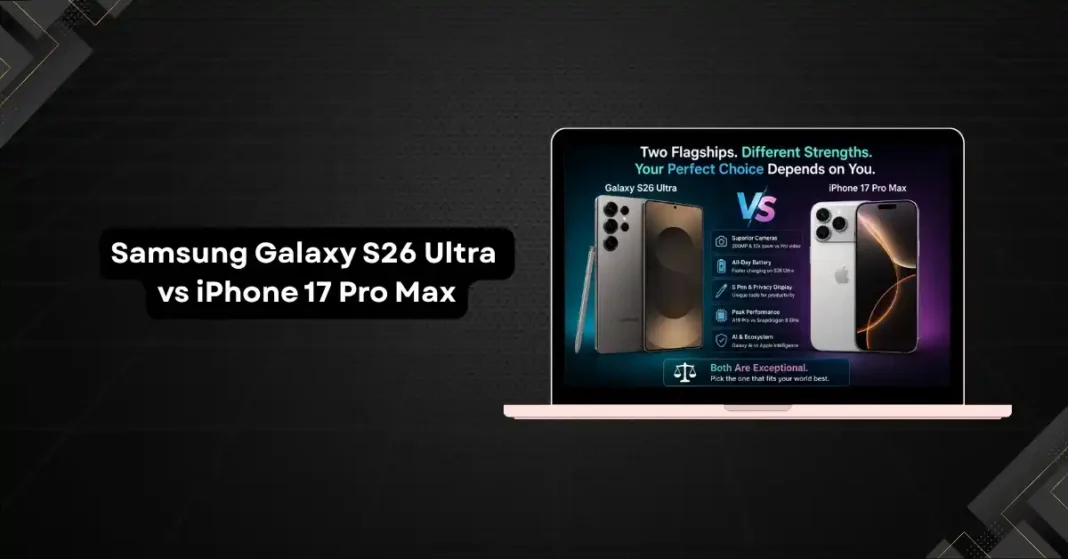
If you are starting fresh with no ecosystem commitment, the S26 Ultra’s camera system, display, and S Pen capabilities give it a slight edge for users who prioritise hardware features. The iPhone 17 Pro Max’s software consistency, video capability, and ecosystem integration give it a slight edge for users who prioritise long-term reliability and professional media production. Either choice is defensible. Neither choice is wrong.