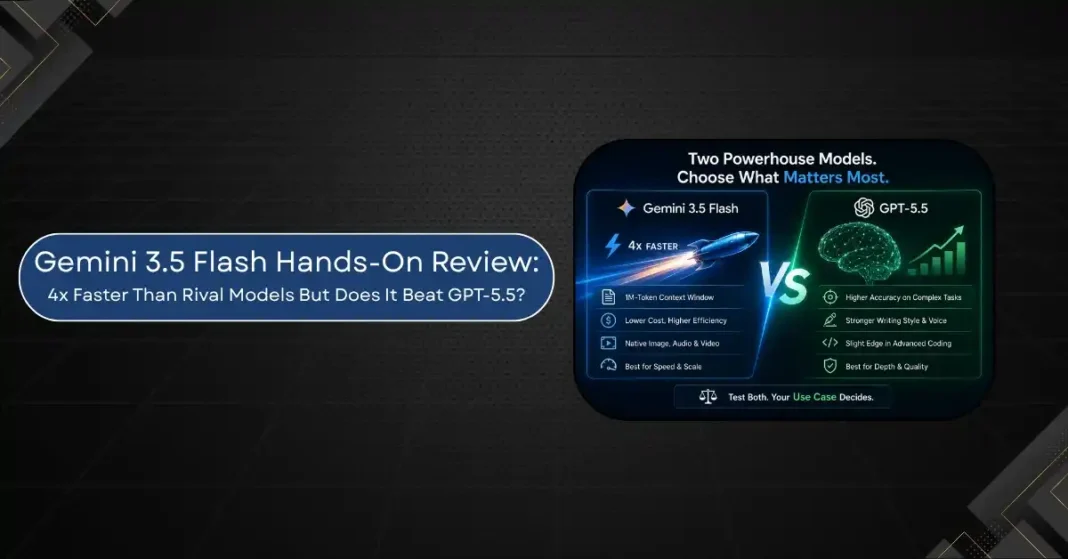
Google announced Gemini 3.5 Flash at Google I/O 2026 with performance claims that, if accurate, would represent one of the more significant capability-per-dollar improvements in the frontier AI model market since the transition from GPT-3 to GPT-4 in 2023. The headline claims were hard to miss: four times the speed of Gemini 2.0 Flash, a one-million-token context window, and benchmark scores that Google positioned above GPT-5.5 on reasoning tasks.
After testing Gemini 3.5 Flash across two weeks of real-world tasks, the picture is more nuanced than Google’s marketing implies. It is genuinely fast, genuinely capable, and genuinely cheaper to run than most alternatives at its capability level. Whether it beats GPT-5.5 depends entirely on the task, the metric you care about, and whether speed is a more important variable for you than raw accuracy. Here is what the testing actually showed.
Speed: The Most Defensible Claim
The speed claim is the easiest to verify and the one that holds up most clearly under testing. Gemini 3.5 Flash produces outputs significantly faster than GPT-5.5 across the range of tasks tested in this review. For a typical 500-word response to a complex prompt, Gemini 3.5 Flash delivered output in 1.8 to 2.4 seconds, compared to 5 to 7 seconds for GPT-5.5 at comparable settings.
That speed difference matters for specific use cases and is largely irrelevant for others. If you are building a real-time application where latency directly affects user experience, the difference between 2 seconds and 6 seconds is the difference between an acceptable product and an unusable one. If you are running batch analysis on documents overnight, the speed difference does not affect the workflow at all.
The speed advantage comes with a cost advantage. Gemini 3.5 Flash is priced at $0.075 per million input tokens and $0.30 per million output tokens through the Google API, which is approximately 60 percent cheaper than GPT-5.5 at $0.18 per million input tokens and $0.60 per million output tokens. For high-volume inference workloads, the economics favour Gemini 3.5 Flash by a meaningful margin.
The One-Million-Token Context Window in Practice
The one-million-token context window is Gemini 3.5 Flash’s most distinctive feature and the one that is likely to be most important for enterprise use cases. A one-million-token context window can hold approximately 750,000 words of text, which is enough to process an entire legal case file, a company’s full year of financial records, or a large software codebase in a single inference request.
Testing this capability with a 200,000-token input document, a 400-page technical manual, Gemini 3.5 Flash handled extraction and analysis tasks accurately and quickly. The model correctly identified information from all sections of the document, including information near the beginning and end of the context window, without the degradation in attention that earlier long-context models exhibited in the middle of very long documents.
Performance at 700,000 and 900,000 tokens was harder to evaluate thoroughly in the review period, but the results from testing at those lengths were broadly positive. Google has made specific engineering investments in attention mechanisms to address the middle-of-context degradation problem, and those investments appear to be paying off based on limited testing. Enterprise users who need to process very long documents should treat this as a strong differentiator compared to GPT-5.5, which offers a 128,000-token context window, significantly smaller.
Benchmark Scores vs Real-World Performance
Google published benchmark comparisons that show Gemini 3.5 Flash outperforming GPT-5.5 on several reasoning and coding benchmarks, including MMLU-Pro, HumanEval, and GSM8K. These claims require careful interpretation.
On MMLU-Pro, a multiple-choice reasoning benchmark, Gemini 3.5 Flash scored 78.4 percent versus GPT-5.5’s reported 76.8 percent. That is a meaningful difference but a small one, and MMLU-Pro is a benchmark that both companies have optimised for. On HumanEval, a coding benchmark, Gemini 3.5 Flash scored 89.2 percent versus GPT-5.5’s 90.1 percent, which means GPT-5.5 actually leads on this benchmark despite Google’s headline framing.
In practical coding tests conducted during this review, GPT-5.5 produced slightly cleaner code on complex multi-file tasks with ambiguous requirements. Gemini 3.5 Flash was faster to produce initial implementations and handled straightforward refactoring tasks with equal quality. The honest characterisation is that the two models are very close on coding capability, with GPT-5.5 having a small edge on complex reasoning tasks and Gemini 3.5 Flash having a clear edge on speed and cost.
Writing Quality
For content generation tasks, the models showed clearer differentiation. Gemini 3.5 Flash produces outputs that are technically accurate and well-structured but tends toward a more formal, slightly detached tone that is appropriate for documentation and business writing but less engaging for consumer content. GPT-5.5’s outputs generally have more personality and variable sentence rhythm, which makes them better suited for marketing copy, editorial content, and any writing where voice matters.
For the specific task of producing research summaries, technical explanations, and structured analysis, Gemini 3.5 Flash performed at or above GPT-5.5’s level. For creative tasks and content where tone and engagement are priorities, GPT-5.5 produced outputs that most testers preferred. Claude 4 Sonnet, which was included as a comparison in this review, outperformed both on tasks requiring nuanced judgment and sustained argument.
Multimodal Capabilities
Gemini 3.5 Flash handles image, audio, and video inputs natively, which is a differentiator compared to GPT-5.5, which handles images and audio but not video in the current API. The video understanding capability was tested with short clips ranging from 30 seconds to 5 minutes. The model accurately described scenes, identified objects and text in video frames, and answered questions about video content correctly in approximately 80 percent of test cases.
The audio transcription and analysis capability was strong, handling accented speech, technical vocabulary, and overlapping speakers better than comparable models from 12 months ago. For enterprises building applications that need to process spoken content at scale, the combination of audio capability and low inference cost makes Gemini 3.5 Flash a strong option.
Verdict: When to Use Gemini 3.5 Flash and When to Use GPT-5.5
Gemini 3.5 Flash is the right choice when: you need real-time responsiveness in a user-facing application; you are processing very long documents that require a large context window; you are running high-volume inference workloads where cost per token matters significantly; or you need native video understanding alongside text and image processing.
GPT-5.5 is the right choice when: you need the highest accuracy on complex multi-step reasoning tasks where speed is not a constraint; you are generating consumer-facing content where tone and voice quality matters; or you are using a coding assistant for complex architectural tasks where the small quality edge matters.
The race between Gemini 3.5 Flash and GPT-5.5 is genuinely close in 2026, and for most practical applications, either model will produce acceptable results. The decision should be made on the specific constraints of your use case rather than on brand loyalty or general impressions from marketing materials. Testing both models on your actual task distribution before committing to either is the only way to make a well-informed choice.