SEO Research Summary
Primary Keyword: marketing trends June 2026 Secondary Keywords: AI marketing trends 2026, agentic commerce, Cannes Lions 2026 AI, AI search marketing, Google AI Overviews 2026 Search Intent: Informational — readers want to understand what changed this month and why it matters, not buy something right now.
Key Takeaways
- Cannes Lions 2026 (June 22–26) is forcing brands to define what “human-made” creative actually means, with new AI Craft award categories.
- Google added AI agents to Android phones (Chrome’s auto-browse) that can book and buy things on their own.
- Google Analytics 4 now has a dedicated channel that tracks traffic from AI assistants like ChatGPT and Gemini.
- Meta is using more off-platform data to power Feed and AI answers.
- Shopify made “agentic commerce” the default for every merchant — your products can now be bought directly through AI shopping assistants.
Introduction
Imagine you’re a small business owner. You wake up, check your marketing dashboard, and suddenly the rules have changed — again. That’s basically what June 2026 feels like for marketers.
This month brought a wave of updates that are nudging marketing further away from “people clicking ads” and closer to “AI agents making decisions for people.” It’s a big shift, and if you’re not paying attention, your brand could quietly lose visibility without you ever noticing why.
In this article, you’ll learn about the five biggest marketing and AI shifts happening right now — Cannes Lions’ AI reckoning, AI agents browsing the web on their own, new AI tracking tools, Meta’s data strategy, and Shopify’s commerce overhaul. We’ll break each one down in plain English, explain why it matters, and give you practical next steps.
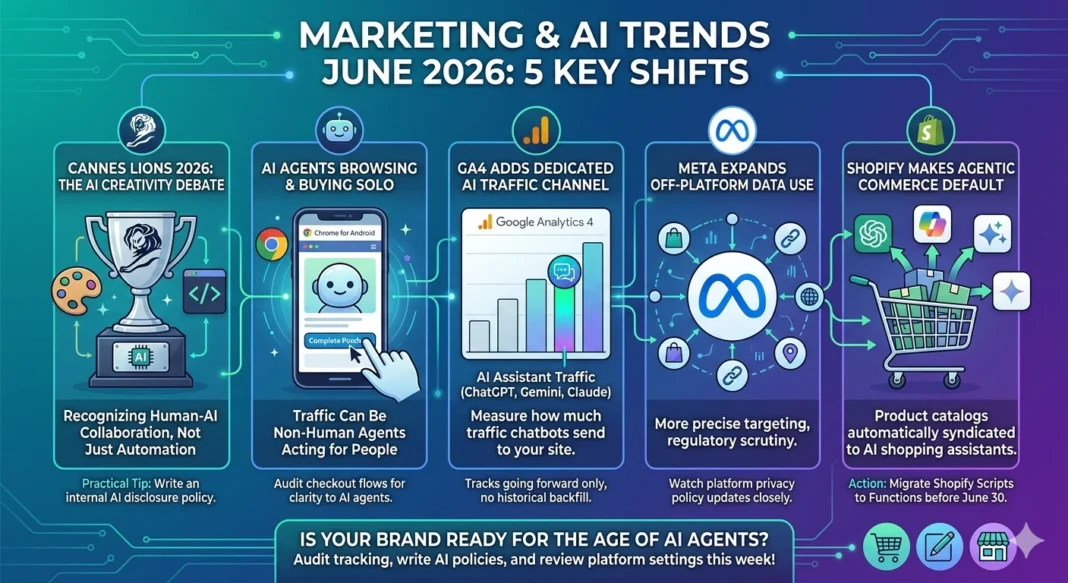
1. Cannes Lions 2026: The AI Creativity Debate
Cannes Lions, the world’s biggest creative advertising festival, runs June 22–26, 2026, in France. This year, the festival introduced new “AI Craft” award categories specifically designed to recognize work where humans and AI collaborate — not where AI just generates everything on its own.
Why now? Because consumers pushed back hard after seeing too much obviously AI-made advertising, including widely criticized AI-generated content during this year’s Super Bowl. Brands are realizing that “made by AI” isn’t automatically a selling point — sometimes it’s the opposite.
Practical tip: If your brand uses AI in any part of content creation, write down a simple internal policy. Decide what level of AI involvement is okay, and when you’ll disclose it. Having this ready before a customer asks is much better than scrambling after a complaint.
2. AI Agents Are Now Browsing and Buying on Their Own
Google rolled out an AI agent feature in Chrome for Android phones that can browse websites and complete purchases without a person tapping through every step.
This means a chunk of your future “traffic” might not be a human at all — it could be an AI assistant acting on someone’s behalf. That changes how you should think about website design, checkout flows, and even how clearly your product information is structured (since an AI agent needs to “understand” your page, not just look at it).
Common mistake: Treating all website visits as the same. Going forward, agent traffic and human traffic may behave very differently, and lumping them together in your analytics can hide what’s actually working.
3. Google Analytics 4 Adds an AI Traffic Channel
As of mid-May 2026, Google Analytics 4 automatically tags sessions coming from AI tools like ChatGPT, Gemini, and Claude — instead of dumping them into a vague “Referral” bucket.
This closes a real blind spot. Before, marketers had no clean way to see how much traffic AI chatbots were sending to their site. Now you can actually measure it.
Important note: This only tracks sessions going forward from when the feature launched — it won’t backfill historical AI traffic. So don’t panic if your past reports don’t show it.
4. Meta Expands Use of Off-Platform Data
Meta is folding more data from outside its own apps into what shows up in your Feed and in its AI-generated answers. In simple terms: Meta’s AI is getting “smarter” about you by looking at more than just what you do inside Facebook or Instagram.
For marketers, this likely means more precise targeting opportunities — but also more reason to keep an eye on privacy expectations and platform policy updates, since data practices like this tend to draw regulatory attention.
5. Shopify Makes Agentic Commerce the Default
Perhaps the biggest operational shift this month: Shopify now automatically syndicates merchant product catalogs to AI shopping assistants like ChatGPT, Microsoft Copilot, and Google’s AI Mode — by default, not as an opt-in upgrade.
Store owners also get new order attribution data showing which AI channel actually drove a sale.
Action item: If you’re a Shopify merchant still using older “Shopify Scripts,” migrate to Shopify Functions soon — Scripts is being shut down for good on June 30, 2026.
Comparison: Old Marketing Model vs. AI-Agent Marketing Model
| Aspect | Traditional Model | AI-Agent Model (2026) |
|---|---|---|
| Who visits your site | Humans clicking links | Humans + AI agents browsing/buying |
| Tracking traffic source | Search, social, referral | Dedicated AI assistant channel (GA4) |
| Buying process | Manual checkout | Agent completes purchase automatically |
| Product discovery | SEO + ads | AI shopping assistant citations |
| Creative judged by | Engagement, awards | Human/AI collaboration transparency |
Who Should Pay Attention to These Trends
- E-commerce brands, especially Shopify merchants, since agentic commerce directly affects how products get discovered and bought.
- Content and SEO teams, since AI traffic tracking and AI search citations now directly affect visibility.
- Creative and brand teams, since Cannes Lions is setting the tone for acceptable AI use in advertising.
- Smaller brands without big budgets can actually benefit here, since AI shopping assistants and AI traffic tracking are leveling the playing field a bit — visibility is shifting from “who has the biggest ad budget” toward “who is clearly structured and trustworthy online.”
Common Mistakes to Avoid
- Ignoring AI traffic in your reports — Set up GA4’s AI channel tracking now instead of waiting.
- Not having an AI-use policy for creative work — Write one before a crisis forces the conversation.
- Leaving Shopify Scripts running past June 30 — Migrate to Functions immediately if this applies to you.
- Treating AI agent visits like normal human visits — Separate the data so you understand real customer behavior.
- Assuming Cannes Lions trends are “just for big brands” — The conversation about disclosure and AI ethics affects brands of every size.
Expert Tips
- Don’t wait for AI shopping assistants to “catch up” to your brand — make sure your product descriptions are clear, structured, and accurate today, since that’s what AI agents read to make buying decisions.
- Review your analytics monthly for AI-channel traffic, even if the numbers look small right now. Early trend lines matter more than current volume.
- When writing an AI-use disclosure policy, keep it short and practical — a one-page internal guideline is more useful than a long, vague statement.
Future Trends: What’s Next
Expect the line between “search,” “shopping,” and “AI conversation” to keep blurring through the rest of 2026. More platforms will likely follow Shopify’s lead in making AI-agent commerce a default setting rather than an extra feature. Expect more transparency requirements (possibly even regulatory ones) around AI-generated advertising. And expect analytics tools across the industry — not just Google’s — to build out better ways of separating human traffic from agent traffic.
Conclusion
June 2026 marks a turning point: AI isn’t just helping marketers create content anymore — it’s actively browsing, deciding, and buying on behalf of customers. From Cannes Lions’ creative reckoning to Shopify’s agentic commerce rollout, the message is the same. Marketers need to know who — or what — is actually visiting and buying from their brand, and have a clear point of view on how AI fits into their creative and commerce strategy.
Key recommendation: Audit your current tracking setup, write a simple AI-use policy, and check your e-commerce platform’s AI integration settings this week — not next quarter.
FAQ
What are the biggest marketing trends for June 2026? Cannes Lions’ AI Craft awards, Chrome’s AI browsing agent, GA4’s new AI traffic channel, Meta’s expanded data use, and Shopify’s default agentic commerce rollout.
What is agentic commerce? It’s when AI assistants browse, select, and complete purchases on a customer’s behalf, without the person manually clicking through every step.
Does Google Analytics track AI chatbot traffic? Yes. As of May 2026, GA4 has a dedicated channel that automatically tags sessions from AI tools like ChatGPT, Gemini, and Claude.
Should my brand have an AI-use policy for creative work? Yes. It helps you respond clearly and confidently if customers ask whether content was AI-generated.
What happens to Shopify Scripts after June 30, 2026? It shuts down completely. Merchants need to migrate to Shopify Functions before that date.
Why is Cannes Lions focused on AI this year? Because consumer backlash against obviously AI-generated ads has grown, the festival is emphasizing human-AI collaboration over full AI automation.
Will AI traffic show up in my past analytics data? No. GA4’s AI channel only tracks sessions from when the feature launched onward — it doesn’t apply retroactively.