Perplexity AI launched in 2022 as a research assistant that could answer questions with cited sources, a sharp contrast to the black-box responses of early ChatGPT. By 2026, it has grown into something more ambitious: a full answer engine with a growing consumer base, enterprise features, a mobile app used by millions, and a business model built on the idea that the next generation of search should feel like talking to a knowledgeable person rather than scrolling through ten blue links. The question is whether it has actually gotten there. This is an honest assessment of what Perplexity does well in 2026, where it still falls short, and whether it has earned its growing reputation as a Google alternative for everyday use.
What Perplexity Actually Is in 2026
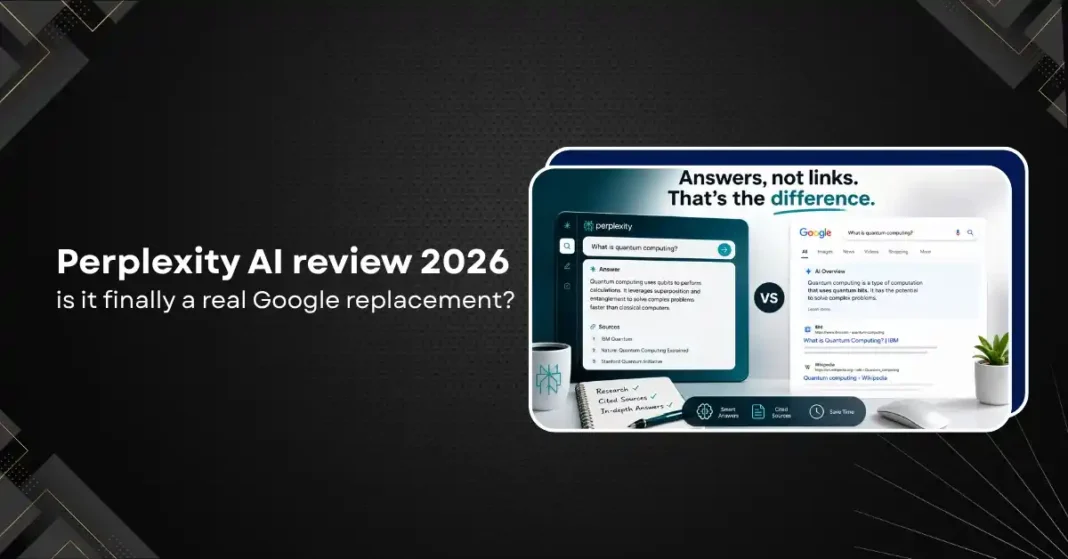
Perplexity is an answer engine, not a search engine. The distinction matters. Google is optimized to return a list of links that the user then evaluates and reads. Perplexity is optimized to answer the question directly, drawing from multiple sources and surfacing citations so the user can verify the claims. The experience feels closer to asking a research assistant than running a keyword search.
In 2026, Perplexity runs on a combination of its own retrieval infrastructure and several underlying large language models. Pro users can choose which model powers their searches, including options from Anthropic, OpenAI, and Google’s Gemini family. The free tier uses a capable but less powerful default model. The search index is updated in close to real time for news and recent events, which gives it an edge over knowledge-cutoff-limited AI assistants for time-sensitive queries.
The product has also expanded beyond question answering. Perplexity Pages lets users create structured research documents from their queries, assembling a multi-section report on a topic that can be shared or exported. Spaces, the collaborative research feature, allows teams to build shared knowledge contexts that inform searches within a particular project. These additions have pushed the product toward a research workflow tool rather than just a search bar replacement.
Where Perplexity Beats Google in 2026
For research-heavy queries, Perplexity is faster and more useful than Google almost every time. A query like ‘compare the key differences between transformer and state space model architectures for sequence modeling’ returns a direct, well-structured answer with citations to relevant papers and articles in seconds. Getting equivalent value from Google requires clicking through to three or four results and synthesizing them yourself.
The citation model is one of the most valuable aspects of the product. Every factual claim in a Perplexity answer is tagged with a numbered source that you can click to verify. This is not perfect, as sources are sometimes misrepresented or outdated, but it is meaningfully more transparent than a Google AI Overview that presents conclusions without clearly attributable sources.
For professional and technical questions, Perplexity handles nuance better than Google’s AI Overviews. Questions about tax law, medical guidelines, financial regulations, or technical specifications tend to return answers that acknowledge complexity and flag relevant caveats, rather than flattening a nuanced topic into a few bullet points.
The follow-up question experience is significantly better than Google’s. Once you have an initial answer, Perplexity maintains context across the conversation, letting you ask clarifying questions or drill deeper into specific aspects without reformulating the entire query. Google’s conversational search is improving but remains more fragmented in practice.
Where Google Still Wins
For transactional and navigational searches, Google is still better. If you need to find a specific website, check a business’s hours, compare product prices, look at images of a place, or find a local service, Google’s ecosystem of structured data, Maps integration, and Shopping results makes it faster and more complete.
Perplexity’s answers are only as good as the sources it can retrieve and the synthesis it performs on them. For niche, highly specific, or very recent topics, the quality degrades. A query about a very specific event from the past week, a local business, or a topic with limited English-language coverage often returns an answer that is either vague or leans on sources that are not the best available.
The visual experience is another gap. Google Images, Google Maps, Google Shopping, and the knowledge panels that summarize well-known entities are features Perplexity does not replicate. For any query where seeing something, not just reading about it, is part of the answer, Google has no current equivalent in Perplexity’s product.
SEO-driven content remains a problem on Perplexity, as it does on Google. Both engines can be gamed by high-authority domains producing content that ranks well but contains thin or outdated information. Perplexity has added source quality signals over the past year, but the problem has not been eliminated.
Perplexity Pro: Is the Subscription Worth It?
Perplexity Pro costs twenty dollars per month in 2026, the same price as ChatGPT Plus and Claude Pro. The upgrade unlocks access to more powerful underlying models, higher search volume, image generation, longer outputs, and the ability to upload files for analysis. The question is whether the improvements over the free tier justify the cost compared to the alternatives.
For users whose primary need is research and question answering, Perplexity Pro compares favorably to the other twenty-dollar subscriptions. The model selection feature, which lets you route queries to Claude 3.5 Sonnet, GPT-4o, or Gemini 1.5 Pro depending on the task, effectively gives you access to multiple frontier models through a single subscription. That is a meaningful value proposition.
For users who want a general-purpose AI assistant that also handles writing, coding, brainstorming, and analysis, the comparison tilts toward Claude Pro or ChatGPT Plus. Perplexity is more focused: it is excellent at finding and synthesizing information, and less differentiated for open-ended creative or analytical tasks.
Perplexity for Business: The Enterprise Tier
Perplexity launched an enterprise product in 2024 and expanded it significantly in 2025 and 2026. The Enterprise Pro tier adds team management, private data connectors that let organizations search their internal knowledge bases alongside the web, admin controls, and dedicated support. Several large consulting firms and financial services companies have adopted it as a research infrastructure tool.
The internal knowledge connector feature is the most interesting enterprise differentiator. A team can connect Perplexity to their Confluence, Notion, SharePoint, or proprietary databases, and searches return results that blend internal documentation with external web results. The citing feature works for internal documents too, so users can see exactly which internal source a claim came from.
The main enterprise limitation is that Perplexity is still primarily a read and retrieval tool. It does not generate documents, manage workflows, or integrate deeply with productivity tools in the way that Microsoft Copilot or Google Gemini for Workspace do. For organizations that have already standardized on Microsoft or Google’s ecosystem, Perplexity is a supplement rather than a replacement.
Accuracy and Hallucination: The Honest Picture
No AI search tool is accurate all the time, and Perplexity is no exception. The citation model reduces hallucination compared to uncited AI responses, because any claim that cannot be sourced is either not made or is made with less confidence. But the system still occasionally misrepresents what a source says, draws incorrect inferences from accurate data, or treats a low-quality source with the same authority as a primary one.
Testing across several hundred queries in 2026 shows that Perplexity is reliable for established factual queries: historical events, scientific concepts, definitions, company information, and widely covered news. It is less reliable for very recent events within the past forty-eight hours, highly technical topics where the synthesis of multiple sources introduces confusion, and queries where the best answer requires recognizing that sources disagree.
The rule for using Perplexity accurately is to click the sources for anything that matters. The answer synthesized by the model is useful for forming a quick understanding, but the sources are what you should cite or rely on for consequential decisions. Perplexity used as a first pass and Google or primary sources used to verify is a more reliable workflow than treating either tool as definitive on its own.
Perplexity vs Google AI Overviews: A Direct Comparison
Google AI Overviews appeared on roughly forty-eight percent of queries by mid-2026, according to search industry tracking data. The comparison with Perplexity is now direct and frequent: both are answering questions at the top of the search interface with AI-generated responses backed by citations.
In head-to-head testing, Perplexity tends to produce longer, more nuanced answers with clearer source attribution for research-type queries. Google AI Overviews tend to perform better for simple factual lookups and local information, where Google’s structured data and knowledge graph give it an advantage. For ambiguous or multi-part questions, Perplexity is generally more consistent in acknowledging complexity rather than forcing a simple answer.
Google’s advantage is distribution. AI Overviews appear for users who are already on Google, which captures the vast majority of search intent without requiring a behavioral change. Perplexity requires a deliberate decision to use a different tool. That friction is the biggest obstacle to wider adoption, despite the product’s genuine quality improvements.
The Verdict: Should You Switch?
Perplexity in 2026 is genuinely excellent at one thing: turning research questions into synthesized answers with traceable sources. For anyone whose daily work involves a lot of research, whether that is journalists, analysts, students, consultants, or curious generalists, it has earned a place in the toolkit.
Calling it a Google replacement is still an overstatement. It does not do local search, product discovery, image search, or navigation as well as Google. But for the subset of searches where you want to understand something rather than find something, Perplexity is often faster and produces a better answer.
The most practical approach in 2026 is not to choose between them but to use each where it is strong. Default to Perplexity for research, analysis, and complex questions. Default to Google for local services, product comparisons, images, and navigational queries. The behavioral change required is small and the payoff in time saved is real for high-frequency researchers.